Water is the heaviest thing in a pack, about a kilogram per liter, which is why hikers and campers carry a filter and refill along the way. Portable filters come in a handful of shapes, and the shape decides how you will use it. A straw is the lightest: you drink through it from a bottle or straight from the source. A squeeze or gravity filter pushes water through the same kind of hollow-fiber cartridge into a clean container, by hand pressure or by hanging a bag from a branch, and is far better for a group or for cooking. A pump draws from shallow or awkward sources. We went through the portable filters in our sports and outdoors catalog and ranked them on type, on how specifically the maker states what the filter does, and on owner feedback.
Read this part carefully. We have not tested any of these filters, in a lab or in the field, and we repeat only what each listing claims. Nothing here is a statement that a filter makes any particular water safe to drink. Filters of this kind generally do not remove viruses or dissolved chemicals unless the listing says so, and we note where it does. Prices are not printed because they change daily; every button opens the live Amazon page. For the rest of the kit, see our camping gear under 50 dollars and backpacking stoves guides.
How we picked
- Portable filters only. Straw, squeeze, gravity, pump and battery units for hiking, camping, travel and emergency kits; no refrigerator, pitcher or under-sink filters.
- Claims quoted, not extended. We repeat what each listing says it removes and say plainly when a listing is vague.
- Stated numbers. Pore size, capacity, flow rate and weight, where the maker gives them.
- Ways to use it. Filters that work as a straw, on a bottle and with a bag ranked above single-mode designs.
- Owner feedback. Best-reviewed first; every pick has at least dozens of owner reviews.
The picks
SimPure Portable Gravity-Fed Water Filter with 3L Bag

The SimPure is the best-supported pick in this guide, with thousands of owner reviews and a very strong owner rating, and it uses the format that suits most camps: fill the 3 liter TPU bag, hang it from a tree with the included strap, and let water run through the filter with no pumping or squeezing. The cartridge combines a 0.1 micron hollow fiber ultrafiltration membrane with a coconut shell carbon stage and a PP fiber pre-filter. The maker states a 5,000 liter life and a flow of 27 liters per hour. It can also be used as a personal straw, with a 29.5 inch extension tube, or attached to a water bottle. On claims, the listing says it reduces chlorine and odors and quotes a removal rate above 99.99999 percent, but the text we have does not name the organisms or a test standard. Viruses are not mentioned.
- Thousands of owner reviews with a very strong owner rating
- Hands-free: hang the bag and let gravity work
- Filter also works as a straw or on a bottle
- Stated capacity of 5,000 liters
- Listing quotes a removal percentage without naming the organisms
- No independent certification named in the bullets we have
- Gravity flow slows as the filter loads with silt
LifeStraw Peak Compact Gravity Water Filter, 3 L, Mountain Blue

LifeStraw is the best-known name in the category, and the Peak Series gravity system earns second place for the clarity of its claims. The listing says it protects against 99.999999 percent of bacteria, naming E. coli and Salmonella, 99.999 percent of parasites, naming Giardia and Cryptosporidium, and 99.999 percent of microplastics, along with silt, sand and cloudiness. Those are the maker’s figures, and neither viruses nor chemicals are mentioned. The membrane is described as re-engineered to cope better with sand and silt, and a custom backwash accessory is included to keep the flow up over time. One 3 liter kit can be hung as a gravity system, squeezed like a large bottle, sipped as a straw or used with the filter on a water bottle. The bullets do not give a pore size or a capacity. Hundreds of owners give it a very strong owner rating.
- Maker names the organisms and gives a figure for each
- Four ways to use one filter
- Backwash accessory to restore flow
- Hundreds of owner reviews with a very strong owner rating
- Costs more than twice the SimPure
- No carbon stage for taste is mentioned
- Pore size and capacity are not in the bullets we have
2 Pack Timain Portable Personal Water Filter Straw, Water Purifier Survival for Emergency Preparedness, Outdoor Activities, Travel, Camping, Hiking, Fishing, Hunting
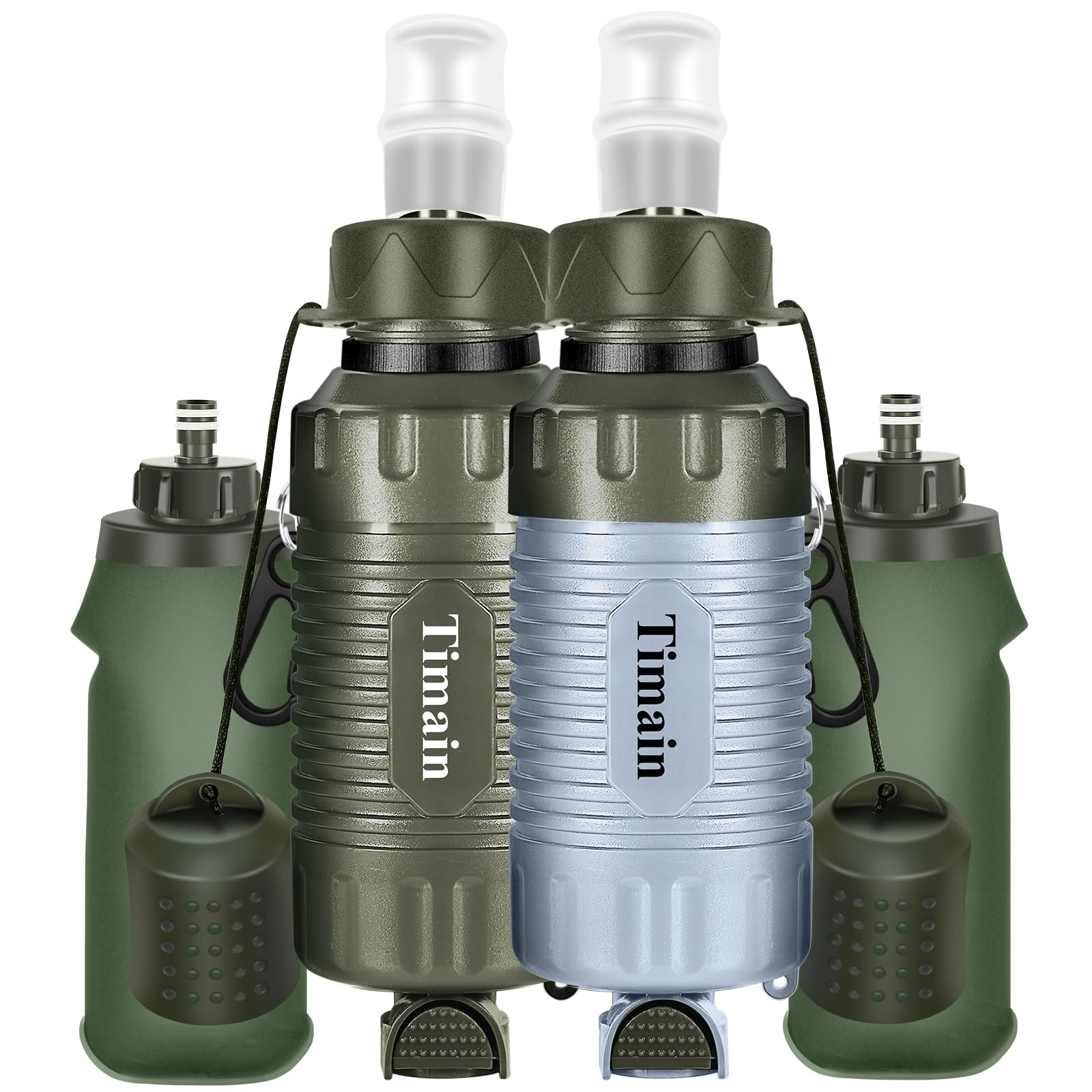
A straw is the lightest insurance you can carry, and this Timain kit gives you two. Each filter weighs about 2 ounces, fits in a palm, and uses a 0.1 micron hollow fiber membrane that the maker says removes 99.9999 percent of E. coli and the smallest microplastics from surface water. What lifts it above a bare straw is the 12 fluid ounce soft flask in the kit: screw the filter on, squeeze, and you can fill a cup or a pot instead of lying at the water’s edge. It also works dipped directly into the source, or with an extension tube when the water is out of reach. The bullets we have do not give a capacity in liters, and they mention neither viruses nor chemicals, so treat it as a filter for clear running water in the backcountry. Hundreds of owners give it a strong owner rating.
- Two filters, so each hiker carries one
- Soft flask included for squeeze filtering
- Names the organism and the pore size
- Hundreds of owner reviews with a strong owner rating
- Capacity in liters is not stated in the bullets we have
- 12 fl oz bag is small for camp use
- Viruses and chemicals are not mentioned
4 Packs of Water Filter Straws, Portable Personal Water Filtration System, Ultrafiltration Water Purifier, Emergency Preparedness for Camping, Hiking, Drinking, Travel, Hunting, and Family Outings
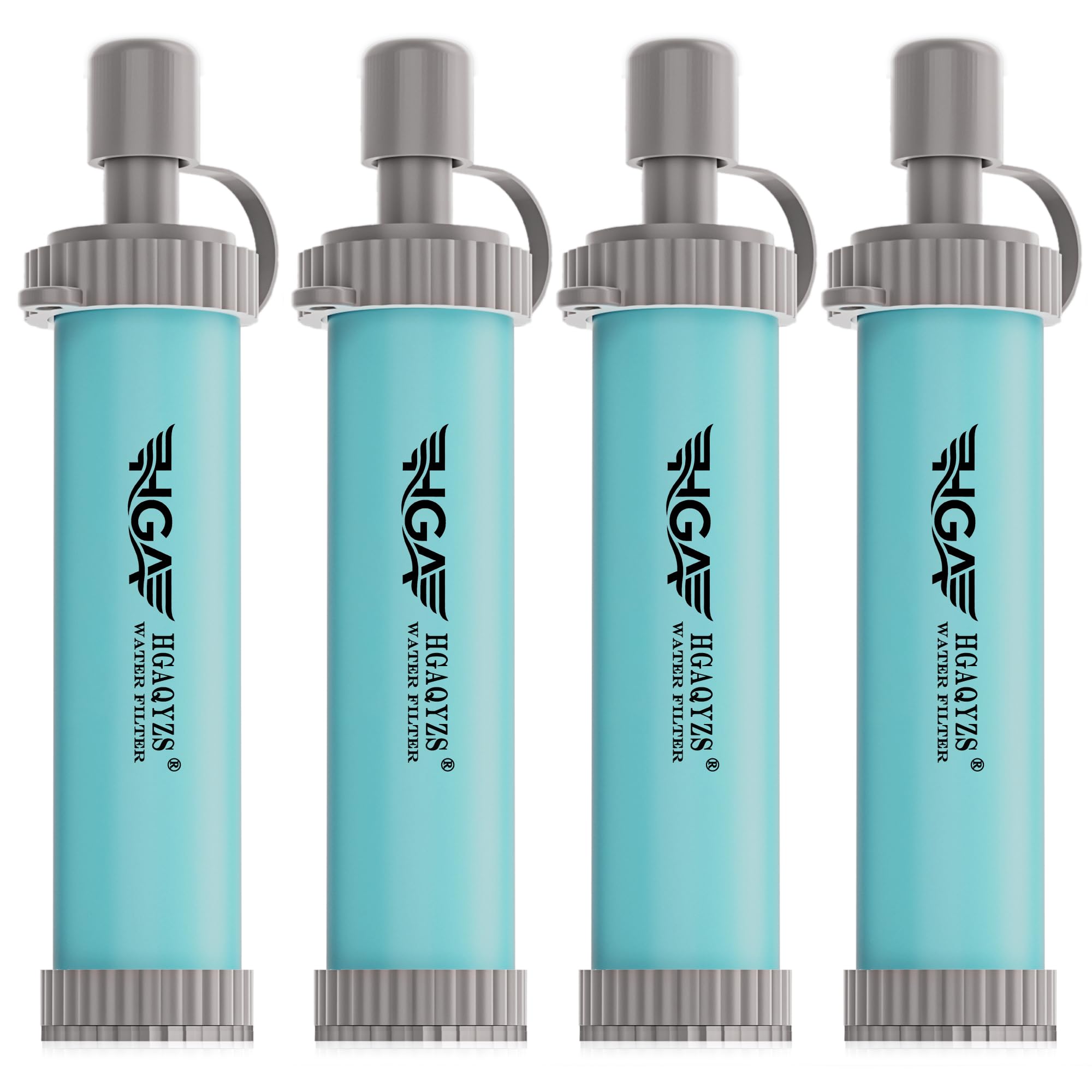
This four-pack is the cheap way to put a filter in every daypack or glovebox. Each straw is 4.53 inches long, an inch across and just 0.9 ounce, made from BPA-free ABS around a hollow fiber ultrafiltration membrane with a stated 0.1 micron pore size. The listing cites a CMA certification with a test report number and says that report validates the removal of odor and particles and lead-free materials; it also says the product was tested to meet EPA standards. A separate bullet says the membranes remove pollutants, odors, chlorine and organic chemicals, which is a broad claim for a hollow fiber filter with no carbon stage described, so we would not rely on it. No bacteria or parasites are named in the text we have. Dozens of owners give it a very strong owner rating.
- Four very light straws for a family or several kits
- Pore size, dimensions and weight are stated
- Listing cites a specific test report number
- Very strong owner rating from dozens of owner reviews
- Claims about chlorine and organic chemicals are not backed by a named standard in the bullets
- No organisms are named in the text we have
- No squeeze bag included
Emergency Water Filter Straw, Blue Color New 15-Packs, Survival Gear Portable Purification System for Outdoor Activities Hiking Camping Fishing
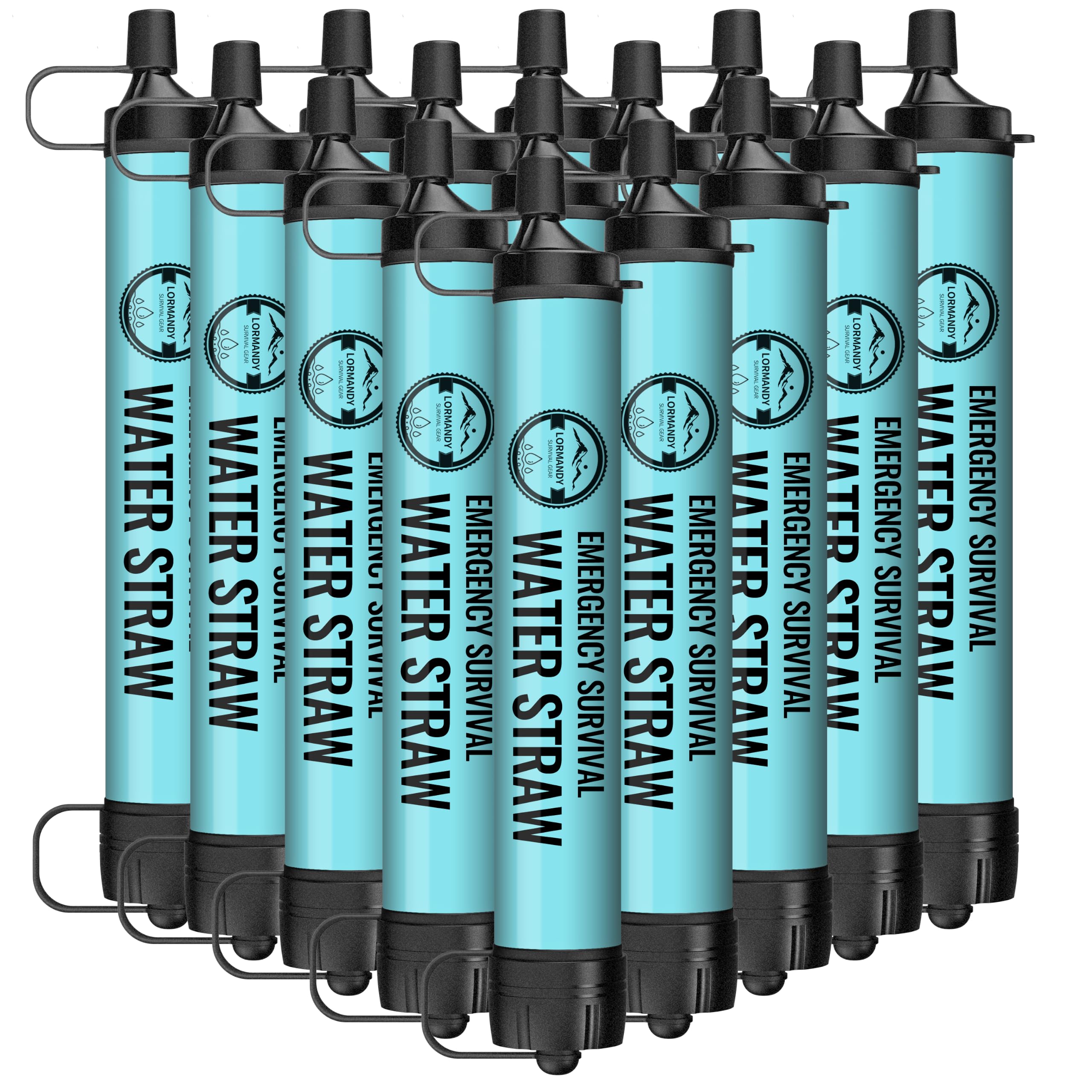
Fifteen straws in one box is a purchase for a scout troop, a hiking club, a workplace emergency cupboard or a household that wants one in every bag and vehicle. Each straw weighs under 1.8 ounces and is made from BPA-free ABS; you drink through it directly from a stream or lake, or drop it into a filled water bottle. The maker gives a flow of about 800 ml per minute and a capacity of 1,300 gallons. Where the listing falls short is on substance: it speaks of triple filtration testing and high-precision pore size, but the text we have gives no pore size as a number and names no bacteria, parasites, viruses or chemicals, only particles and improved taste. So this is the least documented filter in the guide. Hundreds of owners give it a very strong owner rating. Check the live page for test data.
- Fifteen straws in one order for clubs, scout groups or household kits
- Works from the source or inside a water bottle
- Hundreds of owner reviews with a very strong owner rating
- Flow rate and capacity are stated
- Listing is vague about what is actually removed
- Pore size is not given as a number
- More filters than most households need
Timain Outdoor Portable Water Filter Pump, Water Filtration Systems, Perfect for Travel, Camping, Hiking, Fishing, Hunting, Emergency Preparedness (4500 Liters)

A pump earns its place when the source is a trickle, a shallow pool or the bottom of a steep bank, because the intake hose goes to the water and you stay where you are. The Timain pump is a compact hand-operated unit that the maker rates for 4,500 liters before the filter needs replacing, and one pump can serve a small group. The listing says the filter removes 99.99 percent of E. coli and the smallest microplastics and that all parts touching water are food-grade; it does not give a pore size, and viruses and chemicals are not mentioned. The kit is complete: the pump, a foldable water pouch, a carrying case, a plastic wrench, extra tubing and a small compass. Pumping takes more effort than hanging a bag, which is why gravity filters rank higher. Dozens of owners give it a strong owner rating.
- Draws from shallow puddles and seeps a straw cannot reach
- One pump serves several people
- Complete kit with pouch, case and spare tubing
- Strong owner rating from dozens of owner reviews
- Pumping is slower and more work than gravity
- Pore size is not stated
- Viruses and chemicals are not mentioned
Purewell Portable Electric RO Water Filter System with UV Light, Remove PFAS
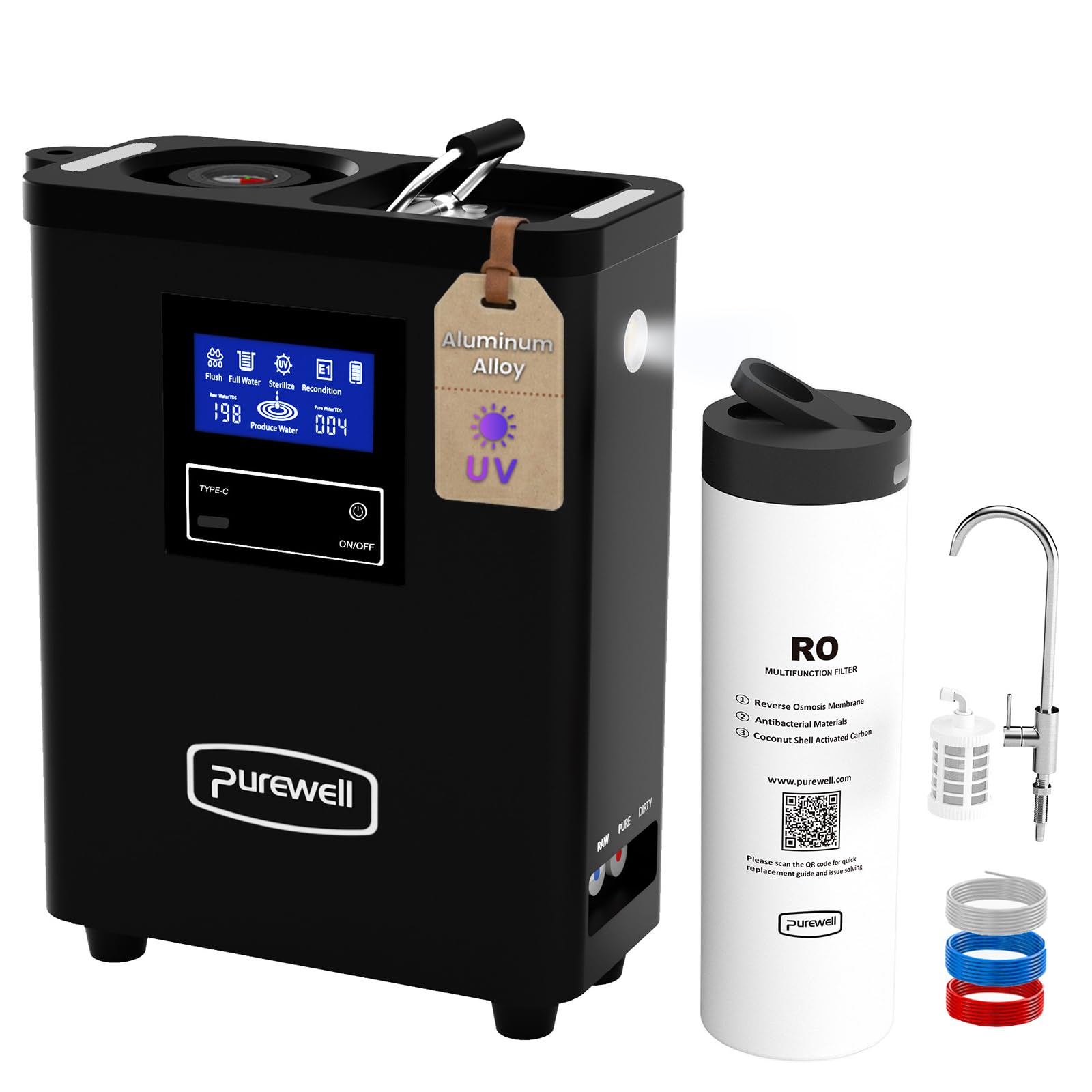
The Purewell K8680/P01 is a different class of device: a rechargeable reverse osmosis system in an aluminum case, for a vehicle, a cabin or an emergency shelf more than a backpack. The maker describes a 0.0001 micron RO membrane with a dual UV lamp and says it can reduce up to 99.999 percent of TDS, PFOA, PFOS, fluorine, arsenic, chlorine, lead and most heavy metals, citing SGS and NSF/ANSI laboratory tests without naming the standard in the text we have. That makes it the only listing here that addresses dissolved chemicals at all. A display shows TDS, the battery runs for up to 6.5 hours on a 54 watt fast charger, and it fills a 2.1 liter bottle in about three minutes. One part of waste water is produced for every two of filtered water. Dozens of owners give it a very strong owner rating.
- Only pick whose listing names dissolved chemicals and metals
- TDS display shows water quality
- Aluminum body with carry bag and built-in lighting
- Very strong owner rating from dozens of owner reviews
- By far the bulkiest and most expensive pick
- Produces waste water and depends on a charged battery
- Viruses are not named in the bullets we have
Compare the picks
| Product | Type | Stated pore size | Stated capacity | Listing names | Our score | Our score | |
|---|---|---|---|---|---|---|---|
| SimPure gravity 3LSimPure | Gravity bag | 0.1 micron | 5,000 liters | Chlorine and odors; organisms not named | 9.2/10 | 9.2 | See price |
| LifeStraw Peak gravity 3LLifeStraw | Gravity bag | Not stated | Not stated | Bacteria, parasites, microplastics | 9.1/10 | 9.1 | See price |
| Timain straws, 2-packTimain | Straw with squeeze bag | 0.1 micron | Not stated | E. coli, microplastics | 8.6/10 | 8.6 | See price |
| Filter straws, 4-packHGAQYZS | Straw | 0.1 micron | Not stated | Odor and particles | 8.9/10 | 8.9 | See price |
| Filter straws, 15-packLormandy | Straw | Not stated | 1,300 gallons | Particles and taste | 8.9/10 | 8.9 | See price |
| Timain hand pumpTimain | Hand pump | Not stated | 4,500 liters | E. coli, microplastics | 8.7/10 | 8.7 | See price |
| Purewell electric ROPurewell | Battery RO with UV | 0.0001 micron | RO element 12 to 36 months | TDS, PFOA, PFOS, metals | 8.9/10 | 8.9 | See price |
What these filters do and do not do
A hollow-fiber filter is a physical sieve. Its pores, typically 0.1 micron, are sized to hold back bacteria, parasites and particles, and makers that have tested for those say so, as LifeStraw and Timain do in their listings. Viruses are far smaller, and dissolved chemicals, metals and salts are not particles at all, so filters of this kind generally do not remove them unless the listing states otherwise; of these seven, only the Purewell reverse osmosis unit names chemicals and metals. No filter here is described for salt water. Choose the cleanest, clearest source available, follow the maker’s instructions, and where water quality is doubtful follow the advice of local health authorities on additional treatment.
Straw, gravity, pump or powered?
Match the type to the trip. A solo day hiker is well served by a straw with a squeeze bag. Two or more people cooking at camp will find a 3 liter gravity bag far less work, since it filters while you pitch the tent. A pump is the specialist for shallow or hard-to-reach water. A battery-powered reverse osmosis unit is heavy and needs charging, so it belongs in a vehicle or at a base camp.
Looking after a filter
Flow slows as the membrane loads up, and backflushing with clean water, where the maker provides for it, restores much of it; the LifeStraw kit includes a backwash accessory for that purpose. Keep the clean side clean: do not let unfiltered water touch the outlet, the cap or the inside of the clean bottle. Makers of hollow-fiber filters commonly warn that freezing can damage the fibers without any visible sign, so keep a wet filter from freezing overnight. Dry and store it as the manual directs, and replace it at the stated capacity or sooner if the flow does not recover.
Do portable water filters remove viruses?
Generally not. Hollow-fiber filters with 0.1 micron pores are sized for bacteria, parasites and particles, and none of the straw, gravity or pump listings here mentions viruses. Follow local health advice on extra treatment where viruses are a concern.
Which type of portable filter is best for camping with a group?
A gravity filter. The SimPure and the LifeStraw Peak Compact Gravity both use a 3 liter bag that you fill and hang, so water filters without pumping or squeezing while you do other things.
What does 0.1 micron mean on a water filter?
It is the stated pore size of the membrane, one ten-thousandth of a millimeter. The SimPure, the Timain straws and the 4-pack straws state 0.1 micron. Pore size alone is not a test result, so look for the organisms a maker names.
Do any of these filters remove chemicals or heavy metals?
Only one listing here says so: the Purewell portable reverse osmosis unit names TDS, PFOA, PFOS, fluorine, arsenic, chlorine, lead and most heavy metals. The SimPure listing mentions chlorine and odors through its carbon stage.
How long does a portable water filter last?
It depends on the maker rating and the water. Stated figures here include 5,000 liters for the SimPure and 4,500 liters for the Timain pump. Silty water clogs a filter sooner, and backflushing where provided extends its life.
Prices and stock change daily. The buttons above open Amazon so you always see the current price. Do Best Deal may earn a commission if you buy through them, at no extra cost to you.
Do Best Deal is a participant in the Amazon Services LLC Associates Program. As an Amazon Associate we earn from qualifying purchases. If you buy through links on this site we may earn a commission, at no extra cost to you. Learn more.