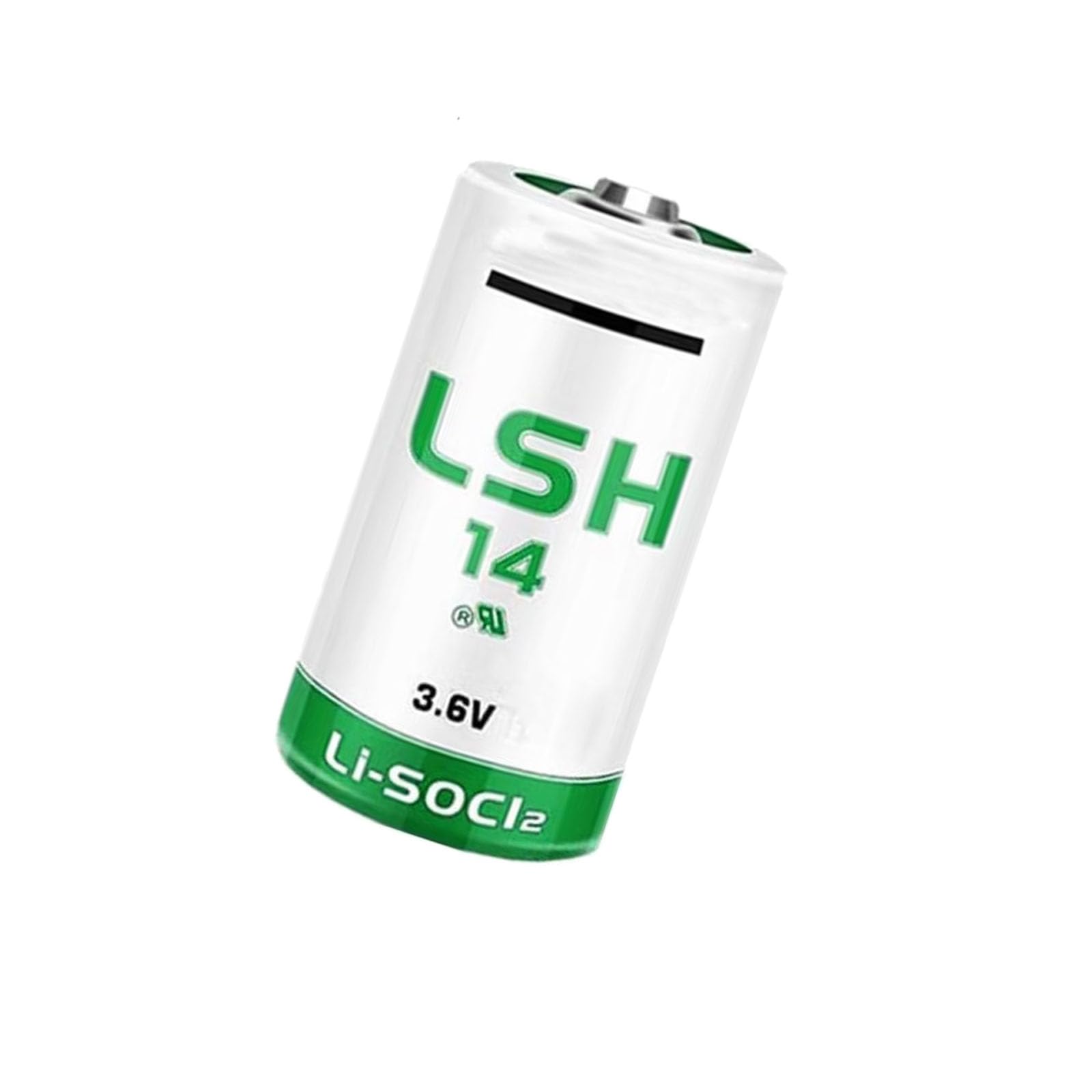
The 9-volt battery is the one you only think about at three in the morning when the smoke detector chirps. It also powers carbon monoxide alarms, multimeters, guitar pedals, wireless microphones and a surprising number of toys, and because most of those devices sit for months between uses, the battery that matters is the one that holds its charge on the shelf and does not leak inside the device. We ranked the 9V batteries in our beauty and health catalog by chemistry (alkaline, lithium or rechargeable NiMH), the shelf life each maker guarantees, leak protection, pack size and cost per battery, and what thousands of owners report after years of replacing them.
We have not discharged every cell on a test rig; the verdicts rest on the published specs and the owner review history, and we score each pick ourselves rather than repeating the figures on the listing. Prices are not printed because they change daily and pack sizes vary; every button opens the live Amazon page. For the smaller cells, see our AA and AAA batteries guide, and for keeping mains-powered gear alive in an outage, our UPS battery backups guide. Do Best Deal readers asked which 9V to keep in the drawer, and the answer is below.
How we picked
- Shelf life guaranteed. Every alkaline pick states five to ten years in storage, since most 9V batteries spend years waiting.
- Leak protection claimed. All picks state a leak-resistant or leak-proof design; a leaking 9V ruins a smoke alarm or a pedal.
- Three chemistries. Alkaline for everyday use, lithium for ten-year smoke alarm duty and extreme temperatures, NiMH rechargeable for high-drain music gear.
- Owner history. Each pick has a large base of owner reviews with a positive overall sentiment; the top pick has one of the largest review bases in the whole catalog.
- Pack value. Packs from four to ten, with the per-battery cost noted where it matters.
The picks
Amazon Basics 8-Pack 9V Long-Lasting Alkaline Batteries for Smoke Detector, Electronics & Audio, Reliable, 5-Year Shelf Life

Amazon Basics sells more 9V batteries than anyone else in our catalog, and the reason is simple: eight alkaline cells, a five-year leak-free shelf life, and a price per battery that the name brands cannot match. They are rated for the usual 9V duty of smoke detectors, garage door openers, radios and toys, and owners widely praise them for doing exactly that at a fraction of the cost. The packaging is Amazon’s frustration-free carton, which opens without scissors and keeps the spares together, a small thing that matters when you are standing on a chair under a chirping alarm. They are ordinary alkalines, so plan on replacing a smoke detector cell yearly, and they do not recharge. The most common owner complaints mention a cell or two reading low out of the pack, which is the risk of buying any battery that has sat in a warehouse; check the date on the carton and rotate the drawer stock. For the house battery drawer, this is the one. Our score 9.4/10.
- The most-bought 9V battery in the catalog, widely praised by owners for value
- Five-year leak-free shelf life for a drawer battery
- Eight to a pack, enough for every alarm in a house
- Easy-open packaging that stores the spares
- Not a lithium; expect roughly a year in a smoke alarm
- Not rechargeable
- Most owner complaints mention occasional cells arriving low after long warehouse storage
DURACELL Coppertop 9V Battery, Long-Lasting All-Purpose Alkaline 9V Batteries for Household and Office Devices, 4 Count (Pack of 2)
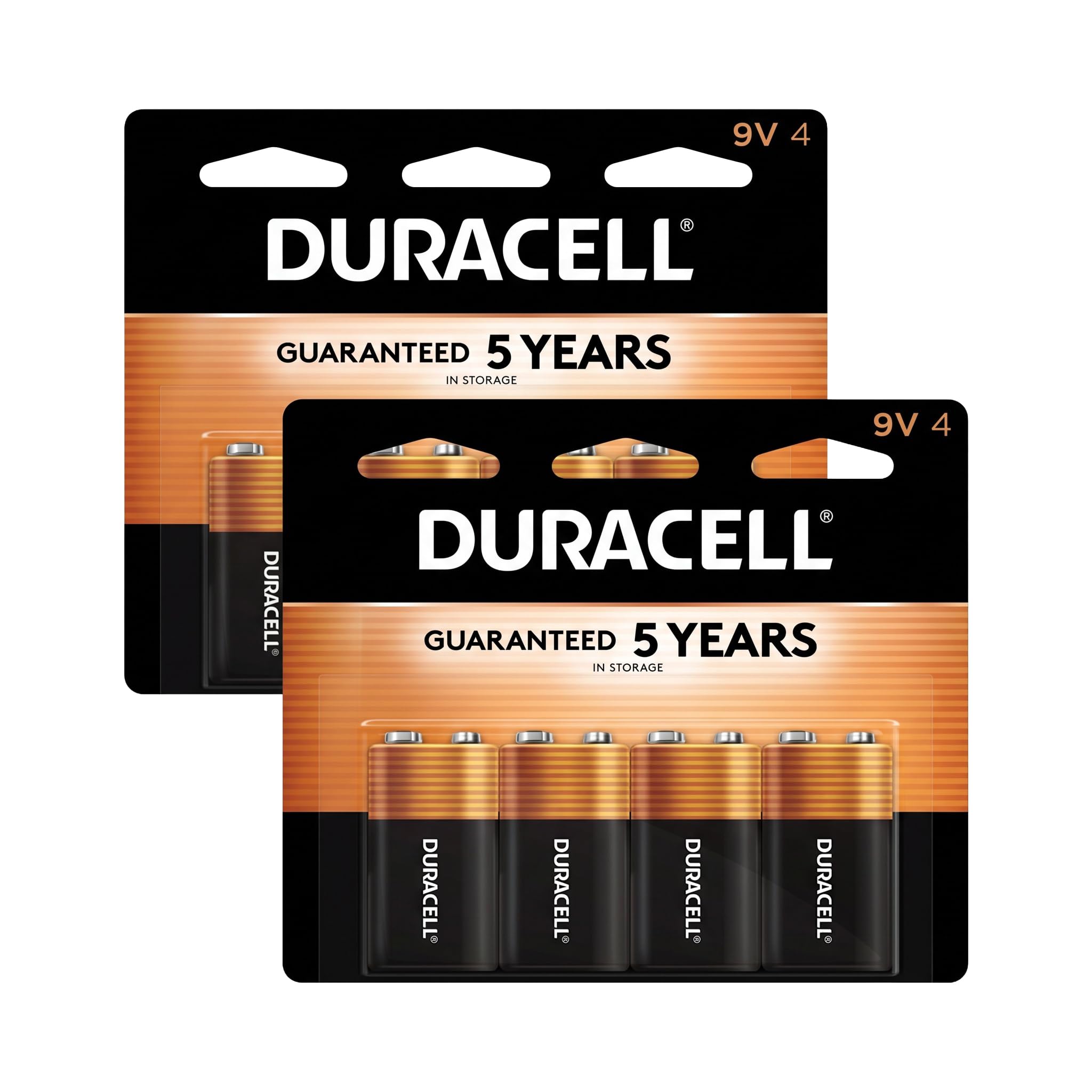
Duracell Coppertop is the 9V battery that safety devices are designed around, and the listing leans into that: it names smoke detectors, carbon monoxide detectors, security sensors and alarm panels first, then walkie-talkies, guitar pedals, multimeters and AED trainers. The cells are guaranteed for five years in storage and against defects in material and workmanship, and owners widely praise them as the battery that simply works when the alarm test button is pressed. It is sold as four-packs, which is a sensible number for the annual change in a house with several alarms, though the listing is a pack of two four-packs and the per-battery price is worth checking. Duracell charges a premium over the Amazon Basics, Kodak and ACDelco cells for the same alkaline chemistry, and in a smoke alarm it will still want changing yearly. For the devices that protect the house, most people are happy to pay the difference. Our score 9.6/10.
- The battery most smoke detector makers picture on the box; widely praised by owners for reliability
- Five-year storage guarantee and a defects guarantee
- Rated for professional test gear and AED trainers, not just toys
- Four-packs suit the annual change on every alarm in a home
- Costs more per cell than Amazon Basics, Kodak or ACDelco
- Alkaline, so a yearly change in a smoke alarm
- Pack-of-two listing can confuse the per-battery price
Energizer MAX 9V Batteries, 9 Volt Alkaline Batteries, 4 Count, (Pack of 2)

Energizer MAX is the other name-brand alkaline, and its claim is leak protection: Energizer says the cells are made to last and not to leak, and the owner history backs that up with widespread praise for cells that came out of old multimeters and toys clean. The batteries hold their charge for up to five years in storage, are rated for smoke detectors, safety devices and hand-held meters, and contain a token amount of recycled material. Like the Duracell they are sold in four-packs, with the listing being two of them. The price is name-brand, the chemistry is still alkaline with a one-year life in a smoke alarm, and the listing has only a single image, so read the title to confirm you are getting two four-packs. If leak protection is your main worry, because the battery is going into a vintage pedal or a meter that will sit in a toolbox for years, this is the alkaline to pick. Our score 9.6/10.
- Energizer markets MAX as made not to leak, and owners widely praise it on that point
- Five-year storage life
- Rated for hand-held meters and safety devices
- A small amount of recycled content
- Name-brand pricing
- Alkaline, so yearly in a smoke detector
- Single product image on the listing; check the pack count before ordering
ACDelco 9V Batteries, Maximum Power Super Alkaline Battery for Home and Office, 7-Year Shelf Life, Reclosable Packaging, 8 Count (Pack of 2)
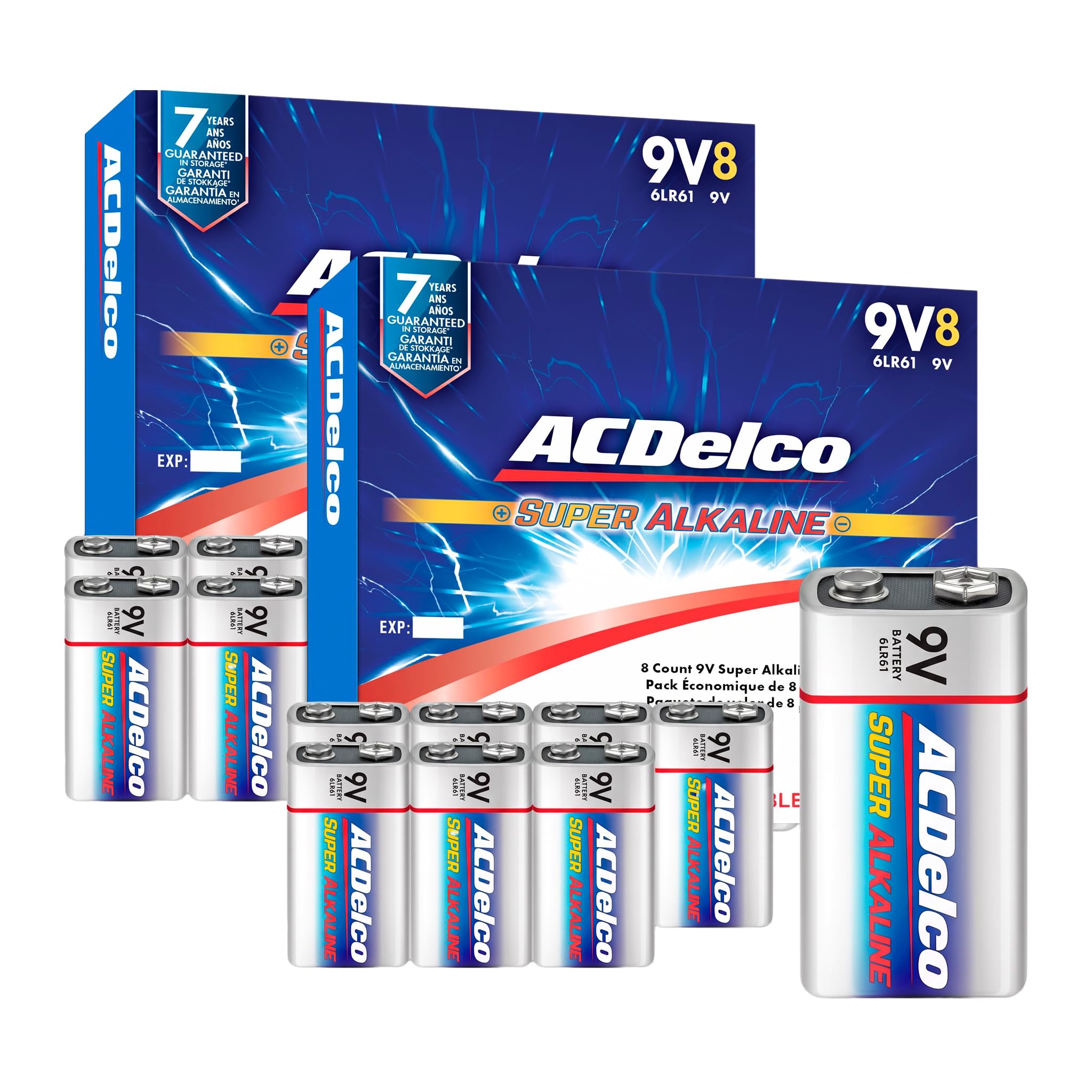
ACDelco is better known for car parts, but its 9V super alkaline has become a quiet favorite for bulk buyers: a seven-year shelf life that beats the five years of Duracell and Energizer, a stainless steel coating that ACDelco says prevents leaks, no mercury or cadmium, and a reclosable pack that keeps the spares in order. The listing is two eight-packs, which covers every alarm, clock and radio in a large house with cells to spare. Owners widely praise it as the cheaper battery that behaves like a name brand in smoke detectors and clocks. The caveats are modest. Sixteen cells is more than a one-bedroom apartment needs before the shelf life runs out, and the most common owner complaints mention shorter life in high-drain toys, which is where the Rayovac Fusion below is the better alkaline. For stocking a landlord’s cupboard or an office supply closet, it is the value pick. Our score 9.4/10.
- Seven-year shelf life, longer than Duracell or Energizer
- Reclosable packaging keeps spares tidy
- No mercury or cadmium
- Widely praised by owners as a cheaper battery that performs like the big names
- Lower brand recognition in batteries than in car parts
- Sixteen cells per order is a lot for a small home
- Some owner complaints mention short life in high-drain toys
Rayovac 9V Batteries, Fusion Premium 9 Volt Battery Alkaline, 2 Count (Pack of 2)
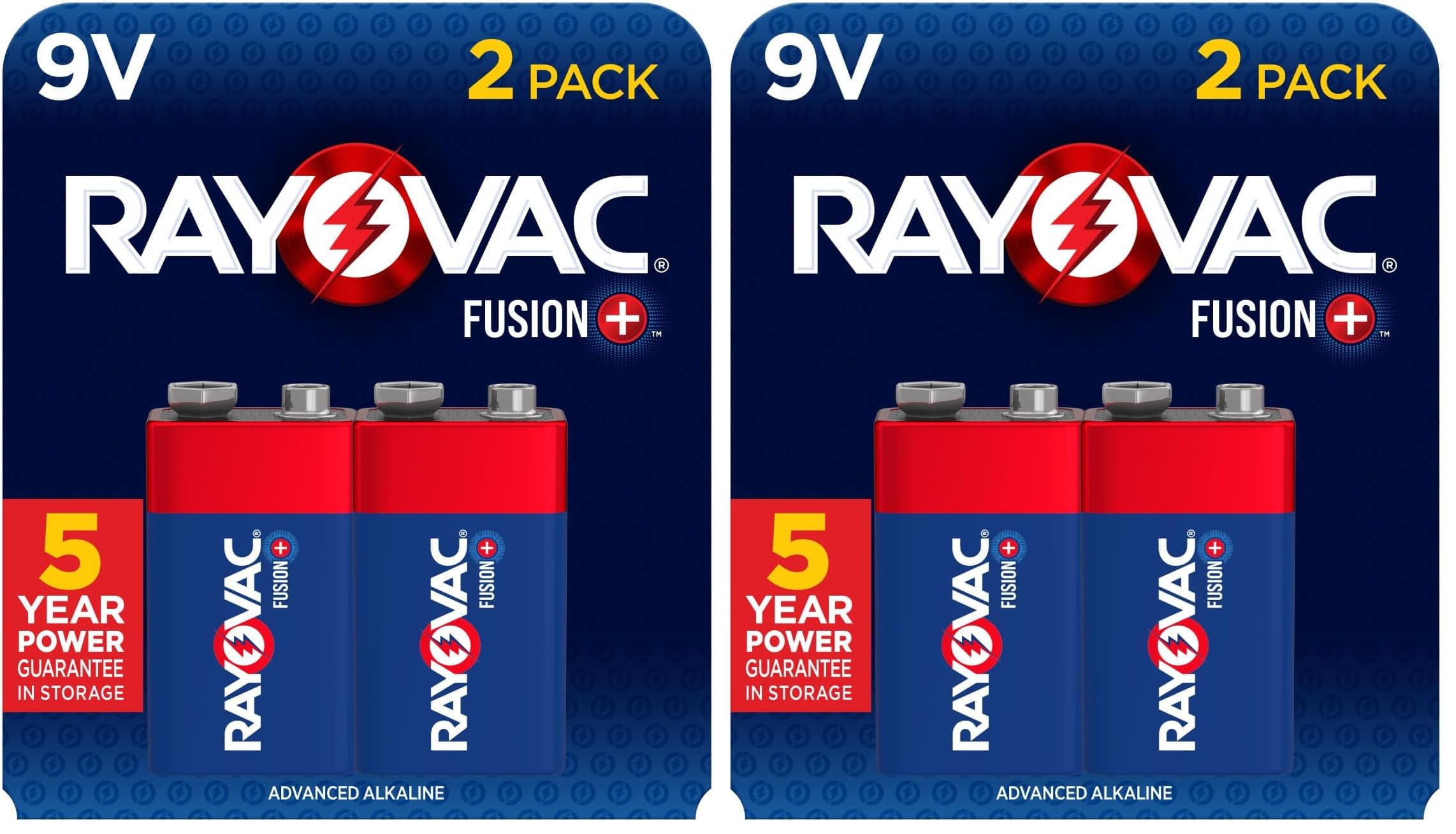
Rayovac calls Fusion its most powerful 9V alkaline, and it aims the battery at the devices that empty ordinary cells fast: wireless microphones, high-powered toys and the like, alongside the usual smoke detector duty. It carries a five-year power guarantee in storage and a leak-resistant design, and owners widely praise it as a cheaper alternative to Duracell that holds voltage well under load. The listing is two two-packs, which is the right quantity for a musician who needs a fresh cell in a pedal or a mic for a gig and does not want a carton of them. That small count is also the weakness for household stocking, and the review base is smaller than the Amazon Basics or Duracell. If you drain a 9V every week in a microphone, the Energizer rechargeable below will be cheaper by the end of the year; if you drain one every few months, the Fusion is the alkaline to buy. Our score 9.4/10.
- Rayovac positions Fusion as its most powerful 9V, aimed at wireless mics and high-drain toys
- Five-year storage guarantee and leak protection
- Widely praised by owners for value against Duracell
- Two-packs are handy for a single pedal or mic
- Only four cells per order
- Fewer owner reviews than the biggest brands here
- Still alkaline; a rechargeable is cheaper over time for daily mic use
KODAK 9V Alkaline Batteries (10 Pack) Smoke Alarm Battery, 6LR61, PP3
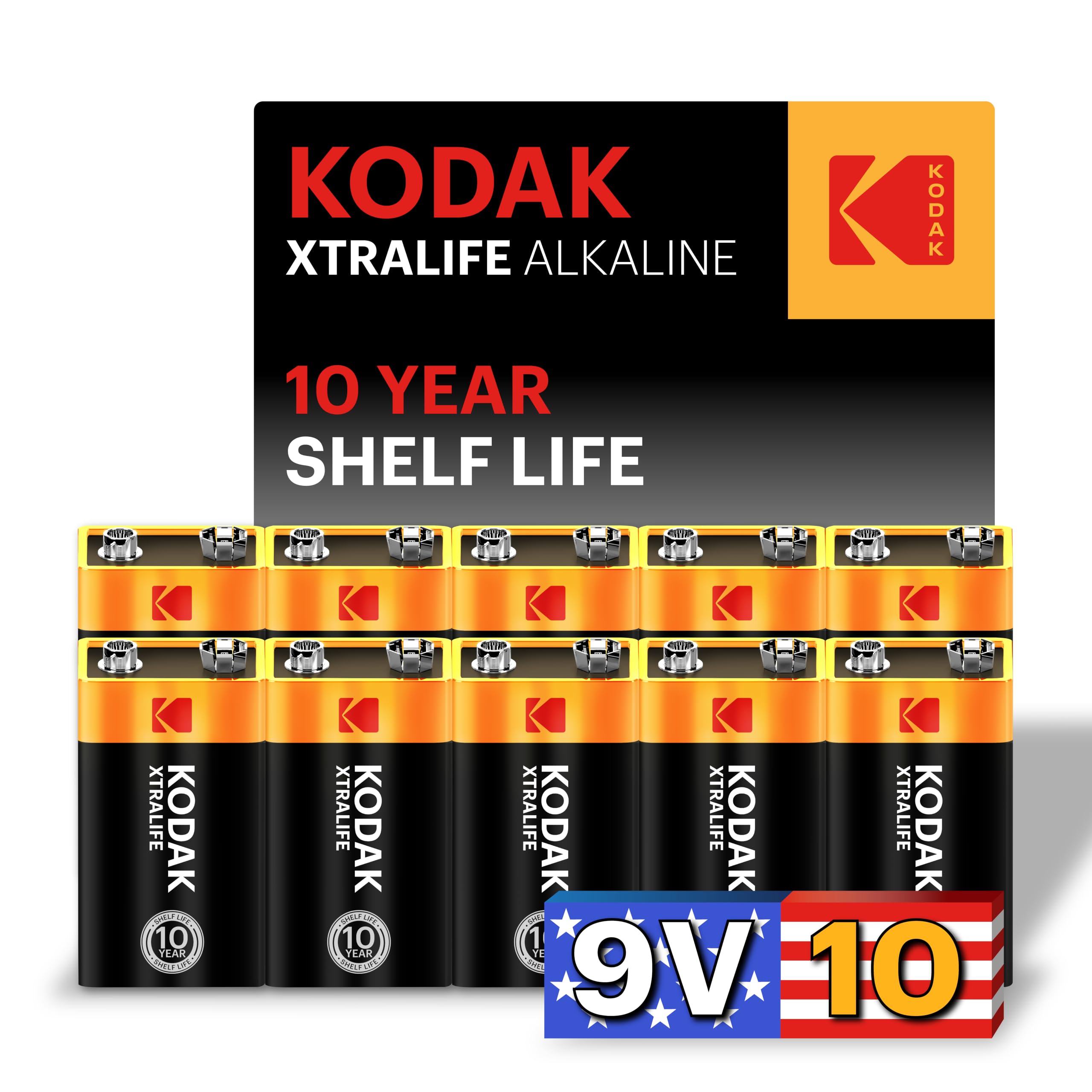
The Kodak Xtralife 9V stands out for one number: a guaranteed ten-year shelf life, double the five years most alkalines promise, which makes a ten-pack a genuinely sensible buy for a house with several alarms. The cells are standard 6LR61 / PP3 alkalines with a leak-resistant design, Kodak rates them at twice the power of zinc-carbon 9V cells, and they ship in a plastic-free recyclable carton. Owners widely praise them for smoke alarm duty and for the price per cell, which sits well below Duracell. Be clear about what the name means: Kodak batteries are produced under license by a battery maker, not by the imaging company, and the most common owner complaints mention somewhat less capacity than the premium brands in high-drain gear. For the low-drain job most 9V batteries do, sitting in an alarm for a year, that difference does not show, and the ten-year shelf life is a real advantage for stocking up. Our score 9.2/10.
- Ten-year guaranteed shelf life, the longest of the alkalines here
- Ten cells in a plastic-free carton
- Rated at 100 percent more power than zinc 9V cells
- Widely praised by owners for smoke alarm duty at a low price
- Kodak batteries are made under license, not by the camera company
- Alkaline, so still a yearly change in an alarm
- A few owner complaints mention lower capacity than Duracell in heavy use
Voniko 9V Lithium Battery 4-Pack, 10-Year Shelf Life, Long-Lasting Power for Smoke Detectors, Carbon Monoxide Alarms & Medical Devices
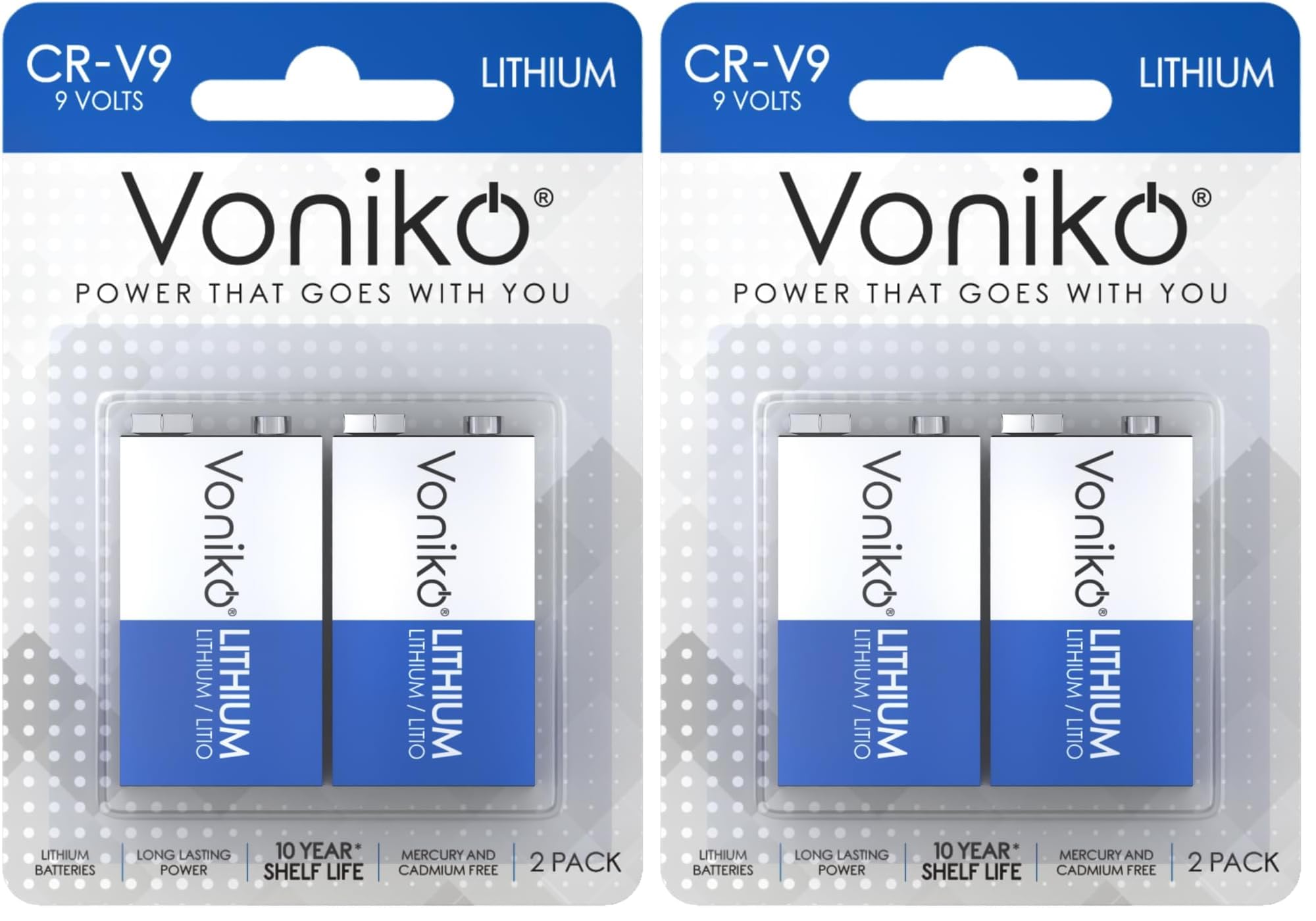
Lithium is the chemistry that ends the annual smoke alarm ritual. Voniko’s 9V lithium holds its charge for ten years on the shelf, delivers roughly twice the energy of an alkaline, and works from -40 F to 140 F, which is why it is the battery for alarms in an unheated garage, a cabin or an RV. It has leak-proof construction plus short-circuit and overcurrent protection, and the four-pack covers the alarms in most homes. Owners praise it precisely for going years between changes and for surviving temperatures that kill alkalines. There are reasons it is not ranked higher. It has far fewer owner reviews than the big alkaline brands, it costs several times as much per cell, and some devices, particularly older alarms and sensitive test gear, specify alkaline because lithium 9V cells sit at a slightly higher voltage when fresh, so read the device manual. For a smoke alarm you cannot reach easily, it is worth every penny. Our score 8.8/10.
- Lithium lasts years in a smoke alarm where alkaline lasts one
- Works from -40 F to 140 F, so it suits garages, sheds and vehicles
- Ten-year shelf life and leak-proof construction
- Owners praise it for ending the yearly alarm change
- Smaller owner base than the alkaline brands
- Costs several times an alkaline per cell
- Not every device tolerates the slightly higher open-circuit voltage of lithium; check the manual
Energizer 9V Batteries, Pre-Charged 9 Volt Rechargeable Batteries, Pack of 2
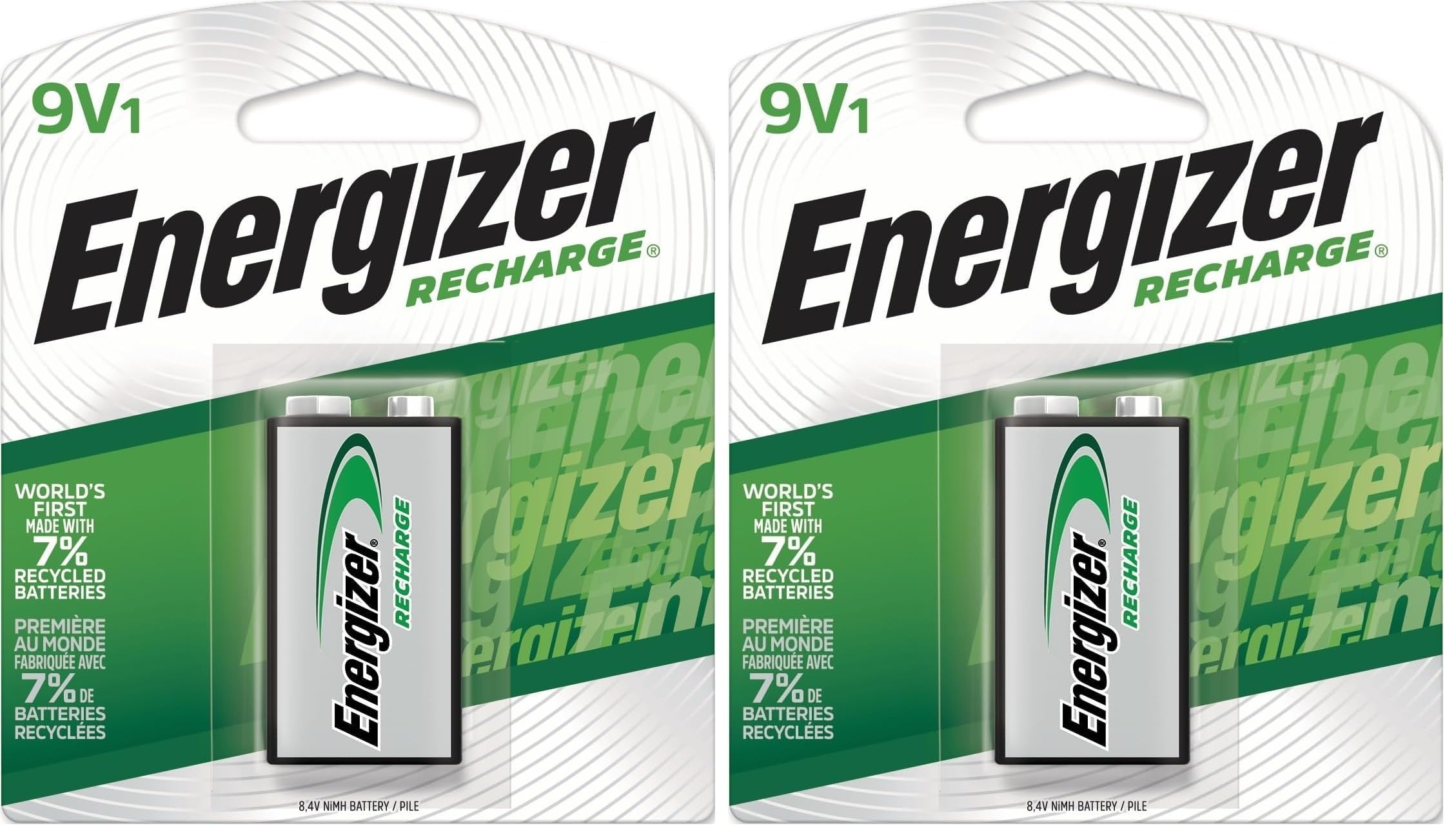
A musician who swaps a 9V every rehearsal, or a parent of a toy that eats them, should stop buying alkalines and buy this. The Energizer Recharge Universal 9V is a 175 mAh NiMH cell that charges hundreds of times, arrives pre-charged, holds its charge up to twelve months in storage, and is rated for a three-year usable life under typical use, which works out to a cost per use that no alkaline approaches. Owners praise it for pedalboards, wireless microphones and portable stereos. The limits are the usual ones for rechargeable 9V cells: capacity is lower than an alkaline, so a pedal runs for less time per charge, you need a charger that takes 9V cells, and NiMH self-discharges slowly, which is why neither we nor Energizer suggest it for a smoke alarm that must sit for a year. Buy the lithium above for alarms and this for anything that gets used every week. Our score 8.8/10.
- Hundreds of recharges replace a drawer of alkalines for daily-use gear
- Pre-charged and holds a charge up to a year in storage
- Leak-resistant design from a major brand
- Owners praise it for pedalboards and wireless mics
- 175 mAh is lower capacity than an alkaline, so run time per charge is shorter
- Needs a 9V-capable charger, sold separately
- Not recommended for smoke alarms, which need a battery that holds charge for a year
Compare the picks
| Product | Chemistry | Count | Shelf life | Best for | Our score | Our score | |
|---|---|---|---|---|---|---|---|
| Amazon Basics 8-packAmazon Basics | Alkaline | 8 | 5 years | The drawer, all-purpose | 9.4/10 | 9.4 | See price |
| Duracell CoppertopDURACELL | Alkaline | 4 x 2 | 5 years guaranteed | Smoke and CO alarms | 9.6/10 | 9.6 | See price |
| Energizer MAXEnergizer | Alkaline | 4 x 2 | 5 years | Meters, pedals, leak-sensitive gear | 9.6/10 | 9.6 | See price |
| ACDelco 8-pack x 2Powermax | Super alkaline | 8 x 2 | 7 years | Bulk stocking | 9.4/10 | 9.4 | See price |
| Rayovac FusionRayovac | Premium alkaline | 2 x 2 | 5 years | Wireless mics, high-drain toys | 9.4/10 | 9.4 | See price |
| Kodak Xtralife 10-packKODAK | Alkaline | 10 | 10 years | Stocking several alarms | 9.2/10 | 9.2 | See price |
| Voniko Lithium 4-packVoniko | Lithium | 4 | 10 years | Hard-to-reach alarms, extreme temperatures | 8.8/10 | 8.8 | See price |
| Energizer RechargeableEnergizer | NiMH 175 mAh | 2 | 12 months charge retention | Pedals, mics, daily use | 8.8/10 | 8.8 | See price |
Alkaline, lithium or rechargeable?
Alkaline is the default and the right choice for most 9V jobs: it is cheap, it holds a charge for five to ten years in the pack, and in a smoke alarm it lasts about a year, which lines up with the yearly change that alarm makers recommend anyway. Lithium costs several times more per cell but delivers around twice the energy, works in freezing and baking temperatures, and can run an alarm for years; it is the pick for alarms on high ceilings, in garages and in vehicles. Rechargeable NiMH has the lowest capacity per charge and self-discharges over months, so it is wrong for alarms, but for a guitar pedal, a wireless mic or a toy that drains a cell weekly it pays for itself within a few months. Many homes end up with two kinds: a pack of alkalines in the drawer and a pair of rechargeables on the pedalboard.
Smoke detector battery rules
Most battery-powered smoke and carbon monoxide alarms take a single 9V, and the makers agree on the routine: test monthly, change the battery once a year (daylight saving weekend is the usual reminder), and replace the whole alarm after ten years. A chirp every thirty to sixty seconds means the battery is low, and some alarms chirp more in cold weather because alkaline voltage dips; that is why a lithium cell is worth it in a garage. Use the chemistry the alarm manual specifies: most accept alkaline or lithium, a few older models want alkaline only, and almost none recommend rechargeables. When you change one alarm, change them all, write the date on the new battery with a marker, and keep the old ones out of the trash where a loose 9V can short against a key or coin.
Shelf life, leaks and buying in bulk
A 9V battery spends most of its life waiting, so the shelf-life guarantee is the spec to read: five years for Amazon Basics, Duracell, Energizer and Rayovac, seven for ACDelco, ten for Kodak and the Voniko lithium. Buy only what you will use inside that window, because a cell that has sat in a drawer past its date is the usual explanation for a brand-new battery that reads low. Leaks are the other risk: all the picks here claim leak-resistant construction, but no alkaline is immune once it is fully drained, so pull dead batteries out of devices promptly rather than leaving them in. In bulk, the ACDelco and Kodak packs are the cheapest per cell; for a small home, an eight-pack of Amazon Basics and a four-pack of lithium for the alarms is the sensible shopping list.
What is the best 9V battery for a smoke detector?
For a yearly change, Duracell Coppertop or Amazon Basics. For an alarm you want to leave alone for years, or one in a cold garage, the Voniko 9V lithium with its ten-year shelf life and -40 F rating.
How long does a 9V battery last in a smoke alarm?
About a year for an alkaline, which is why alarm makers say to change it annually. A lithium 9V typically lasts several years. Rechargeable NiMH cells self-discharge and are not recommended for alarms.
Are expensive 9V batteries worth it?
For low-drain jobs such as alarms and clocks, the Amazon Basics, Kodak and ACDelco cells perform much like Duracell and Energizer at a lower price. For high-drain devices and leak-sensitive gear, the Rayovac Fusion and Energizer MAX earn their premium.
Can I use a rechargeable 9V in a guitar pedal?
Yes, and it is the cheapest option over time. The Energizer Recharge 175 mAh cell runs a pedal for less time per charge than an alkaline but can be recharged hundreds of times. Keep a charged spare.
How should I store spare 9V batteries?
In the original pack or a case, at room temperature, with the terminals covered so they cannot touch metal. Check the date on the carton and use them within the maker shelf life, which is five to ten years for the picks here.
Prices and stock change daily. The buttons above open Amazon so you always see the current price. We may earn a commission if you buy through them, at no extra cost to you.
Do Best Deal is a participant in the Amazon Services LLC Associates Program. As an Amazon Associate we earn from qualifying purchases. If you buy through links on this site we may earn a commission, at no extra cost to you. Learn more.