Studio monitors are speakers built to tell the truth. Where a living-room speaker is voiced to flatter music with extra bass and sparkle, a monitor aims for a flat response so that a mix which sounds balanced on it will sound balanced in a car, on earbuds and on a phone. Every monitor here is powered, with the amplifier inside the cabinet, so there is no receiver to buy: you connect an audio interface, a mixer or a computer and start working. The choices that matter are woofer size, which sets how low the bass reaches and how big a room the speaker suits, the inputs on the back, and the tuning controls that adapt the sound to a desk or a wall. We ranked the powered monitors in our audio catalog by drivers and amplifier power, stated frequency response, balanced and unbalanced inputs, room controls, and what hundreds to thousands of owners report after months of mixing and listening.
We have not mixed on every one of these ourselves; the verdicts rest on the spec sheets and the owner review history. Prices are not printed because they change daily; every button opens the live Amazon page. If you only want better sound at a computer, our computer speakers guide is the simpler route, and for music in a living room see our bookshelf speakers and stereo systems guide.
How we picked
- Powered monitors sold as studio monitors, with a built-in amplifier. Stands, pads, headphones and passive hi-fi speakers were left out.
- A balanced input (TRS or XLR) on every pick, so the speakers connect properly to an audio interface or mixer.
- Stated drivers, power and response from the maker; where a figure is not published we say so.
- Tuning controls such as high and low trim, room switches or app equalization counted in a pick’s favor.
- Owner feedback from several hundred to several thousand reviews, with hiss, hum, Bluetooth and reliability complaints noted.
The picks
Edifier MR4 Power Studio Monitor Speakers, 4 inch Active Near-Field Speaker
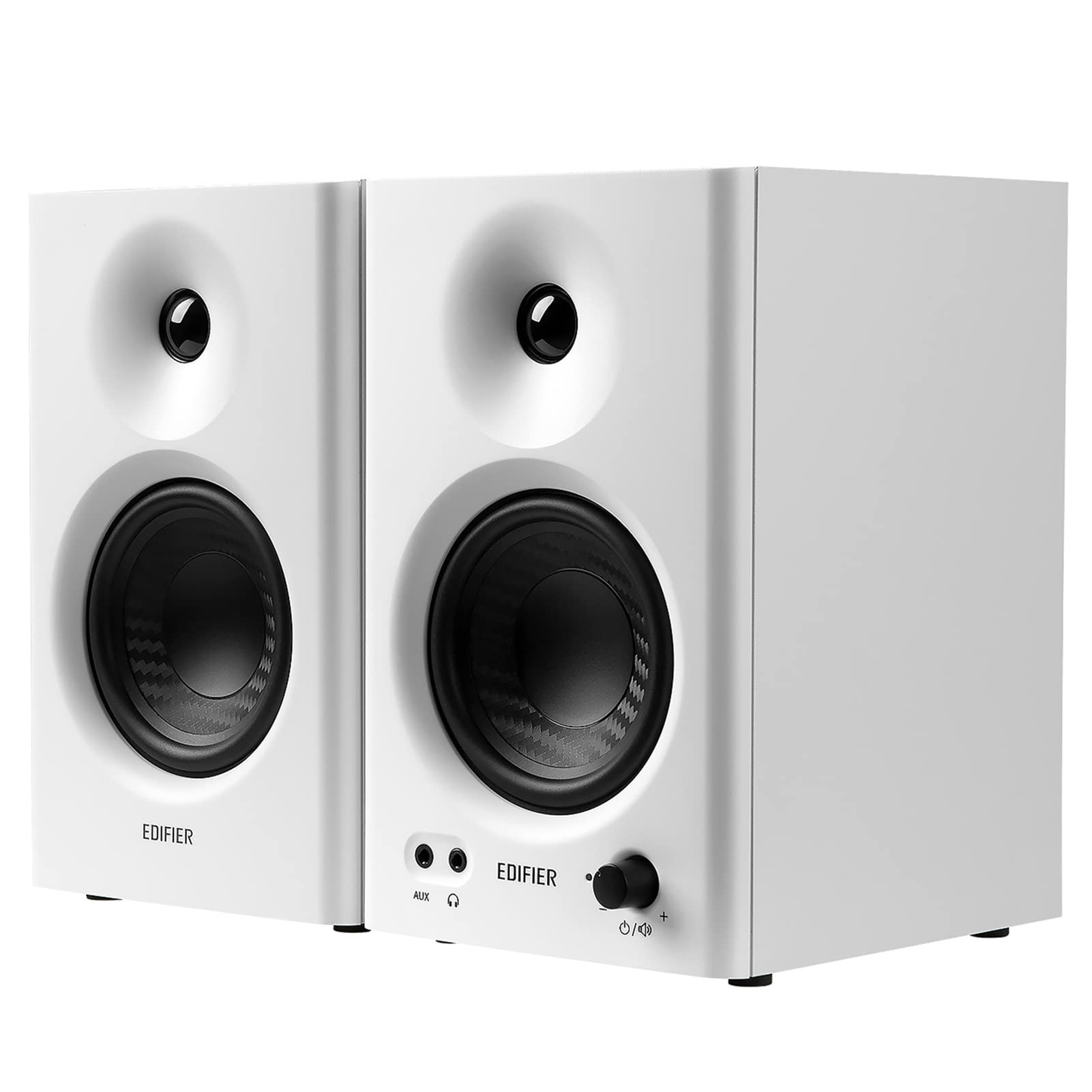
The MR4 is the pair that made near-flat monitoring affordable, and thousands of owners back it with an excellent owner rating. Edifier took its well-liked bookshelf design and retuned it toward a near-flat response for people who make music, edit video or record podcasts. Each cabinet is MDF, which damps resonance better than plastic, with a 4 inch composite woofer and a 1 inch silk dome tweeter. The back panel has a balanced 1/4 inch TRS input for an audio interface plus unbalanced RCA and AUX for a computer or a phone, and separate knobs trim the highs and lows. On the front you get a volume knob that also switches between monitor mode, for accurate work, and music mode, a warmer voicing for listening, and a headphone jack. Four-inch woofers will not reproduce the bottom octave, so check bass-heavy mixes on headphones, and there is no Bluetooth. For a first desk studio, it is the smart start.
- Thousands of owner reviews with an excellent owner rating
- Balanced TRS input at an entry-level cost
- Monitor mode for work, music mode for relaxed listening
- Front volume knob and headphone jack
- 4 inch woofers cannot reach deep bass
- No Bluetooth on this model
- Sold as a linked pair, so the speakers cannot be bought singly
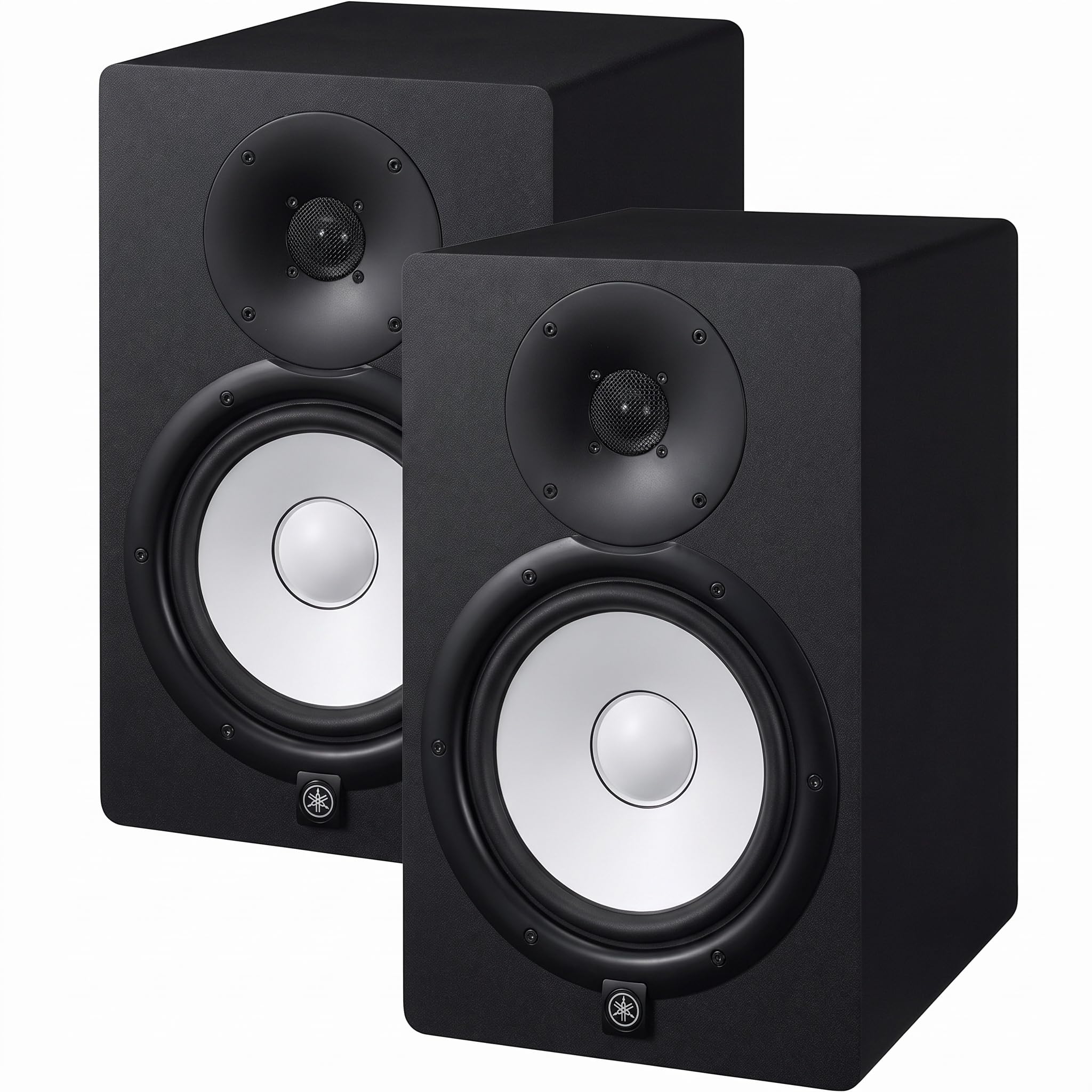
The HS8 is the monitor other monitors are compared with. Its white-coned 8 inch woofer and 1 inch dome tweeter are each driven by their own amplifier, 75 watts for the lows and 45 for the highs, crossing over at 2 kHz, and the stated response runs from 38 Hz to 30 kHz, low enough to judge kick drums and bass lines without a subwoofer. Two switches on the back adapt it to the room: room control cuts the bass build-up below 500 Hz when the speaker sits near a wall, and high trim nudges the treble up or down by 2 dB. Inputs are XLR and TRS only. This listing is for a pack of two, and thousands of owners give the HS8 the highest rating in this guide. It is a serious purchase, the cabinets are large, and an untreated bedroom will not let them show their best. For mixing that has to translate everywhere, it is the standard.
- Highest owner rating on this page, with thousands of reviews
- Response down to 38 Hz without a subwoofer
- Room control switch tames bass near a wall
- The white-cone reference found in studios worldwide
- Costs several times as much as the entry-level pairs
- Large cabinets need stands and a treated room to shine
- Balanced inputs only; no RCA, AUX or Bluetooth
PreSonus Eris E5 Pair 2-Way 5.25 Near Field Studio Monitors
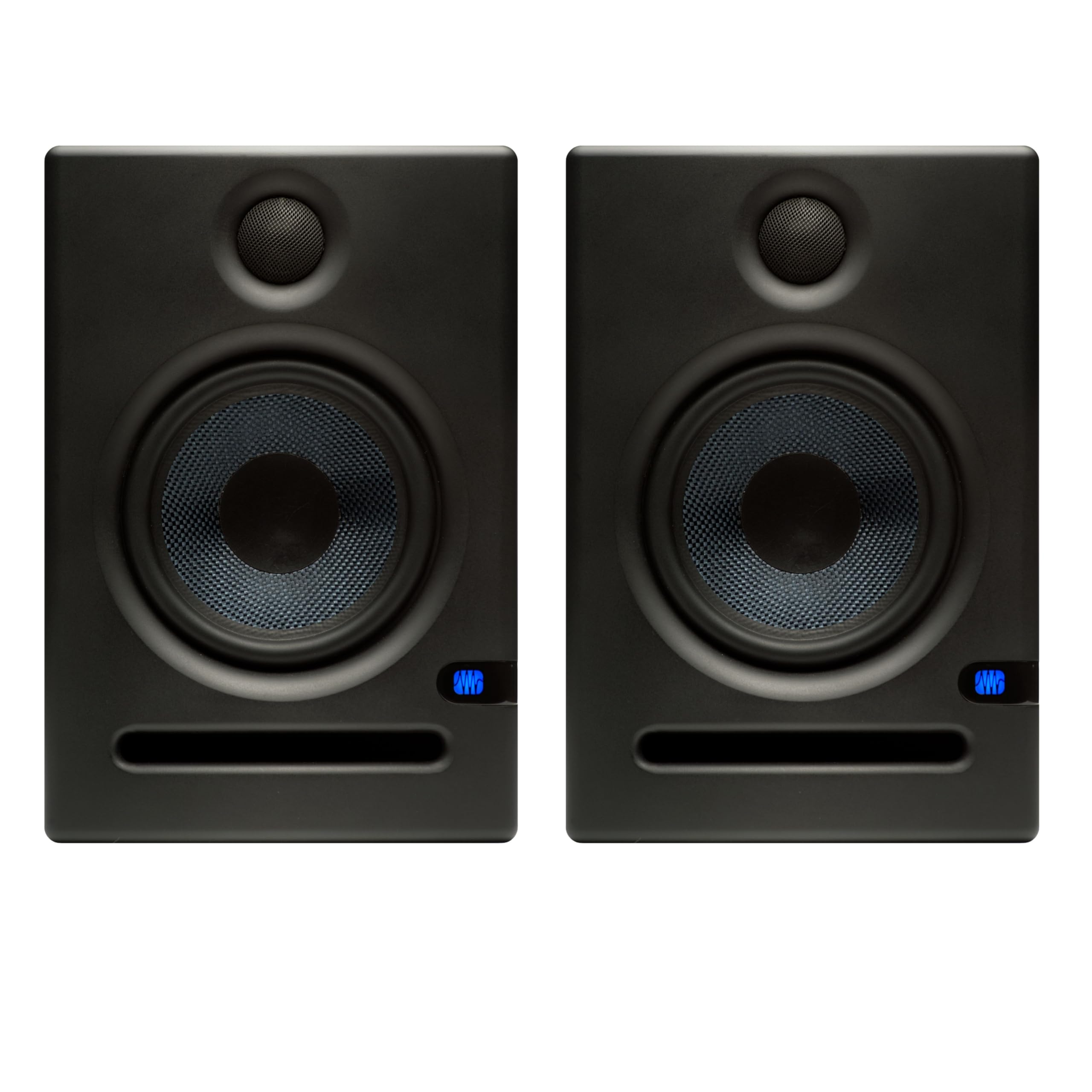
The Eris E5 has been the default recommendation for a small project studio for years, and it remains the most complete 5 inch monitor here. A 5.25 inch woven composite woofer handles the low end with little distortion, a 1 inch low-mass silk dome tweeter keeps the top smooth, and each driver has its own Class AB amplifier for 80 watts per speaker. The back panel is properly professional: balanced XLR and 1/4 inch TRS inputs, unbalanced RCA for a computer or a DJ controller, and acoustic tuning controls that contour the response for the room and for where the speaker sits. PreSonus also builds in RF shielding, current limiting and over-temperature protection. Many hundreds of owners give it a very strong owner rating. It cannot reach as low as the HS8, and there are no convenience features such as Bluetooth or a headphone jack. For learning to mix in a spare room, it is the right size.
- XLR, TRS and RCA cover every interface and mixer
- Acoustic tuning controls shape the sound to the room
- Many hundreds of owner reviews with a very strong owner rating
- Class AB amplification with protection circuits
- Bass rolls off earlier than the 8 inch Yamaha
- No Bluetooth or headphone output
- Rear ports need space behind the cabinet
Edifier MR5 2.0 Studio Monitor Bookshelf Speakers, 110W RMS, Black

The MR5 is Edifier’s grown-up monitor and an unusual design at its level: a true three-way speaker, with a 5 inch long-throw woofer, a 3.75 inch midrange driver and a 1 inch silk dome tweeter in a dimpled waveguide, divided by an active crossover. Giving the midrange its own driver helps vocals and guitars stay clear when the woofer is busy. The stated response is 46 Hz to 40 kHz, a 110 watt RMS Class D amplifier delivers a peak of 101 dB, and the input list is the longest here: XLR, TRS, RCA, AUX and multi-point Bluetooth with LDAC, plus a front headphone output. Rear knobs trim highs and lows, and the EDIFIER ConneX app adds low cut, desktop and acoustic space presets. Thousands of owners give it a very strong owner rating. It costs about twice the MR4 and takes more desk. For one pair that mixes by day and streams by night, it is the most versatile.
- Dedicated midrange driver for clearer vocals
- Every input type including XLR and Bluetooth
- App presets for desktop placement and room acoustics
- Thousands of owner reviews with a very strong owner rating
- Costs roughly twice the MR4
- App tuning adds a step that purists may skip
- Larger and deeper than a 4 inch pair
JBL Professional 1 Series 104-BT Compact Desktop Reference Monitors with Bluetooth, Black, Sold as Pair, 4.5-inch Speaker

JBL’s 104-BT is designed for the smallest desks. Its coaxial driver puts a 0.75 inch soft-dome tweeter at the center of a 4.5 inch woofer, so highs and lows come from the same point and the image stays stable even when you sit very close or move around, which is how people actually work at a laptop. A 60 watt Class D amplifier in the master speaker powers both cabinets, and a front-panel control selects Bluetooth 5.0, AUX, RCA or TRS, or mixes them all, beside a volume knob and a headphone jack that mutes the speakers. JBL is frank about the range: 88 Hz to 20 kHz at minus 3 dB, so the deepest bass is simply absent. There is no XLR and no room tuning. Many hundreds of owners give it a very strong owner rating. For podcast editing, video work and a travel rig, it is the neat choice.
- Coaxial driver gives a wide sweet spot at close range
- Small rounded cabinets fit beside a laptop
- Front-panel input switching and headphone jack
- Many hundreds of owner reviews with a very strong owner rating
- Bass stops around 88 Hz, so low end must be checked elsewhere
- No XLR input
- No tuning controls for room or placement
Edifier MR3 Powered Studio Monitor, Speaker Hi-Res Active Bluetooth Speaker

The MR3 is the MR4’s smaller, newer sibling, and it trades size for features. Each MDF cabinet holds a 3.5 inch mid-low driver and a 1 inch tweeter, powered at 18 watts a side for a peak of 92.5 dB, which is plenty at arm’s length and not enough to fill a room. The stated response of 52 Hz to 40 kHz carries Hi-Res Audio certification. Connections are generous for the size: balanced TRS for an interface, RCA and AUX that can stay plugged in together, a headphone output, and Bluetooth with multi-point so a phone and a laptop can both stay paired. Music, Monitor and Custom modes switch the voicing, and the EDIFIER ConneX app provides a full equalizer. Hundreds of owners give it a very strong owner rating. It has less headroom than the MR4, and small drivers mean lighter bass. For a tight desk where the monitors also play your daily music, it fits best.
- Balanced TRS and Bluetooth in a very small pair
- Three sound modes plus app equalizer
- RCA and AUX can stay connected at the same time
- Hundreds of owner reviews with a very strong owner rating
- 18 watts a side is for close listening only
- 3.5 inch drivers limit bass weight
- Less headroom than the MR4
Ortizan C7 Powered Studio Monitors Pair with Bluetooth 5.3, White
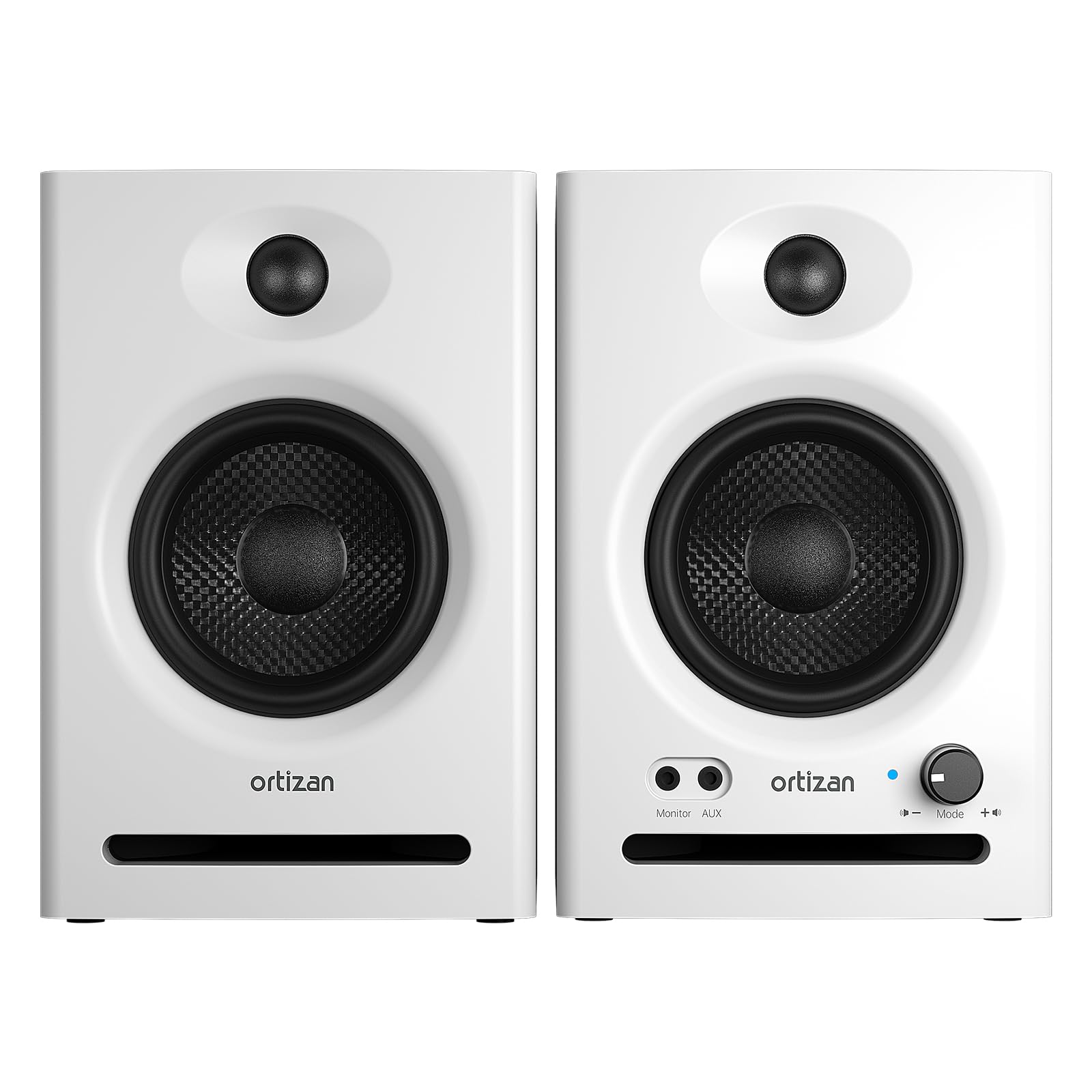
The Ortizan C7 shows how far the entry level has come. It is a small white pair with a 3.5 inch carbon fiber woofer and a 0.75 inch silk dome tweeter in each cabinet, tuned in the laboratory toward the flat curve a monitor needs, according to the maker. What lifts it above ordinary computer speakers is the back panel: a 6.35 millimeter balanced TRS input for a mixer, an audio interface, an electric piano or a guitar processor, alongside RCA, 3.5 millimeter AUX, Bluetooth 5.3, and a USB input feeding a built-in 24-bit DAC so a laptop can send digital audio directly. Hundreds of owners give it an excellent owner rating. The listing does not publish a frequency response or amplifier power, so treat it as a near-field speaker for modest volumes, and the brand has a shorter history than the others here. For a student producer or a first keyboard setup, it is honest value.
- Excellent owner rating at the lowest cost here
- Balanced TRS input, rare on budget speakers
- USB input with a built-in DAC for direct computer audio
- Bluetooth 5.3 for casual listening
- Maker publishes no frequency response or power figures in the listing
- Small drivers and cabinets limit bass and volume
- Younger brand than Edifier, JBL or PreSonus
Compare the picks
| Product | Drivers | Power | Inputs | Tuning | Our score | Our score | |
|---|---|---|---|---|---|---|---|
| Edifier MR4Edifier | 4 in woofer, 1 in tweeter | Not stated in listing | TRS, RCA, AUX | High and low knobs, two modes | 9.2/10 | 9.2 | See price |
| Yamaha HS8 pairYAMAHA | 8 in woofer, 1 in tweeter | 120 W bi-amp per speaker | XLR, TRS | Room control, high trim | 9.4/10 | 9.4 | See price |
| PreSonus Eris E5 pairPreSonus | 5.25 in woofer, 1 in tweeter | 80 W Class AB bi-amp | XLR, TRS, RCA | Acoustic tuning controls | 9/10 | 9.0 | See price |
| Edifier MR5Edifier | 5 in, 3.75 in mid, 1 in tweeter | 110 W RMS Class D | XLR, TRS, RCA, AUX, Bluetooth | Rear knobs plus app | 9/10 | 9.0 | See price |
| JBL 104-BTJBL | Coaxial 4.5 in with 0.75 in tweeter | 60 W Class D | TRS, RCA, AUX, Bluetooth | None | 8.8/10 | 8.8 | See price |
| Edifier MR3Edifier | 3.5 in driver, 1 in tweeter | 18 W x 2 RMS | TRS, RCA, AUX, Bluetooth | Three modes plus app EQ | 9/10 | 9.0 | See price |
| Ortizan C7Ortizan | 3.5 in woofer, 0.75 in tweeter | Not stated in listing | TRS, RCA, AUX, USB, Bluetooth | Factory tuned | 9.2/10 | 9.2 | See price |
What size woofer do you need?
Woofer size sets the bass reach and the listening distance. Monitors of 3.5 to 4.5 inches, such as the Edifier MR3 and MR4, the JBL 104-BT and the Ortizan C7, are for desks where you sit two or three feet away; they are accurate in the midrange and treble but roll off in the bass, so check low end on headphones. Five-inch monitors such as the PreSonus Eris E5 and Edifier MR5 are the sweet spot for a spare-room studio. Eight-inch monitors such as the Yamaha HS8 reach low enough to mix bass with confidence but need distance and a room that is not all bare walls. Bigger is not better in a small untreated room, where large woofers excite boomy resonances.
Balanced or unbalanced inputs?
Balanced connections, XLR or 1/4 inch TRS, carry the signal on two conductors plus a shield and cancel the hum and buzz that cables pick up, which matters when speakers sit near a computer and its power supplies. An audio interface or mixer with balanced outputs should always be connected that way. RCA and 3.5 millimeter AUX are unbalanced and fine for short runs from a laptop or a phone. Every pick here has at least a TRS input. Bluetooth is a convenience for casual listening on the Edifier MR3 and MR5, the JBL and the Ortizan, but it adds delay, so do not record or mix through it.
Placement and room tuning
Set the monitors so that the two speakers and your head form an equal-sided triangle, with the tweeters at ear height and angled toward you. Keep them off a hollow desktop if you can, using stands or dense foam pads, and leave space behind rear-ported cabinets. A speaker pushed against a wall gains bass; the room control switch on the Yamaha, the tuning controls on the PreSonus and the app presets on the Edifier MR5 exist to pull that back. Start with every control flat, play music you know well, and change one setting at a time. Listen at moderate volume: it protects your hearing and gives more reliable mix decisions.
What is the difference between studio monitors and regular speakers?
Studio monitors aim for a flat, uncolored response so you hear a recording as it is, which helps mixes translate to other systems. Regular hi-fi and computer speakers are usually voiced to sound pleasing, with boosted bass or treble. Monitors here are also powered, with amplifiers built in.
Do I need an audio interface for studio monitors?
It is strongly recommended for recording and mixing, because an interface provides balanced outputs and a proper volume control. For listening only, the Edifier MR4, MR3 and MR5, the JBL 104-BT and the Ortizan C7 also accept RCA or AUX from a computer, and the Ortizan has a USB input.
Are 5 inch or 8 inch studio monitors better?
Neither is better in general. Five-inch monitors suit small rooms and close listening and are easier to place. Eight-inch monitors such as the Yamaha HS8 reach deeper bass but need more distance and a better-behaved room. Match the size to the room, not to the budget.
Can I use studio monitors for everyday music and gaming?
Yes. They sound clear and detailed, though a flat response can seem less bassy than consumer speakers at first. Models with a music mode or Bluetooth, such as the Edifier MR4, MR3 and MR5, the JBL 104-BT and the Ortizan C7, are the most convenient for daily use.
Do I need a subwoofer with studio monitors?
Not to begin with. Small monitors miss the lowest octave, and a good pair of headphones covers that gap cheaply. An 8 inch monitor such as the Yamaha HS8, with response stated down to 38 Hz, handles most music without one. Add a subwoofer later if you mix bass-heavy genres.
Prices and stock change daily. The buttons above open Amazon so you always see the current price. Do Best Deal may earn a commission if you buy through them, at no extra cost to you.
Do Best Deal is a participant in the Amazon Services LLC Associates Program. As an Amazon Associate we earn from qualifying purchases. If you buy through links on this site we may earn a commission, at no extra cost to you. Learn more.
