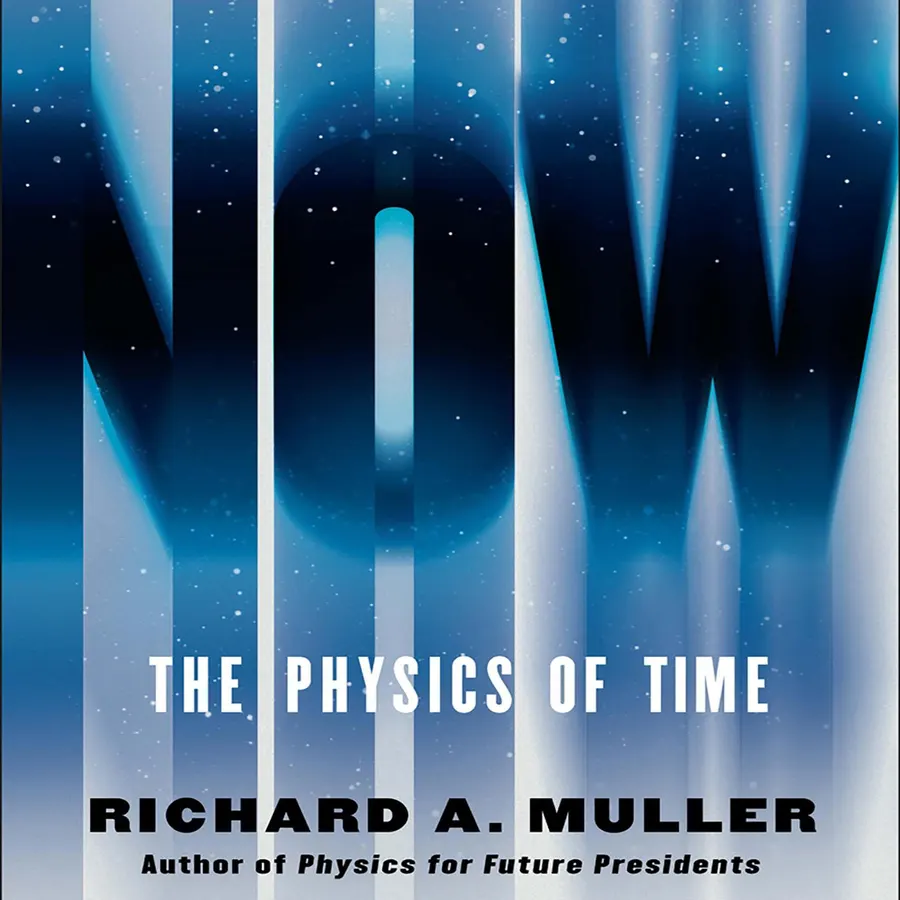
Quick answer The Now: The Physics of Time by Richard A Muller (Author), Christopher Grove (Narrator), Random House Audio (Publisher) & 0 more Format: Audible Audiobook scores 8.8/10 with us. Amazon owners rate it 4.4 out of 5 across 809 reviews, in line with the 4.5 average of the 8 products we track in Audible Books & Originals.
Do Best Deal is a participant in the Amazon Services LLC Associates Program. As an Amazon Associate we earn from qualifying purchases. If you buy through links on this site we may earn a commission, at no extra cost to you. Learn more.
Breakdown from the 10 most helpful reviews we imported.
D
Doctor Moss
Verified purchaseNovember 13, 2016
Provocative, Impressively Readable
I enjoyed reading Muller’s book, maybe as much for its loose ends as its clear discussions along the way. He combines a reconstruction of some basics of relativity and quantum physics with an over-riding question — time’s arrow and our experience of a “now” in time — and a general, philosophical position on the limits of scientific knowledge. And, despite the subject matter, it’s written in an almost breezy manner, although you’ll certainly find yourself going back to read passages a second or third time to understand subtle points.The bulk of the book really is Muller’s laying out of his own
P
Peter J. Wetzel
Verified purchaseApril 29, 2017
A proposal about the meaning of time and of the human soul
Do humans have souls? Do they transcend our physical bodies? Why does Richard A. Muller spend a significant fraction of the text of this new popular level book about the physics of time discussing this?The answer seems to simply be that the question of whether he has a soul is one that is dear to the author’s heart. I’ve tried to figure out if there is any link between this subject and the main purpose of the book but I failed.The primary purpose of the book is to introduce a new and still speculative theory of Muller’s that our sense of ‘now’ and of our involuntary ‘motion’ along the arrow of
H
Herbert Gintis
Verified purchaseOctober 18, 2016
A Nice Contribution to the Discussion of Physics, its Implications, and its Limits
Muller's presentation of modern physics for the layperson is very good. The appendices are extremely well done, especially in dealing with quantum mechanics. His central operating principle is that experienced phenomena cannot be dismissed a illusory just because they do not appear in contemporary physics. For instance, the qualia of consciousness (e.g., I see a blue sky) are real phenomena despite the fact that consciousness does not appear in, and is not explained by, contemporary physics. Similarly, time flows in one direction despite the fact that all of the laws of physics of every day pa
P
Pawan
Verified purchaseOctober 7, 2016
More than a physics book: Helped me realize the importance of this moment we call Now.
After reading hundreds of books over tens of years I think I have finally figured out how to rate a book. I used to think that true rating of a book is the uniqueness of author's ideas, or ease of reading, or clear presentation. I still think these are important factors that make a written piece good. But to judge a book solely by its content is similar to judging it by its cover. And as they say never rate a book by its cover (alone).In my opinion, the best way to rate a book is what impact it makes on the reader. Using that as my yardstick I am giving this book five stars.I have an intuitive
A
Ashutosh S. Jogalekar
Verified purchaseOctober 1, 2016
Two thirds of a good book: 3.5 stars
This book by Berkeley physicist Richard Muller is a combination of very interesting and disappointing. The main goal of the book is to provide an overview of a new theory of the generation of time that Muller has proposed. According to Muller, just like space expands as the universe expands, so does time. Thus, when the Big Bang occurred, along with new space new time was also created, and new time continues to be created even as the expansion of the universe is accelerating.This is a very interesting and in fact fascinating hypothesis. Muller even provides some preliminary, testable experimen
J
jim hughes
Verified purchaseJanuary 1, 2017
I wanted more...
The first part of the book is an interesting and unusually honest summary of where physics is today with respect to the 'big questions'. It does wander a bit, and there are too many digressions; but I liked the way Muller forthrightly faces the conclusion that physics is, and is likely to remain, incomplete; reality doesn't seem to be deterministic at the quantum level, and key aspects of consciousness lie outside of any possible reductionist explanation.But although the author strongly rejects physicalism, he remains committed to an independently existing reality where events 'happen' even in
T
Tony B
Verified purchaseFebruary 11, 2017
A definite "must read" for anyone interested in Physics
This may be the most well-written popular physics books I've ever read. Mr. Muller does an excellent job of explaining some of physics' more challenging concepts in ways that the reader can truly grasp - from Relativity to Quantum Theory. Now, not everyone will be able to mentally deal with the dynamics of time dilation or or entanglement, but if you can, this book explains these phenomena clearly.All that said, the book does tend to wander sometimes. You will venture off on paths that seem completely irrelevant to Time and Now. But most of this wandering is laying groundwork for other ideas w
D
DHT
Verified purchaseJune 12, 2020
An excelent treatise on the physical bases that may be the source of our concept of time and now.
The author is clearly an experienced and knowledgeable physics teacher as he presents the various physics topics in a method and sequence that makes these readily understandable and easy to follow. He also provides ample encouragement to do some key calculations yourself and provides the solutions in appendicees. The story line flows smoothly and continuously from early concepts of time and the "Now" to a suggestion by the author as one he thinks is most likely at the end of the book. Along each step of the way, Muller backs up the concepts with physics arguments. In the style of a true experi
Customer reviews are shown as published on Amazon and are not written by Do Best Deal.