An action camera is a small, sealed video camera built to be strapped to a helmet, a chest, a handlebar or a surfboard and left to record while you concentrate on not falling off. The things that separate a good one from a cheap one are not the headline resolution but the sensor size, the stabilization, how long the battery lasts in the cold, and whether the footage is usable without an afternoon of editing. We ranked the action cameras in our cameras catalog by sensor and frame rates, stabilization, waterproof depth with and without a case, battery life, audio and mounting, and what tens of thousands of owners report after a season of use. Two pocket gimbal cameras are included at the end for people whose action is vlogging rather than diving.
We have not strapped every one of these to a helmet ourselves; the verdicts rest on the spec sheets and on the owner review history. Prices are not printed because they change daily; every button opens the live Amazon page. If what you want is a small camera for travel rather than sport, our point-and-shoot cameras guide is the better list, and our mirrorless cameras for beginners guide covers the step up.
How we picked
- 4K or better. Every pick records at least 4K; the two DJI and Insta360 flagships go to 8K.
- Stabilization that owners praise. Electronic stabilization on every action camera, a physical three-axis gimbal on the two pocket cameras.
- Waterproofing stated honestly. We say whether the camera is sealed on its own or only inside a case, and to what depth.
- Real batteries. Removable batteries on the action cameras, with spares in the box on the AKASO models.
- Owner ratings of 4.3 stars or better; five of the six have thousands of reviews.
The picks
DJI Osmo Action 4 Essential Combo, Waterproof Action Camera Vlogging Camera
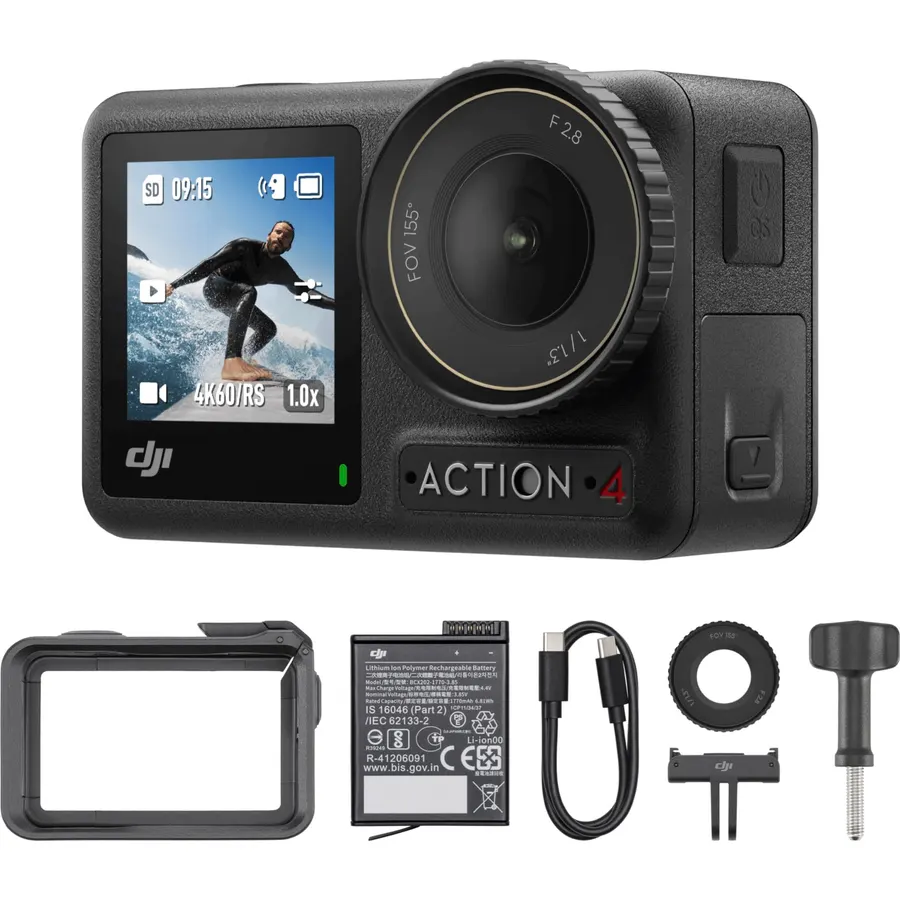
The Osmo Action 4 is the camera to buy if you want footage that looks good straight off the card. Its 1/1.3-inch sensor is far larger than the budget cameras’ and its 2.4 micron pixels are why owners keep mentioning clean dusk and indoor footage; 10-bit color and the D-Log M profile give editors room to grade. It shoots 4K up to 120 frames per second for slow motion, stabilizes through three modes including one that locks the horizon, and is sealed to 18 metres without a case. The battery runs about 150 minutes and is rated to minus 20 Celsius, which matters on a ski lift. DJI’s magnetic quick-release mount is the best in the business, and recent firmware added Pre-Rec, which keeps up to a minute of footage from before you pressed record. About 2,300 owners rate it 4.7 stars.
- 4.7 stars from about 2,300 owners, the best rating here
- Large sensor and 10-bit color give clean low-light footage
- Waterproof to 18 m with no housing
- Magnetic mount swaps from horizontal to vertical in seconds
- Essential Combo ships with one battery
- No 8K or variable aperture, which the Action 6 adds
- Costs about four AKASO EK7000s
AKASO EK7000 4K30FPS 20MP WiFi Action Camera with EIS Ultra HD 131FT Waterproof Underwater Camera Remote Control 4X Zoom Support External Microphone Black
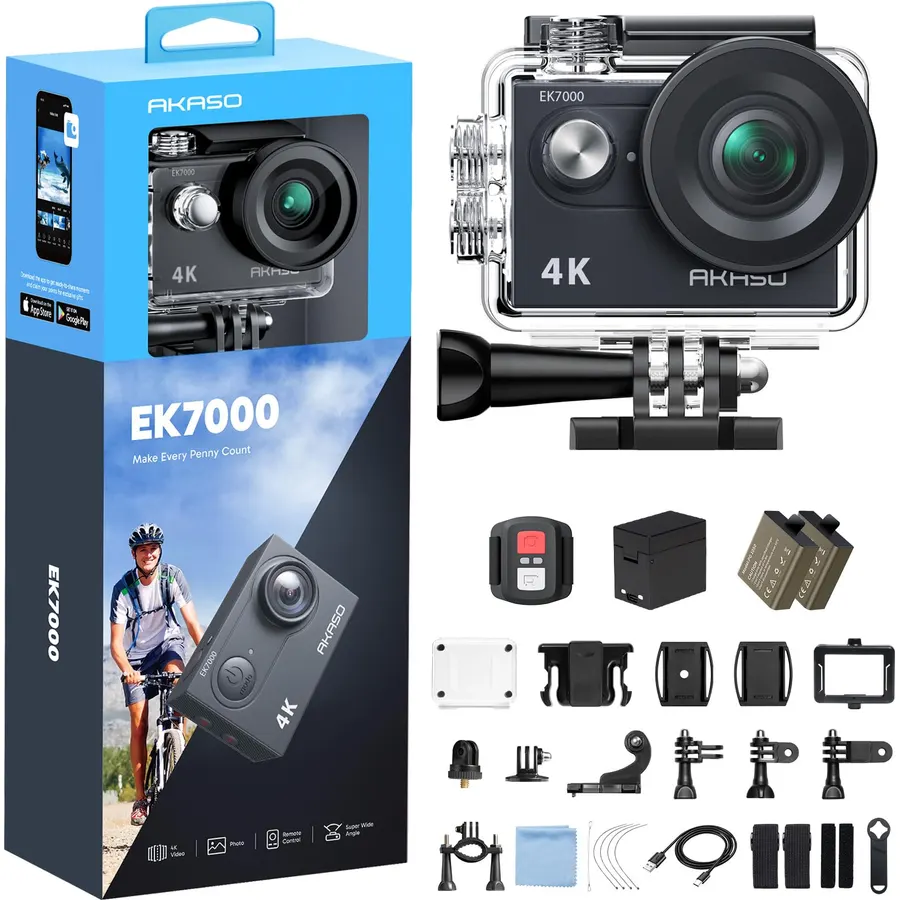
The EK7000 is the action camera that about 40,000 people bought as a first one, and its 4.4-star average says most of them were happy. It records 4K at 30 frames per second and 1080p at higher rates, takes 20MP stills, and ships with a waterproof case good to 40 metres, two batteries, a wrist remote and a bag of mounts, which is everything a holiday or a child’s first camera needs. Electronic stabilization smooths a bike ride but not a mountain-bike descent, the small sensor goes grainy at dusk, and the camera is not sealed on its own, so the case goes on for anything wetter than rain. It supports an external microphone, which the pricier Brave 4 does not advertise. For snorkelling, a dashboard or a kid, it is the sensible budget pick.
- About 40,000 owners at 4.4 stars, the most-reviewed camera on the page
- Two batteries, a case and a mount kit for a budget price
- Wrist remote for gloved hands
- 4K recording at a tenth of the DJI price
- 4K is 30 fps only and from a small sensor
- Needs the case to get wet at all
- Stabilization is basic; night footage is soft
DJI Osmo Action 6 Essential Combo, 8K Waterproof Action Camera
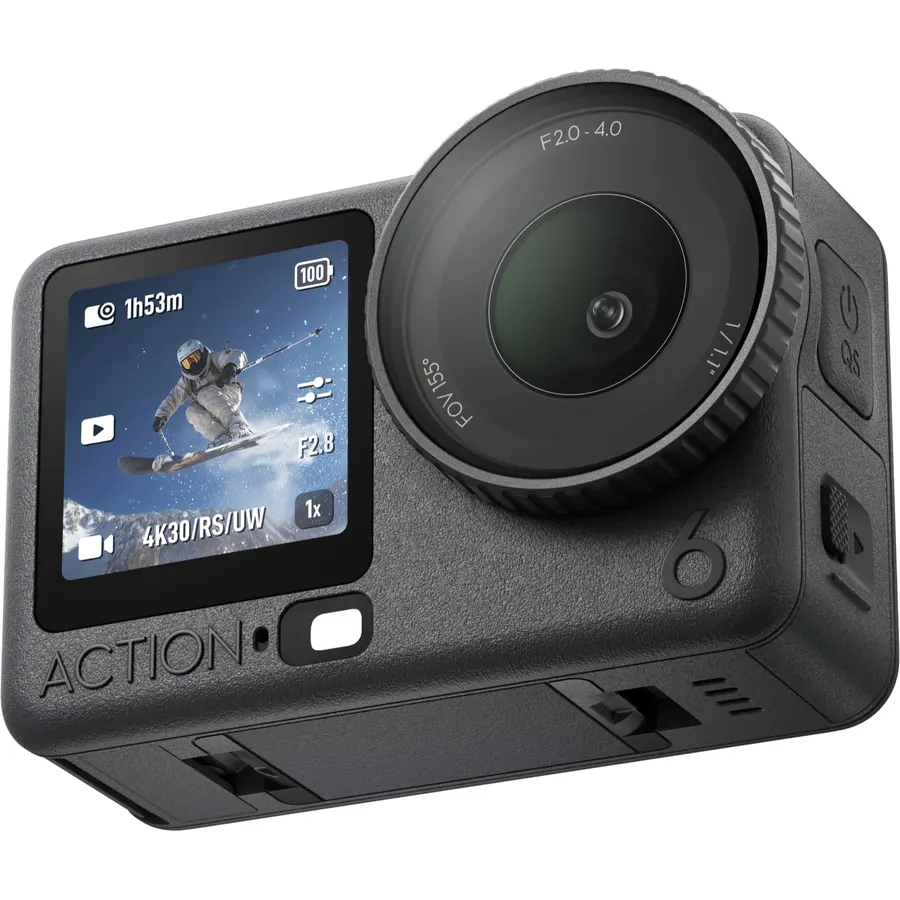
The Action 6 is what DJI built after the Action 4 and it answers the three things people asked for: more resolution, better control of exposure, and more battery. The new 1/1.1-inch sensor is square, so one recording can be cropped to vertical for phones or horizontal for a screen without losing quality, and it shoots 8K. A variable aperture from f/2.0 to f/4.0 lets the camera stop down in bright snow or open up at dusk, which no other action camera does. Stabilization adds a full 360-degree horizon lock, the battery runs about four hours, and two DJI microphone transmitters pair straight to the camera for interviews. It is the priciest action camera on the page and about 2,200 owners rate it 4.5 stars, slightly below the Action 4; the gap is mostly early-firmware complaints and the cost.
- 8K video and a square sensor that reframes vertical or horizontal after the fact
- Variable aperture, a first for action cameras
- About four hours of battery
- Two wireless mics connect with no receiver
- The most expensive action camera here
- 8K files are large and need a fast card and computer
- 4.5 stars from about 2,200 owners, a little below the Action 4
AKASO Brave 4 Action Camera 4K30 Ultra Hd Waterproof Underwater Camera
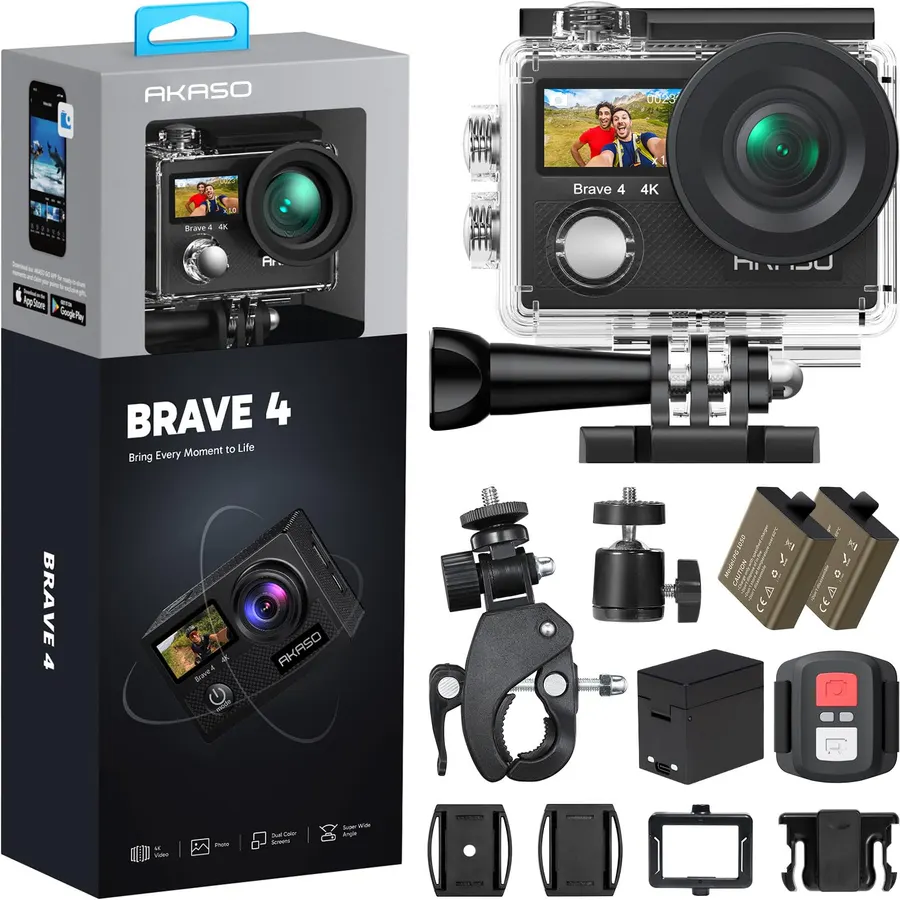
The Brave 4 is the EK7000 with the things its owners asked for: a second screen on the front so you can frame yourself, an adjustable field of view from a 170-degree fisheye down to a 70-degree crop, gyroscope stabilization that is a step smoother, and HDMI out alongside Wi-Fi. Video is still 4K at 30 frames per second and 1080p at 60, photos are 20MP, and the box has two batteries of about 90 minutes each with a dual charger and the waterproof case good to 40 metres. About 17,400 owners rate it 4.4 stars, the same as the EK7000, and the reviews describe the same camera with better ergonomics. If you will talk to the camera, the front screen is worth the difference; if it lives on a helmet, save the money and buy the EK7000.
- Front screen for vlogging and selfies
- Four selectable fields of view
- Wi-Fi and HDMI out
- About 17,400 owners at 4.4 stars
- Still 4K at 30 fps from a small sensor
- Case required for water
- Stabilization lags the DJI by a wide margin
Xtra Muse, Vlogging Camera with 1 inch CMOS and 4K/120fps Videos, Pocket Camera with 3-Axis Gimbal Stabilizer, Fast Focusing, Face/Object Tracking, Digital Video Camera for Photography
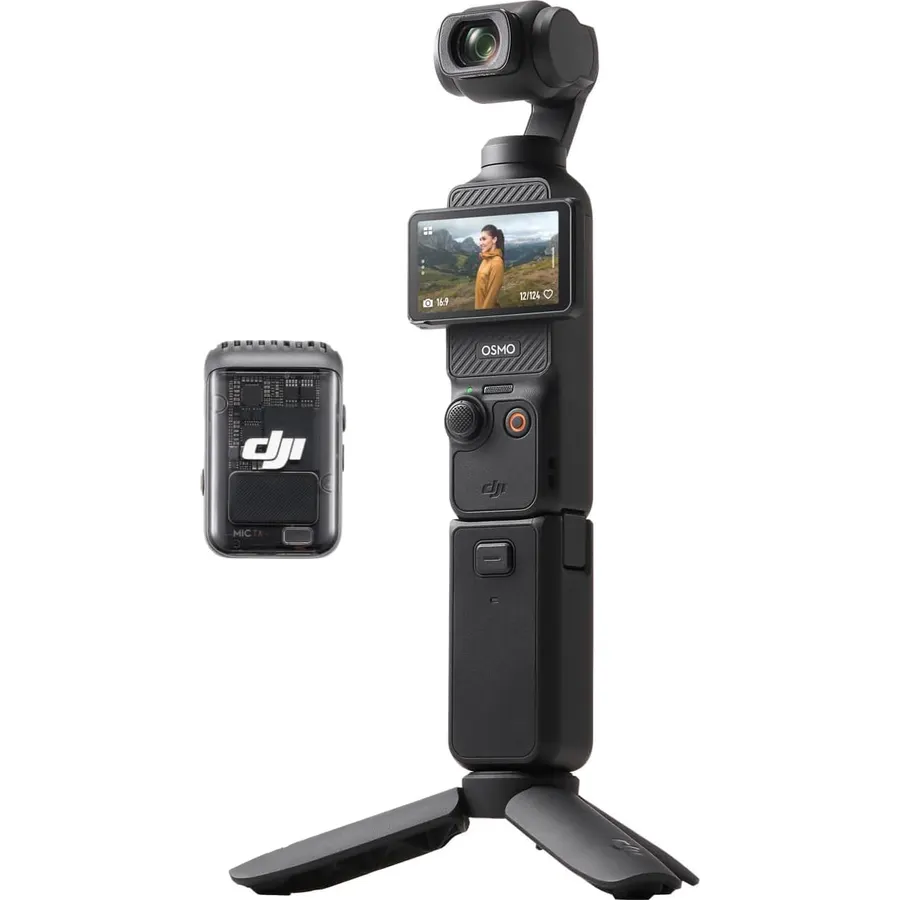
The Xtra Muse is not an action camera, and we list it because a lot of people shopping for one actually want this: a pocket camera on a mechanical three-axis gimbal that makes walking footage look like it was shot on a slider. Its 1-inch sensor is bigger than the DJI Action 6’s, it records 4K up to 120 frames per second in 10-bit X-Log, its 2-inch screen flips for vertical video, and face tracking keeps you in the middle of the frame while you move. It is the camera for city vlogs, travel diaries and talking to the lens while walking. It is not sealed and it is not rugged, so it stays out of the sea and off the handlebars. About 10,500 owners rate it 4.5 stars, the second-best score on the page.
- A 1-inch sensor, larger than any action camera here
- Mechanical gimbal is smoother than any electronic stabilization
- Face tracking follows you on a tripod
- 4.5 stars from about 10,500 owners
- Not waterproof and not built for impact
- Gimbal is delicate; keep it in the bag
- A vlogging tool, not a helmet camera
Insta360 Luna Ultra - 8K Vlogging Camera with Dual Leica Lenses, 12x Zoom, Detachable Touchscreen, Triple AI Chip, Pocket Gimbal Camera for Vlog Photography-Cosmic Black
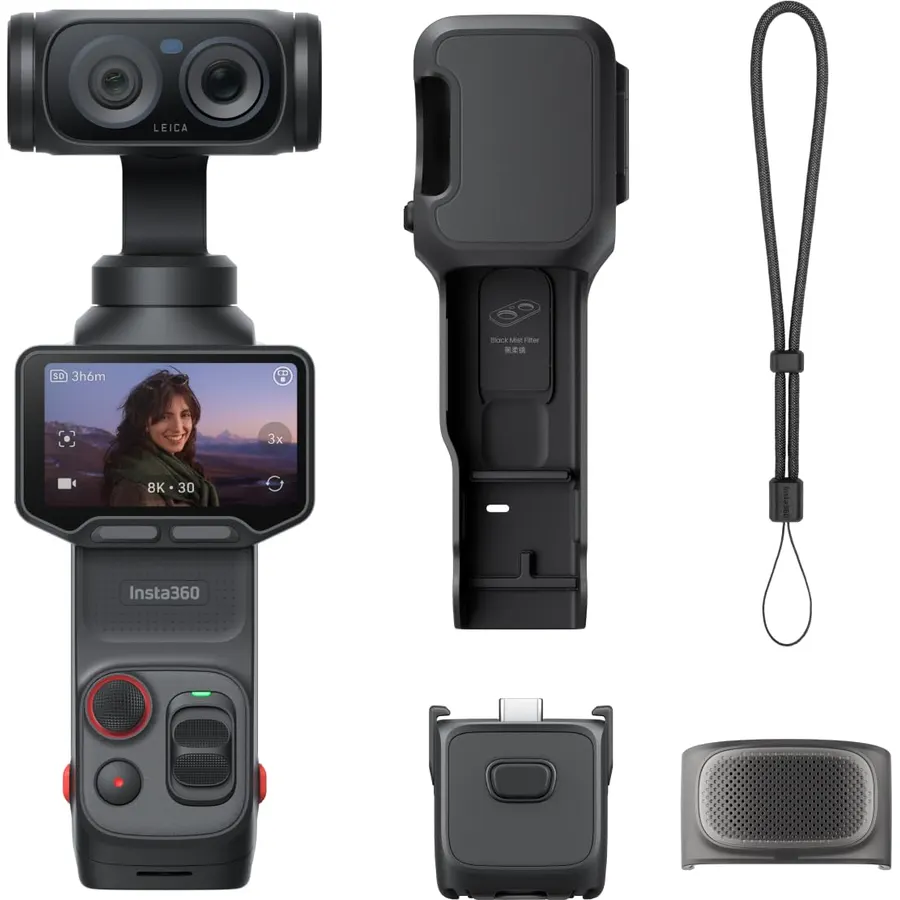
The Luna Ultra is the pocket gimbal camera for people who have outgrown the Xtra Muse. It carries two Leica lenses, a 1-inch main sensor and a 1/1.3-inch telephoto with an f/2.0 aperture, so it can zoom 6x without loss and blur a background optically rather than in software. Video is 8K at 30 frames per second with Dolby Vision and about 14 stops of dynamic range, the gimbal is mechanical, and the 2-inch OLED screen detaches to work as a remote up to 20 metres away, which solves the problem of filming yourself from a distance. It is the newest and dearest camera here, with about 630 owners rating it 4.3 stars, and like the Xtra Muse it is not waterproof or rugged. It ranks last on review history and price, not on capability.
- Two Leica lenses with a real telephoto and optical bokeh
- 8K Dolby Vision and 14 stops of range
- Detachable screen doubles as a remote
- Insta360 app and support
- The most expensive camera on the page by a wide margin
- About 630 reviews so far, at 4.3 stars
- Not waterproof; a studio-grade pocket camera, not an action camera
Compare the picks
| Product | Sensor and video | Stabilization | Waterproof | Battery | Owner rating | Our score | |
|---|---|---|---|---|---|---|---|
| DJI Osmo Action 4DJI | 1/1.3-inch, 4K 120 fps, 10-bit | Electronic, HorizonSteady | 18 m, no case | About 150 min, -20 C | 4.7 (2,300+) | 9.4 | See price |
| AKASO EK7000AKASO | Small sensor, 4K 30 fps | Basic electronic | 40 m in case | Two batteries in box | 4.4 (40,000+) | 8.8 | See price |
| DJI Osmo Action 6DJI | 1/1.1-inch square, 8K, f/2 to f/4 | RockSteady 3.0, 360 horizon | Waterproof, depth not stated | About 4 hours | 4.5 (2,200+) | 9.0 | See price |
| AKASO Brave 4AKASO | Small sensor, 4K 30 fps, dual screens | Gyro electronic | 40 m in case | Two 90-min batteries | 4.4 (17,400+) | 8.8 | See price |
| Xtra MuseXtra Edge | 1-inch, 4K 120 fps, 10-bit | Mechanical 3-axis gimbal | None | Built in | 4.5 (10,500+) | 9.0 | See price |
| Insta360 Luna UltraInsta360 | 1-inch + telephoto, 8K Dolby Vision | Mechanical gimbal | None | Built in | 4.3 (630+) | 8.6 | See price |
Sensor size beats resolution
Every camera here says 4K or 8K on the box, and the number that actually predicts how the footage looks is the sensor behind it. The AKASO cameras use the small sensors that let them cost what they do, and their 4K is sharp in sunshine and soft the moment the light drops. The DJI Action 4’s 1/1.3-inch sensor and the Action 6’s 1/1.1-inch square sensor are several times larger, which is why owners describe their evening and indoor footage as clean; the pocket gimbals go larger still at 1 inch. Frame rate matters for sport: 4K at 120 frames per second on the DJI and the Xtra Muse gives four-times slow motion, where the AKASO cameras manage 4K only at 30. If you mostly shoot midday and want a camera you will not mind losing, the small sensor is fine; if you shoot anything after four in the afternoon, it is not.
Stabilization, waterproofing and the cold
Electronic stabilization crops the frame and shifts it to cancel shake; the DJI versions are good enough to make a mountain-bike run watchable and the AKASO versions are good enough for a walk or a kayak. A mechanical gimbal, as on the Xtra Muse and Luna Ultra, physically moves the lens and is smoother than any electronic system, at the cost of a fragile mechanism and no weather sealing. On water, read the fine print: the DJI Action 4 is sealed to 18 metres on its own, the AKASO cameras are sealed only inside their cases, and the pocket gimbals are not sealed at all. Cold is the other killer; DJI rates its batteries to minus 20 Celsius, and that, more than resolution, is why skiers and winter cyclists pay the difference.
Batteries, mounts and audio
The AKASO cameras ship with two batteries, which is generous, but each lasts about 90 minutes and the cameras do not record while charging as cleanly as the DJI. The Action 4 runs about 150 minutes and the Action 6 about four hours on a charge, both with swappable packs. DJI’s magnetic quick-release mount is a genuine reason to choose the brand if you move the camera between a helmet, a chest and a bike several times a day; the AKASO cameras use the standard three-prong mounts in their kits, which work but take longer. On audio, the EK7000 takes an external mic through its port, the Action 6 pairs two DJI wireless transmitters directly, and the pocket gimbals rely on built-in microphones that are good enough for a quiet street. No GoPro or Insta360 X-series cameras were in our catalog when we wrote this; both are worth a look if you see a good price.
Is the DJI Osmo Action 4 still worth buying now that the Action 6 exists?
Yes. It has the better owner rating, 4.7 against 4.5, is waterproof to 18 metres without a case, and costs roughly half. The Action 6 adds 8K, a variable aperture, a square sensor and four hours of battery, which matter for creators more than for sport.
Are cheap AKASO action cameras any good?
For daylight, holidays and children, yes: about 40,000 owners rate the EK7000 4.4 stars and 17,400 rate the Brave 4 the same. They have small sensors, 4K at 30 fps only and basic stabilization, so they fall behind the DJI cameras in low light and on rough ground.
Can I use an action camera for vlogging?
You can, and the DJI Action 6 and the Brave 4 have front screens for it. But if the vlog is you walking and talking rather than sport, a pocket gimbal such as the Xtra Muse or Insta360 Luna Ultra gives smoother footage, a larger sensor and face tracking.
Which action camera is waterproof without a case?
The DJI Osmo Action 4 to 18 metres. The AKASO EK7000 and Brave 4 are waterproof only inside their included cases, to about 40 metres. The Xtra Muse and Luna Ultra are not waterproof.
Do I need 8K on an action camera?
Rarely. 8K files are large and need a fast card and computer, and most footage ends up at 4K or 1080p. The value of the 8K cameras here is the larger sensor and the ability to crop or reframe, not the delivery resolution.
Prices and stock change daily. The buttons above open Amazon so you always see the current price. We may earn a commission if you buy through them, at no extra cost to you.
Do Best Deal is a participant in the Amazon Services LLC Associates Program. As an Amazon Associate we earn from qualifying purchases. If you buy through links on this site we may earn a commission, at no extra cost to you. Learn more.