The portable generator most people buy in 2026 does not burn anything. A battery power station, often sold as a solar generator because it recharges from a folding panel, gives you wall outlets, USB-C and a car port anywhere with no fumes, no noise and no fuel to store, which is why it has replaced the small gas generator for camping, tailgating, van life and keeping a fridge or a CPAP running through an outage. We ranked the power stations in our garden and outdoor catalog by capacity in watt-hours, continuous and surge output in watts, battery chemistry and rated cycle life, recharge speed from the wall and from solar, ports and weight, and what thousands of owners report after months of use.
We have not run every one of these flat ourselves; the verdicts rest on the spec sheets and on the owner review history. Prices are not printed because they change daily; every button opens the live Amazon page. For the car, our portable jump starters guide covers the small lithium packs that start an engine, and the charging stations for multiple devices guide covers the desk. Do Best Deal ranks by the mix of review volume, rating and fit for the job.
How we picked
- Capacity and output stated separately. Watt-hours decide how long it runs; watts decide what it can run. Every pick lists both plus the surge figure.
- Battery chemistry matters. We favor LiFePO4 (LFP) cells, rated for 3,000 to 10,000 cycles, over older lithium-ion packs rated for a few hundred; the picks that use the older chemistry are cheaper and marked.
- Pure sine wave AC on every pick, so laptops, CPAP machines and motors run cleanly.
- Recharge options. Wall, car and solar input on all eight; we note the fast-charge figures where a maker states them.
- Owner feedback across at least a few hundred reviews, most in the thousands, with a rating of 4.2 or better.
The picks
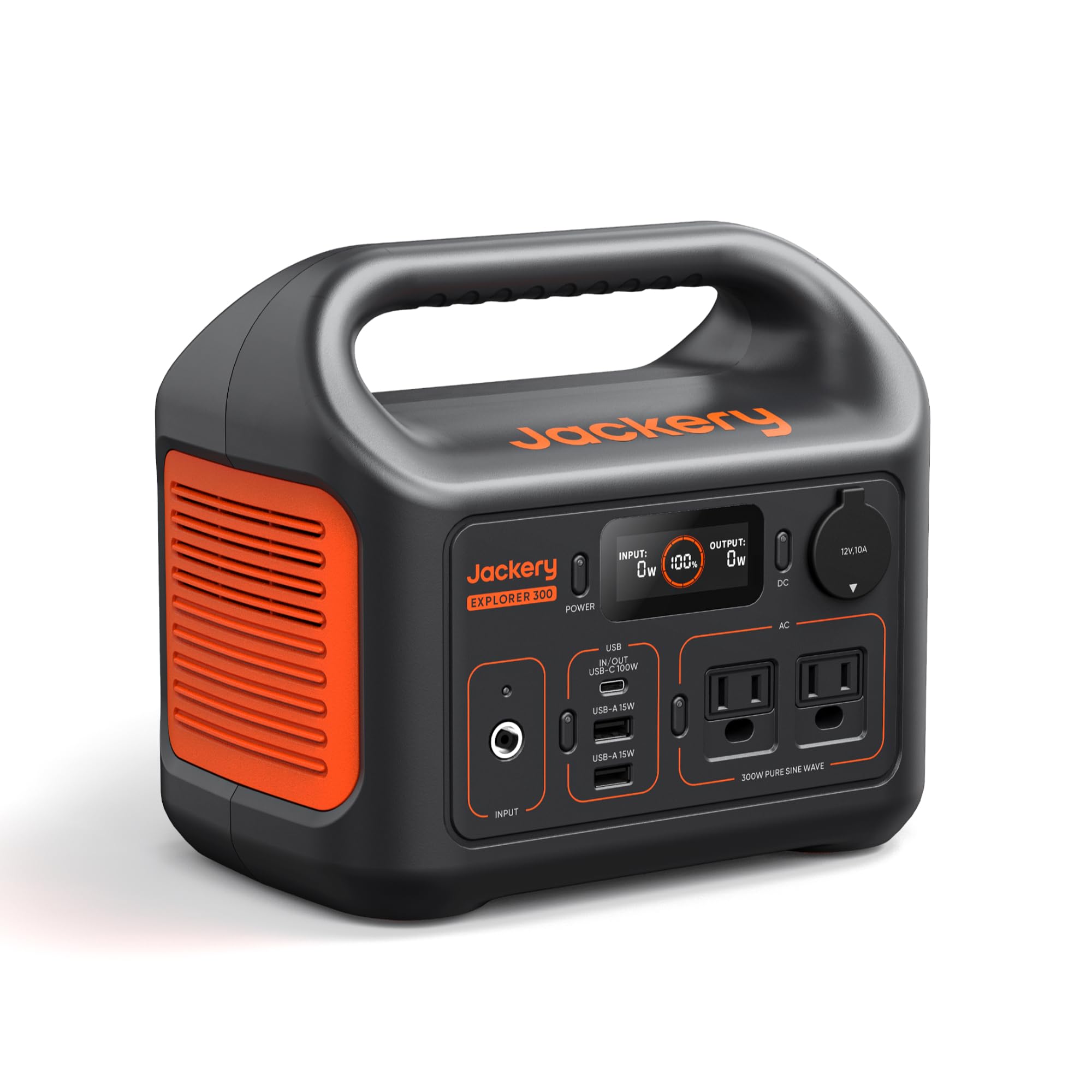
The Explorer 300 is the power station to buy for camping, a van weekend or a short outage, and tens of thousands of owners rating it excellent make it the safest buy on this page. The current version uses LiFePO4 cells, which Jackery rates for more than 4,000 full cycles before capacity drops to 70 percent, so it will outlast the laptops it charges. At 7.5 pounds with an integrated handle it is genuinely portable, and the port mix is right: two AC outlets, a 100W USB-C that charges a laptop at full speed, two USB-A and a 120W car port, six devices at once. From a 100W Jackery panel it reaches 80 percent in about 2.8 hours. The limits are plain: 300 watts will not run anything with a heating element, and 292Wh is a few laptop charges and a night of lights, not a refrigerator. For that, keep reading.
- Tens of thousands of owner reviews, with an excellent owner rating, the most-trusted power station here
- Upgraded to LiFePO4 for an 11-year rated service life
- 7.5 pounds, 17 percent lighter than the category average
- 100W USB-C charges a laptop at full speed
- 300W output will not run a kettle, a heater or most kitchen appliances
- 292Wh is a weekend of phones and lights, not a fridge
- Solar panel sold separately
Jackery Explorer 1000 v2 Portable Power Station,1070Wh,1500W

The Explorer 1000 v2 is where a power station becomes a backup for the house. With 1,070Wh and 1,500 watts of continuous output, 3,000 surge, it runs a refrigerator for a day, an electric pot, a small air conditioner or a CPAP for many nights, and it recharges from empty to full in one hour when emergency charging is switched on in the Jackery app, or 1.7 hours by default to preserve the battery. The LFP cells keep over 70 percent capacity after 4,000 cycles, a ten-year life. Three AC outlets, two USB-C, a USB-A, a car port and a built-in light cover most needs, and the app adds a 30 dB quiet charging mode for overnight. Thousands of owner reviews give it an excellent owner rating. At 23.8 pounds it is a carry, not a pack, and the price is about two Explorer 300s.
- Runs a fridge, electric pots and small AC units on 1,500W
- One-hour full recharge is the fastest here
- LFP cells rated for a 10-year lifespan
- App control with a 30 dB quiet overnight charging mode
- Roughly twice the price of the Explorer 300
- Nearly 24 pounds; a two-hand carry
- One-hour charging must be enabled in the app each time
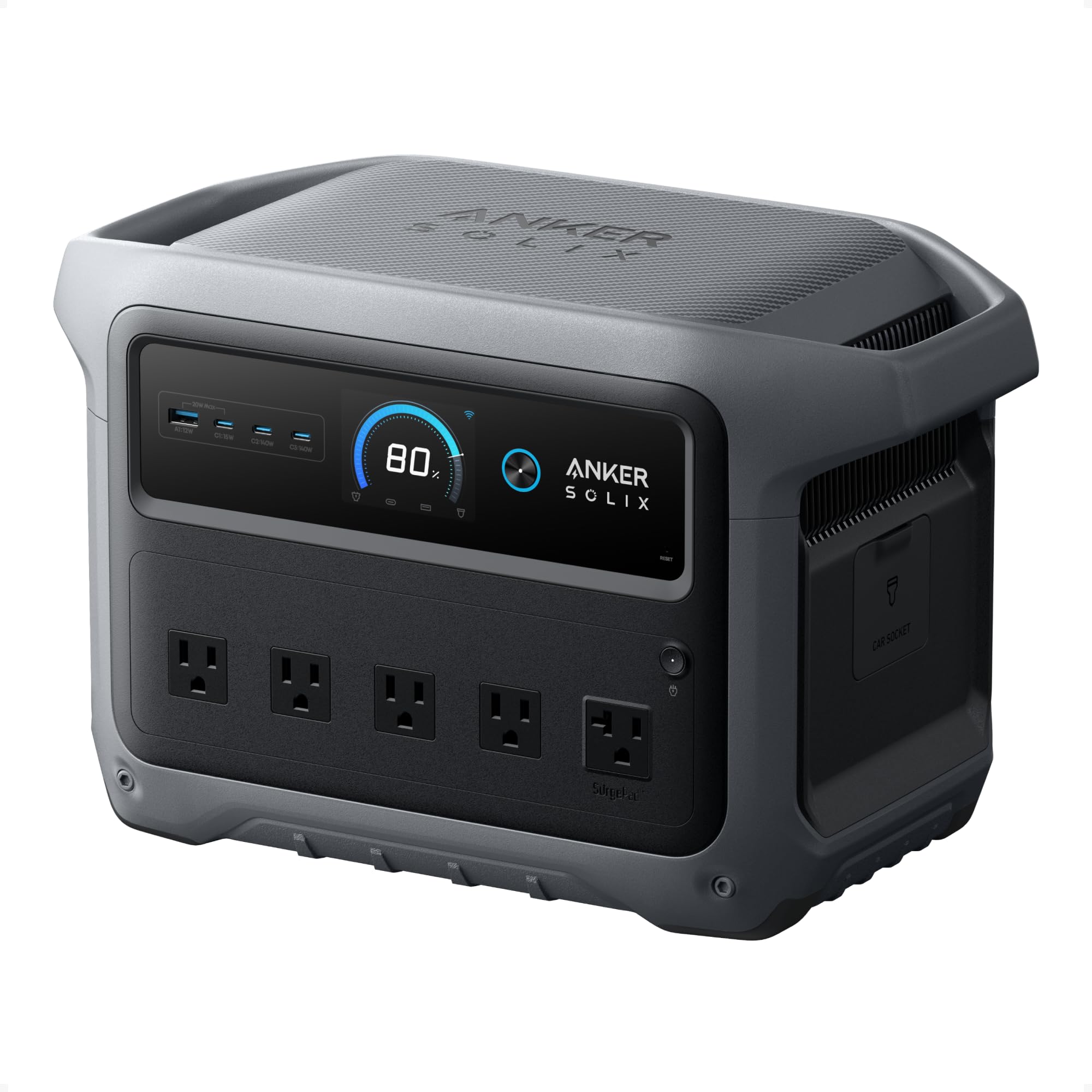
The Anker SOLIX C1000 Gen 2 is the Jackery 1000 v2 rival that charges faster and pushes more power. It delivers 2,000 watts continuous and 3,000 peak from 1,024Wh of LiFePO4 cells rated to keep at least 80 percent capacity after 4,000 cycles, and with HyperFlash enabled in the app it refills from a wall outlet in 49 minutes. Plug in up to 600 watts of solar and it recharges in 1.8 hours, which is the best solar figure on the page. The under-10-millisecond UPS switchover means a CPAP, router or desktop plugged into it stays on when the grid blinks. Ten ports, and a body Anker says is 14 percent smaller and 11 percent lighter than comparable models. Thousands of owner reviews give it an excellent owner rating; the critical ones mention fan noise under heavy load.
- 2,000W output is the highest here below the S2000
- 49-minute recharge from the wall
- True UPS mode keeps a CPAP or router up through a blink
- 600W solar input recharges in under two hours
- Fewer reviews than the Jackery Explorer 300
- Fastest charging needs the Anker app enabled
- Fan is audible under heavy load, per owners
ALLWEI Portable Power Station 300W, 256Wh Solar Generator LiFePO4 Battery
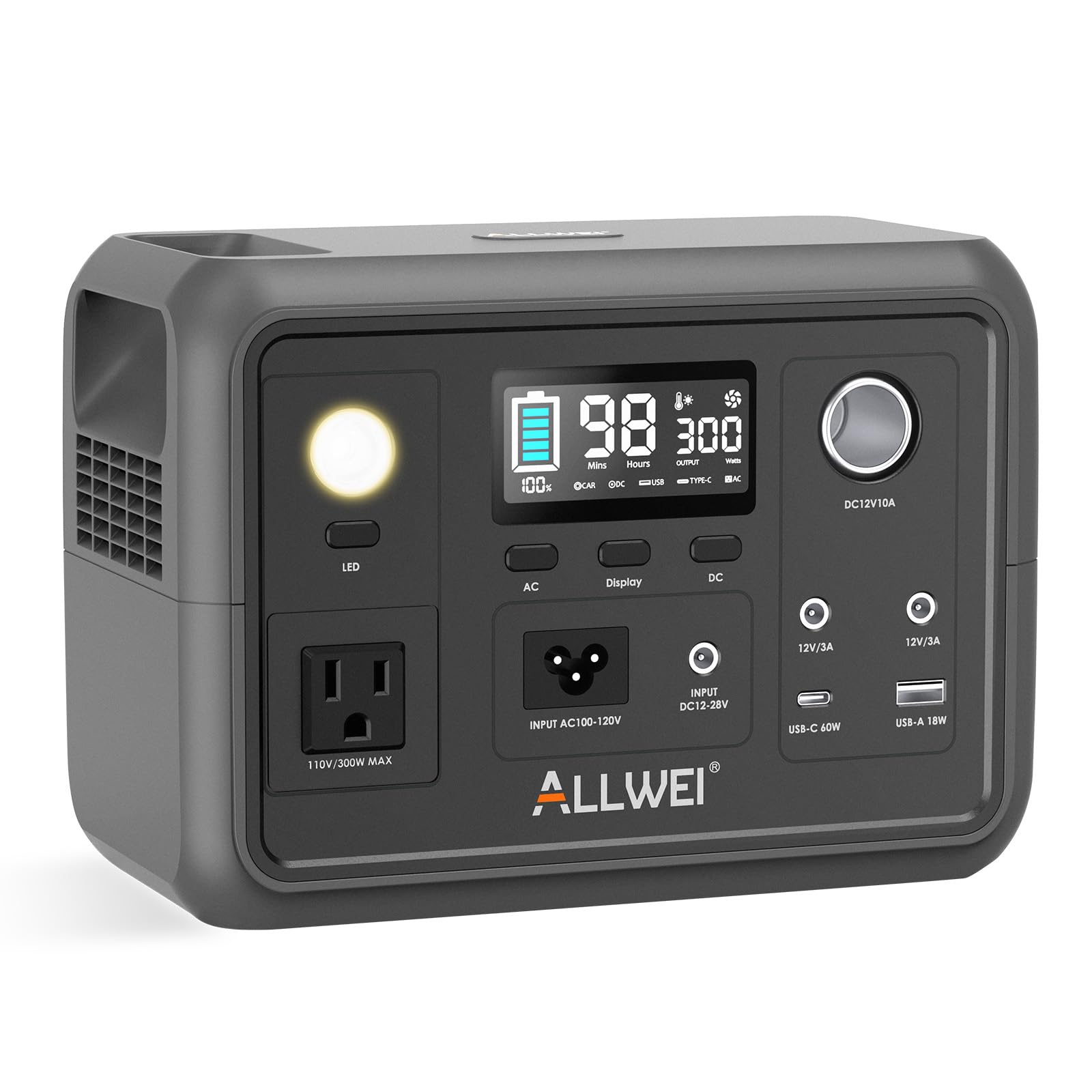
The ALLWEI 300W is the budget pick for people who understand that battery chemistry is the spec that matters most on a cheap power station. It uses LiFePO4 cells rated for 3,000 charge cycles, nearly a decade of regular use, where most stations at its price use older lithium-ion packs rated for a few hundred. Output is 300 watts continuous and 600 peak from a pure sine wave inverter, there is a 60W USB-C, an 18W USB-A, two DC barrel ports and a car port, and it recharges from the wall or a car in about four hours, from a 100W panel in four to five, or faster with wall and solar together. At 6.4 pounds it is the lightest serious pick here, and the three-level light has an SOS mode. Thousands of owner reviews give it a strong owner rating. The single AC outlet is the main compromise.
- LiFePO4 cells at a budget price, 3,000 cycles rated
- Lightest full-feature pick at 6.4 pounds
- Dual charging from wall and solar together
- Built-in 3-level LED light with SOS
- Only one AC outlet
- 60W USB-C is slower than the Jackery 100W
- Solar panel sold separately
GRECELL Portable Power Station 500W, 519Wh/140400mAh Solar Generator Backup Lithium Battery Pack Power Supply with 2 AC Outlets, PD 60W USB-C Power bank for Outdoor RV Camping Home Outage Emergency
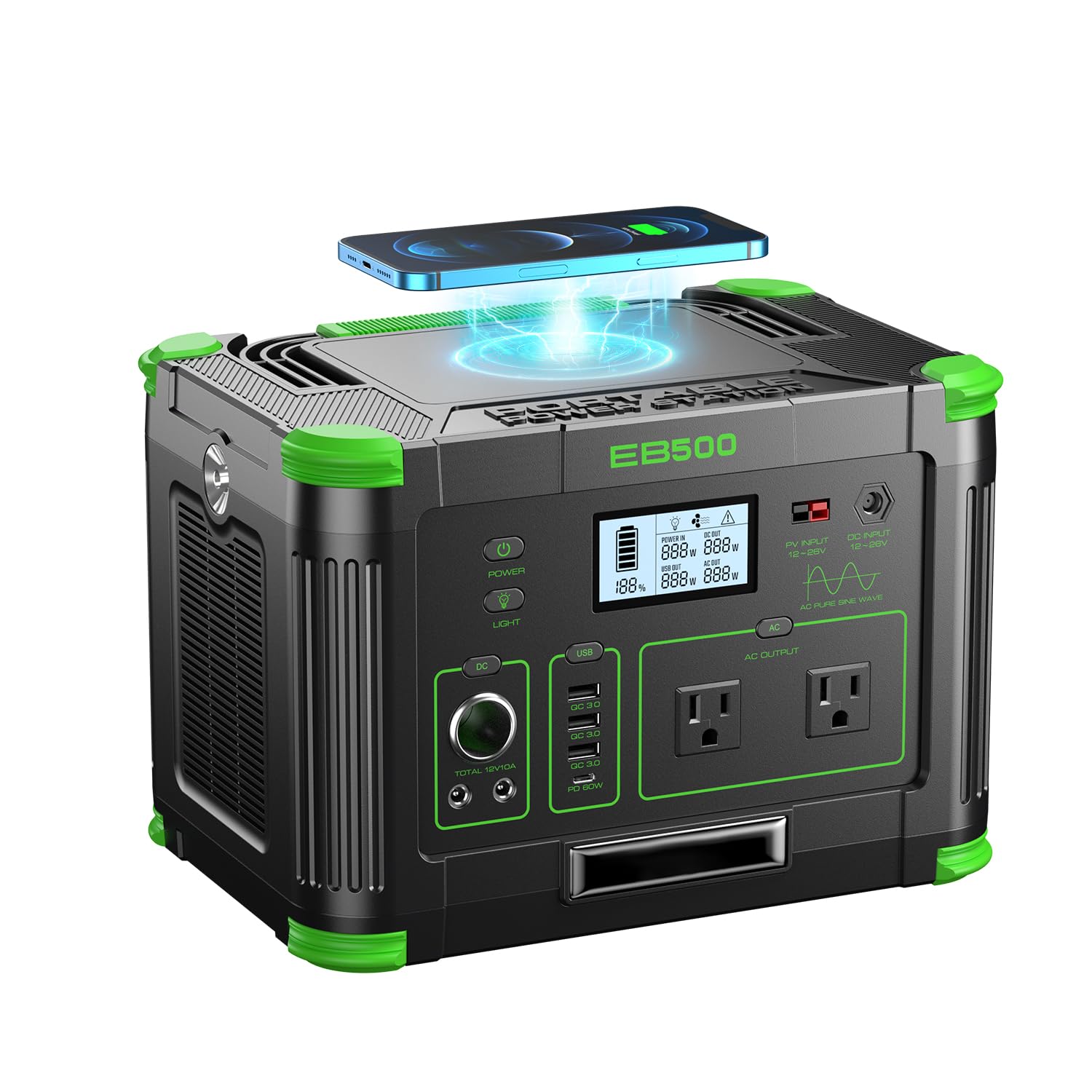
The GRECELL 500W is the most watt-hours per dollar on this page: 519Wh and 500 watts of pure sine wave output through two AC outlets, which is enough to run a 12-volt fridge, a TV, a projector, a small blender or a CPAP across a long weekend. Three QC3.0 USB-A ports, a 60W USB-C PD and the DC and car ports let it feed ten devices at once, and it refills from a 100W panel in six to nine hours of sun or from the wall. The compromise is the battery: it is a conventional lithium-ion pack with a battery management system rather than LiFePO4, so expect hundreds of cycles rather than thousands, and GRECELL is strict that loads must stay under 500 watts and solar input under 23 volts. Hundreds of owner reviews give it a strong owner rating.
- Over 500Wh and two AC outlets for less than the Explorer 300
- Runs a car fridge, a TV, a projector or a CPAP for a long weekend
- Ten devices at once
- 60W USB-C PD
- Lithium-ion, not LiFePO4, so fewer rated cycles
- Hundreds of reviews, the smallest base of the mid-size picks
- Strict 500W ceiling with no stated surge
Portable Solar Generator 300W Portable Power Station with 60W Solar Panel

The ZeroKor kit is for the buyer who wants a solar generator that is actually solar on day one. It bundles a 300W power station with two AC outlets, a DC port and four USB ports with a 60W folding monocrystalline panel rated at 20.5 percent efficiency, and the station has a built-in MPPT controller so it extracts what the small panel can give. The panel also has its own USB-A and USB-C outputs for charging a phone directly. A full battery management system guards against shorts, overloads and overheating, and there is a flashlight with reading and SOS modes. Thousands of owner reviews give it a strong owner rating. Be realistic: 60 watts of panel refills the station over most of a sunny day, the listing does not state cycle life or exact watt-hours, and ZeroKor warns that anything over 300 watts, such as a coffee maker, can damage it.
- The only pick that ships with a solar panel
- Built-in MPPT makes the most of the 60W panel
- Panel has its own USB-A and USB-C to charge phones directly
- Thousands of owner reviews
- 60W panel means a full recharge takes most of a sunny day
- Battery chemistry and watt-hours are not clearly stated
- Loads over 300W can damage it, per the listing
Portable Power Station 200W, FF Flashfish 40800mAh Backup Power Battery Pack With 110V AC Outlets/2 DC Ports/3 USB Ports, Solar Generator Power Supply For Home Backup, Power Outages, and Camping

The Flashfish 200W is the power station to buy when the job is phones, a camera, a tablet, a fan or a CPAP for a night or two, and nothing bigger. It packs 151Wh into about four pounds, with a 200W AC outlet, two DC ports for CPAP and 12-volt gear, two QC3.0 USB ports and a standard USB, and an LCD that shows remaining charge and what is drawing power, with separate AC and DC buttons so the inverter is not wasting energy when you only need USB. It refills from the wall in about four hours, from a car in five, or from Flashfish’s 60W panel in five to six. Thousands of owner reviews give it a strong owner rating. It is a lithium-ion pack rather than LiFePO4, and 151Wh runs out fast with a laptop, which is why it sits below the ALLWEI despite costing less.
- Thousands of owner reviews, with a strong owner rating, for the price of a good power bank
- Four pounds; fits a glove box or a daypack
- AC outlet plus DC ports runs a CPAP for a night or two
- Clear LCD and separate AC and DC switches
- 151Wh is small; a laptop gets two or three charges
- 200W limit rules out most appliances
- Older lithium-ion chemistry
Anker SOLIX S2000 Portable Power Station, 2,010Wh, 1,500W
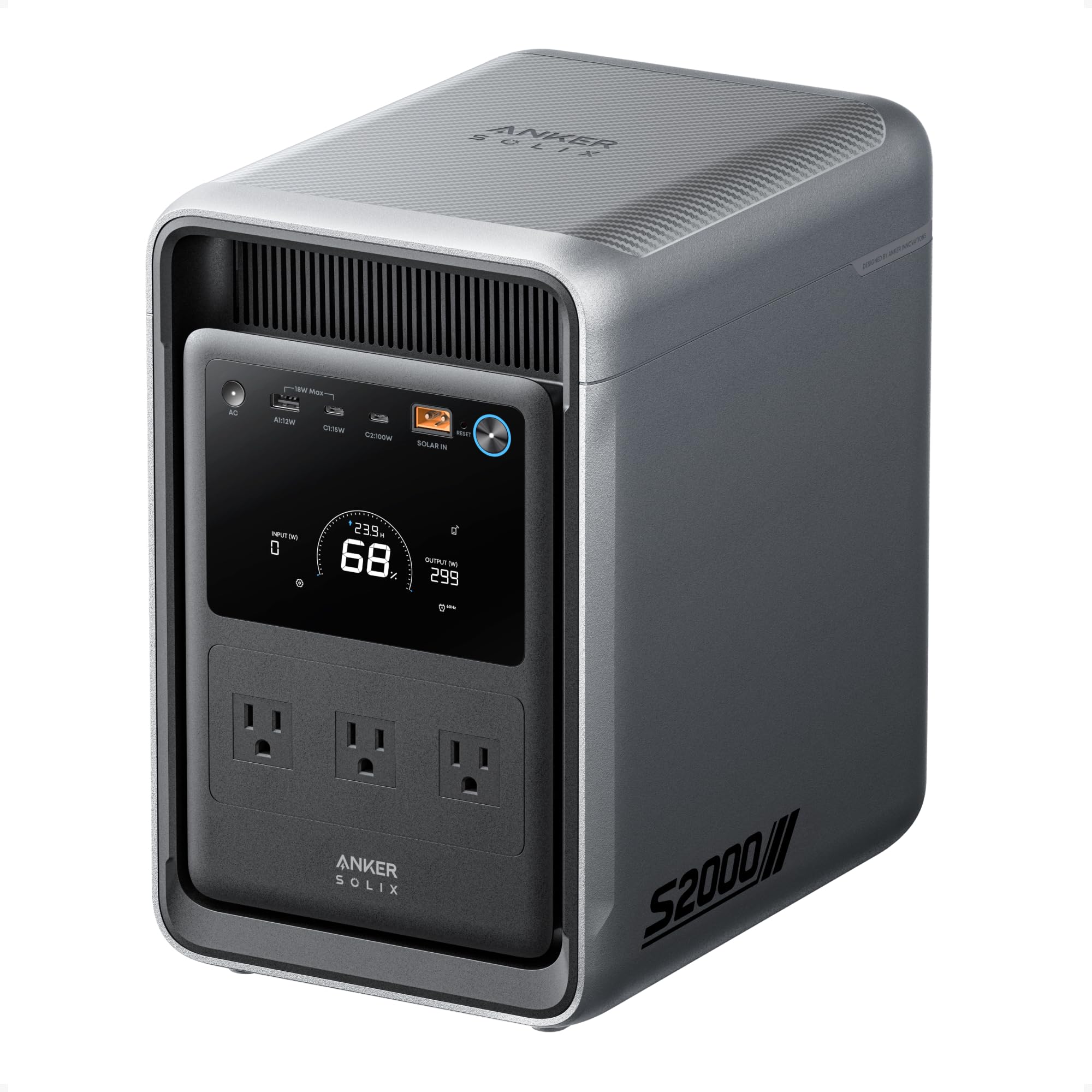
The SOLIX S2000 is for the household that wants the fridge, the freezer and the Wi-Fi to stay up through a multi-day outage. It carries 2,010Wh of LFP cells rated for 10,000 cycles, a 15-year life, with 1,500 watts of continuous output and 3,000 peak through eight AC outlets, four in front for everyday devices and four in the rear for always-on appliances. Anker claims up to 35 hours of refrigerator backup thanks to a 6-watt idle draw and 10 percent higher efficiency, and says it is 30 percent smaller and 25 percent lighter than the average 2kWh unit, at 35.7 pounds. It recharges six ways, including 400 watts of solar and an alternator charger. Hundreds of owner reviews give it an excellent owner rating so far. It is the priciest pick by a distance and, unusually, has no 12-volt car port.
- 2kWh and a 35-hour fridge runtime claim
- 10,000-cycle LFP cells, the longest-rated battery here
- Smallest and lightest 2kWh station per Anker, at 35.7 pounds
- Eight AC outlets split front and rear for a tidy setup
- Most expensive pick by a wide margin
- No 12V DC car port at all
- Hundreds of reviews so far; newer model
Compare the picks
| Product | Capacity | Output | Battery | Weight | Our score | Our score | |
|---|---|---|---|---|---|---|---|
| Jackery Explorer 300Jackery | 292Wh | 300W / 600W surge | LiFePO4, 4,000+ cycles | 7.5 lb | 9.2/10 | 9.2 | See price |
| Jackery Explorer 1000 v2Jackery | 1,070Wh | 1,500W / 3,000W | LFP, 4,000 cycles | 23.8 lb | 9.4/10 | 9.4 | See price |
| Anker SOLIX C1000 Gen 2Anker | 1,024Wh | 2,000W / 3,000W | LiFePO4, 4,000 cycles | Not stated | 9.4/10 | 9.4 | See price |
| ALLWEI 300WALLWEI | 256Wh | 300W / 600W | LiFePO4, 3,000 cycles | 6.4 lb | 8.8/10 | 8.8 | See price |
| GRECELL 500WGRECELL | 519Wh | 500W | Lithium-ion | Not stated | 8.9/10 | 8.9 | See price |
| ZeroKor 300W + 60W panelZeroKor | Not stated | 300W | Not stated | Not stated | 8.4/10 | 8.4 | See price |
| Flashfish 200WFF FLASHFISH | 151Wh | 200W | Lithium-ion | About 4 lb | 8.4/10 | 8.4 | See price |
| Anker SOLIX S2000Anker | 2,010Wh | 1,500W / 3,000W | LFP, 10,000 cycles | 35.7 lb | 9.3/10 | 9.3 | See price |
Watt-hours and watts: sizing the station
Watt-hours tell you how long. A phone holds about 15Wh, a laptop 50 to 70Wh, a CPAP without a humidifier draws 30 to 60 watts an hour, and a modern fridge averages 100 to 150 watts across a day. So a 292Wh Explorer 300 is a weekend of phones, lights and a laptop; a 1,000Wh class unit runs a fridge for a day or a CPAP for a week; the 2kWh S2000 runs a fridge for the better part of two days. Watts tell you what. Anything with a heating element, a kettle, a space heater, a coffee maker, a hair dryer, needs 1,000 to 1,500 watts and will trip or damage a 300W station, which is why the Jackery 1000 v2, Anker C1000 and S2000 exist. Check the surge figure too, since fridges and pumps draw two to three times their running wattage for a second at startup.
LiFePO4 or lithium-ion
Two chemistries appear on this page. LiFePO4, also written LFP, is heavier per watt-hour but rated for 3,000 to 10,000 full cycles and is more tolerant of heat; the Jackery, Anker and ALLWEI picks use it. Older lithium-ion packs, used in the GRECELL, Flashfish and most budget stations, are lighter and cheaper but typically rated for 500 to 800 cycles before capacity drops noticeably. For a station that sits on a shelf for outages, cycle life matters less than price; for one used every weekend or as daily solar storage, LiFePO4 pays for itself. Whatever the chemistry, store it at 50 to 80 percent, top it up every three months, and keep it out of a hot car.
Charging from solar, the wall and the car
Every pick recharges from a wall outlet, a 12-volt car socket and a solar panel, but only the ZeroKor kit includes the panel. Solar refill times depend on the panel: a 60W panel refills a 300Wh station over most of a sunny day, a 100W panel does it in four to five hours, and the Anker C1000 accepts 600 watts of panels for a 1.8-hour refill. Wall charging is where the big brands pull ahead: the Jackery 1000 v2 fills in one hour and the Anker C1000 in 49 minutes, against four hours for the budget picks. If outages are your main use, a fast wall charge matters more than solar; if you camp off-grid for days, buy the panel and match its voltage to the station’s input range.
Is a battery power station really a generator?
Not in the gas sense, but it does the same job for most people: wall outlets, USB and a car port anywhere. It makes no noise or fumes, can run indoors, needs no fuel and recharges from the wall, a car or a solar panel. It cannot run indefinitely the way a gas generator with fuel can.
What size power station runs a refrigerator?
A 1,000Wh class unit with at least 1,500W output, like the Jackery Explorer 1000 v2 or Anker SOLIX C1000 Gen 2, runs a typical fridge for roughly a day. The Anker SOLIX S2000 at 2,010Wh claims up to 35 hours. The 300W picks cannot start a fridge compressor.
Can I run a CPAP on a portable power station?
Yes. Most CPAPs draw 30 to 60 watts without the humidifier, so even the 151Wh Flashfish manages a night or two and the Explorer 300 several nights. Use the DC cable for your machine where possible, since it avoids inverter losses; the Anker C1000 adds a UPS mode so the machine does not drop out if the grid blinks.
Do these come with a solar panel?
Only the ZeroKor 300W kit includes a 60W panel. Jackery, Anker, ALLWEI, GRECELL and Flashfish sell panels separately; match the panel voltage to the station input range listed by the maker, usually 12 to 30 volts.
How long do power station batteries last?
LiFePO4 units like the Jackery, Anker and ALLWEI picks are rated for 3,000 to 10,000 full cycles, a decade or more of regular use. Lithium-ion units like the GRECELL and Flashfish are typically rated for several hundred cycles. Storing at partial charge and away from heat extends either.
Prices and stock change daily. The buttons above open Amazon so you always see the current price. We may earn a commission if you buy through them, at no extra cost to you.
Do Best Deal is a participant in the Amazon Services LLC Associates Program. As an Amazon Associate we earn from qualifying purchases. If you buy through links on this site we may earn a commission, at no extra cost to you. Learn more.