A serger does one job your sewing machine cannot: it trims the seam allowance, wraps the raw edge in thread and sews the seam in a single pass, at twice the speed. That is how store-bought T-shirts, leggings and napkins get their clean insides, and it is why people who sew knits eventually buy one. We ranked the sergers and overlock machines in our crafts catalog by thread capability (2, 3, 4 or 5 threads), whether they have a differential feed that stops knits stretching and chiffon puckering, how painful the threading is, stitch speed, the frame material, the accessories in the box, and what hundreds to thousands of owners report after months of hemming.
We have not run fabric through every one of these ourselves; the verdicts rest on the spec sheets and on the owner review history, because Do Best Deal ranks on owner-review history and spec sheets, not samples. Prices are not printed because they change daily; every button opens the live Amazon page. If you do not yet own a regular machine, start with our sewing machines for beginners guide, and if you sew quilts, the sewing machines for quilting guide pairs well with a serger.
How we picked
- Differential feed on every pick. Without it a serger stretches knits into lettuce edges and puckers lightweight wovens; every machine here has an adjustable feed.
- Three or four threads at least. All eight do 3-4 thread overlock; the Singers add a 2-thread option and the 14T968DC adds a 5-thread safety stitch.
- Threading you can live with. Color-coded guides and numbered loopers are the minimum; lay-in tensions and looper threaders are noted where present.
- Owner history. Every pick has at least a few hundred owner reviews with a good rating, or a strong rating from a smaller but consistent base.
- Honest about the learning curve. Sergers are harder to thread than sewing machines, so the cons call out where owners struggled.
The picks
Brother ST4031HD Serger, Strong & Tough Serger, 1,300 Stitches Per Minute, Durable Metal Frame Overlock Machine, Large Extension Table, 3 Included Accessory Feet

The ST4031HD is the serger most home sewists should buy. It is part of the Brother Strong and Tough line, which means a metal frame rather than a plastic one and a blade made from extra-hard carbon steel, and owners report it chewing through multiple layers of denim and fleece without complaint. It sews 3 or 4 thread overlock at up to 1,300 stitches a minute, the color-coded thread paths and numbered loopers take most of the fear out of threading, and the differential feed keeps jersey flat. What makes it the value pick is the box: a blind stitch foot, a gathering foot and a large extension table come included, where Janome and Juki charge extra for each. Owners rate it strongly across hundreds of reviews. It skips the 2-thread and 5-thread modes, which few home sewists miss, and it is heavier than the budget Singers, which is the trade for the metal frame.
- Metal frame and a carbon steel blade built for denim and layered knits
- Three presser feet and an extension table in the box, which rivals sell separately
- Numbered loopers make the threading order obvious
- A strong owner rating across hundreds of reviews
- No 2-thread or 5-thread option
- Heavier than the plastic-bodied budget sergers
- Some owners report the knife needs careful adjustment on thick seams
Janome MOD-8933 Serger with Lay-In Threading, 3 and 4 Thread Convertible with Differential Feed

Janome built the MOD-8933 for what its listing calls the developing fashion enthusiast, which is a polite way of saying first-serger buyers. The tensions are lay-in rather than threaded through discs, the thread guides are color coded, and the lower looper, which is where every beginner gets stuck, slides forward on a pretension slider so you can reach it. It converts between 3 and 4 threads, switches to a rolled hem without changing plates, and has adjustable presser foot pressure as well as differential feed, so it handles chiffon and sweatshirt fleece alike. Several hundred owners give it a strong rating, and most of the praise is about getting a usable stitch within the first hour. It comes with fewer feet than the Brother and the body is lighter, so it is not the pick for daily upholstery-weight work, but as the first serger in a sewing room it is hard to beat.
- Lay-in threading is the easiest system on this page
- Pretension slider on the lower looper, the hardest thread to seat
- Quick-change rolled hem with no plate swap
- A strong owner rating across several hundred reviews
- Fewer accessories in the box than the Brother ST4031HD
- Lighter build than the metal-frame picks
- Manual is terse; owners lean on video tutorials
Juki, MO-50E, 3 or 4 Thread Serger, Lay In Tensions, Adjustable Differential Feed, Built In Rolled Hem, Automatic Lower Looper Threader, Retractable Upper Knife (MO-50E/UL)

Juki is the company whose overlockers sit in garment factories, and the MO-50E is its entry into home sewing rooms at a price close to the Janome. It has lay-in tensions, a built-in rolled hem, an adjustable calibrated knife you can retract to sew a decorative edge without trimming, and the feature that earns it a place here: an automatic lower looper threader, so the one thread that normally needs tweezers and patience seats itself. Three or four thread stitching and adjustable differential feed round out the spec. A few hundred owners rate it solidly, and the reviews read like a Juki machine: not pretty, not padded with accessories, but it runs and keeps running. If the Janome and Brother are sold out, or you simply want the brand that professionals use, this is the one.
- Automatic lower looper threader removes the worst threading step
- Juki industrial heritage; the brand builds factory overlockers
- Retractable upper knife for decorative edges without cutting
- A solid owner rating from a few hundred owners
- Plain styling and a basic accessory set
- Fewer owner reviews than the Singers and Brothers
- No extension table included
SINGER Professional 14T968DC Heavy-Duty Serger Overlock with Accessory Kit

The Singer Professional 5 is the serger for people who want everything in one machine: 2, 3 and 4 thread overlock plus a 5-thread safety stitch that sews a chain-stitch seam and an overlocked edge together, the construction method on jeans and workwear. Its tension is fully automatic and self-adjusting, so you move from denim to jersey without touching a dial, it runs at 1,300 stitches a minute, and the accessory kit includes a spare knife. It has well over a thousand owner reviews, the most of any serger here, and the rating is good rather than strong; the critical reviews cluster around threading the chain looper and on units that needed a timing adjustment out of the box. It costs about double the Janome and Juki. If you need the 5-thread stitch it is the only option on this page; if you do not, the Brother is the better buy.
- Only pick with a 5-thread safety stitch and chain stitch
- Self-adjusting tension, so no dial fiddling between fabrics
- The most-reviewed serger here, with well over a thousand owner reviews
- Extra knife and a proper accessory kit in the box
- A good rather than strong owner rating; threading the chain looper is the common complaint
- Costs about twice the Janome or Juki
- Heavy and large on a sewing table
SINGER S0100 High Speed Serger Overlock Machine, 2-3-4 Thread Capability
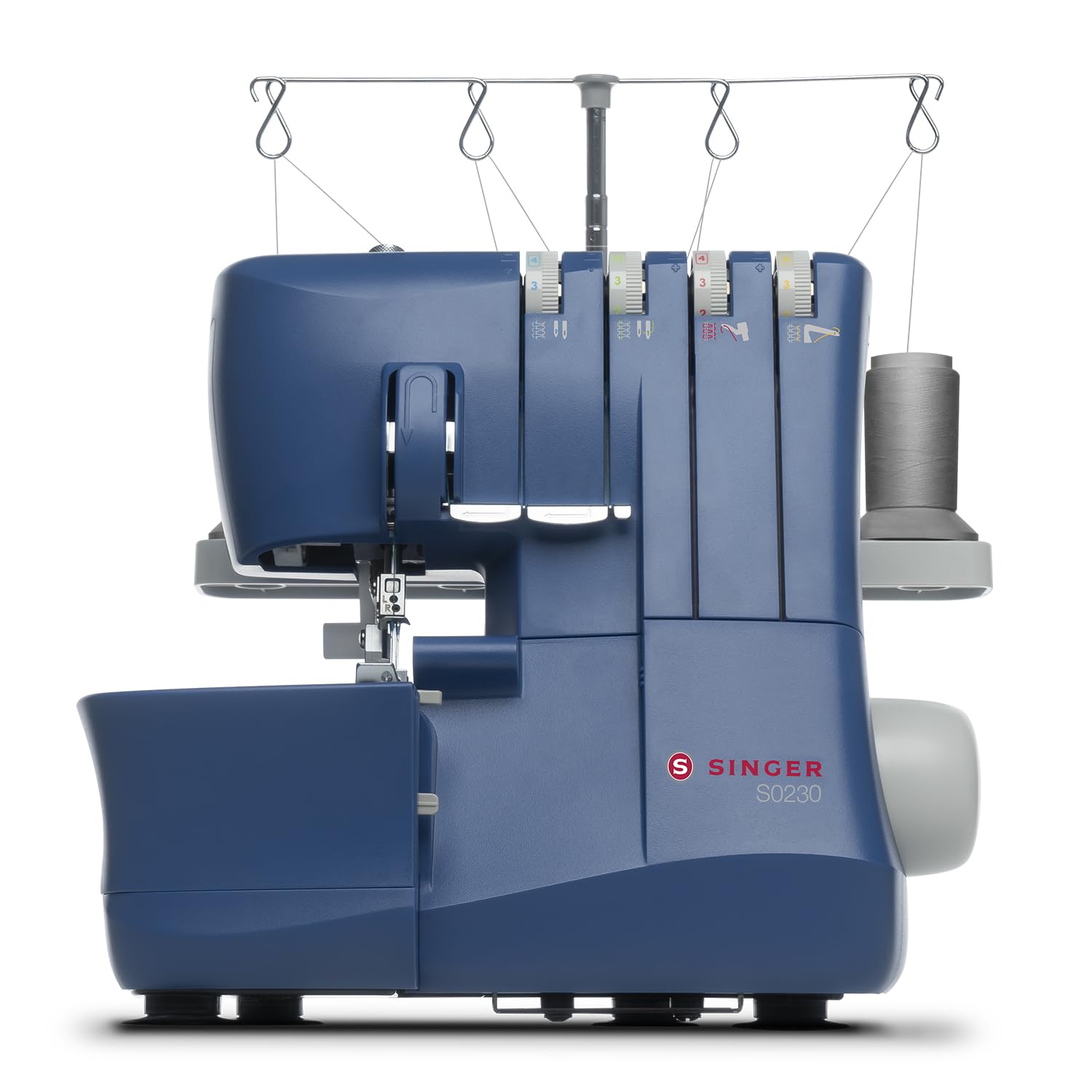
The S0100 is the budget route into serging and the second most-reviewed machine on this page. It does 2, 3 and 4 thread stitches, runs at the same 1,300 stitches a minute as machines costing twice as much, has adjustable differential feed, and comes pre-threaded with color-coded guides printed on the body so your first seam happens minutes after unboxing. Hundreds of owners rate it well, and the people who love it are hobby sewists making knit tops, napkins and pyjamas. The critical reviews are about the second threading, once the factory thread runs out, and about the light plastic body, which is fine for cotton and jersey and not for day-in, day-out canvas. For a first serger that you are not sure you will use every week, it is the sensible buy.
- Lowest price here for a 2-3-4 thread serger with differential feed
- Arrives pre-threaded so you can serge on day one
- Full 1,300 stitches per minute
- Hundreds of owner reviews with a good rating
- Plastic-bodied; not for daily heavy denim
- A good rather than strong rating; re-threading after the factory thread runs out trips up some owners
- Basic accessory set
SINGER S14-78 Serger Overlock Machine, 2-3-4 Stitch Capability, White

The S14-78 is the Singer to buy if you hem sleeves and trouser legs: slide off the extension table and a free arm appears, so you can serge round a cuff instead of fighting it flat. It does 2, 3 and 4 thread stitches, includes the 2-thread looper converter, and switches to rolled and narrow hem modes for scarves and table linens. Differential feed is standard. A few hundred owners rate it solidly, slightly above the S0100, and the reviews praise the free arm and the clean rolled hem. The complaints are the usual serger ones about threading, plus the fact that the slide-off cover is the only work surface, so a larger project wants a table behind it. Between the two budget Singers, pick this one if you sew garments and the S0100 if you mostly finish edges on home decor.
- Free arm for cuffs, sleeves and trouser hems, rare at this price
- Two-thread converter included for fine edges
- Rolled and narrow hem modes for napkins and scarves
- A solid owner rating from a few hundred owners
- Fewer reviews than the S0100
- Threading diagram is small; owners recommend a video
- No extension table beyond the slide-off cover

The 8002D is the Janome for people who want a plain, reliable machine and nothing clever. It sews 3 or 4 thread overlock at 1,300 stitches a minute, has an adjustable differential feed that keeps knits and lightweight cottons flat, and uses color-coded threading paths with clearly marked tension dials rather than the lay-in system on the MOD-8933. The mechanical design is the point: owners describe a machine that was set up once and has not drifted since. It has the best owner rating of any serger here, though from the smallest base, in the low hundreds, so we rank it below the better-proven Brother and MOD-8933. It is also the pricier of the two Janomes and comes with a basic accessory set. For a second serger, or for someone who already knows how to thread one, it is an easy recommendation.
- Highest owner rating on this page
- Simple mechanical design with little to go wrong
- Differential feed handles jersey and lightweight cotton
- Full 1,300 stitches per minute
- Fewest owner reviews here, in the low hundreds
- No lay-in tensions, unlike the MOD-8933
- Basic accessory set with no extension table

The 2340CV is here because the question comes up in every serger thread: how do I get the flat, two-row hem on the bottom of a store-bought T-shirt? The answer is a coverstitch machine, and this Brother is the one most home sewists buy. It sews wide and narrow cover stitches and a tri-cover with three needles, plus a chain stitch, on hems from 3 to 6 millimeters, at 1,100 stitches a minute, with a metal frame, color-coded lay-in threading and a hem foot in the box. Well over a thousand owners rate it solidly. Be clear about what it is not: it has no knife and does not overlock, so it sits beside a serger rather than replacing one. Owners say the learning curve is about tension on thick seams and finishing a row cleanly. If you sew knitwear to sell or simply want your hems to look bought, it is the final piece.
- The professional twin-needle hem on T-shirts and leggings
- Metal frame; well over a thousand owner reviews with a solid rating
- Lay-in threading and a fast looper system
- Hem foot included
- Does not overlock or trim; it is a second machine, not a replacement
- Costs more than most sergers here
- Chain-off and thread tension on thick seams take practice
Compare the picks
| Product | Threads | Speed | Threading | Frame | Our score | Our score | |
|---|---|---|---|---|---|---|---|
| Brother ST4031HDBrother | 3-4 | 1,300 spm | Color-coded, numbered loopers | Metal | 9.0/10 | 9.0 | See price |
| Janome MOD-8933Janome | 3-4 | Not stated | Lay-in, pretension slider | Standard | 9.0/10 | 9.0 | See price |
| Juki MO-50EJUKI | 3-4 | Not stated | Lay-in, auto lower looper | Standard | 8.8/10 | 8.8 | See price |
| Singer 14T968DCSINGER | 2-3-4-5 | 1,300 spm | Diagram, auto tension | Heavy duty | 8.4/10 | 8.4 | See price |
| Singer S0100SINGER | 2-3-4 | 1,300 spm | Color-coded, pre-threaded | Standard | 8.4/10 | 8.4 | See price |
| Singer S14-78SINGER | 2-3-4 | Not stated | Color-coded, free arm | Standard | 8.6/10 | 8.6 | See price |
| Janome 8002DJanome | 3-4 | 1,300 spm | Color-coded dials | Standard | 9.1/10 | 9.1 | See price |
| Brother 2340CV coverstitchBrother | Cover and chain | 1,100 spm | Lay-in | Metal | 8.6/10 | 8.6 | See price |
Serger, overlocker or coverstitch?
Serger and overlocker are the same machine; the first is the American word and the second the British one. Both trim the fabric edge with a knife and wrap it in two, three or four threads while sewing the seam. A coverstitch machine, like the Brother 2340CV, has no knife and sews the flat twin-needle hem you see on T-shirts; it cannot finish a raw edge. Combination machines that do both exist but cost far more and demand a full re-thread to switch modes, which is why most sewists who want both end up with two machines on the table.
How many threads do you need?
Four-thread overlock is the everyday seam for knits: two needles make a seam that stretches, and the loopers wrap the edge. Three-thread is for finishing edges on wovens before you sew them on a regular machine, and for rolled hems on napkins and scarves. Two-thread, on the Singers, makes a very fine edge on sheer fabric. The five-thread safety stitch on the Singer 14T968DC adds a chain-stitch seam next to the overlock, the construction you see inside jeans. For most people a 3-4 thread machine with differential feed, which is every serger here, covers everything they will sew.
Threading, the honest version
Every serger is harder to thread than a sewing machine, and the order matters: upper looper, lower looper, then needles, or the threads tangle. The picks that make it easiest are the Janome MOD-8933 with its lay-in tensions and pretension slider, and the Juki MO-50E with its automatic lower looper threader. The Brother and Singers rely on color-coded paths, which work once you have done it twice. The trick owners repeat most often is to never fully unthread: cut each thread near the spool, tie the new color on, and pull it through. If you want to avoid threading entirely, Brother and Juki sell air-threading sergers, but they cost two to three times what the machines here do.
Do I need a serger if I already have a sewing machine?
Not for wovens; a zigzag or overcast stitch finishes those edges. For knits and anything you sew often, a serger is faster, stretches with the fabric and looks like store-bought work inside. Most people who buy one say they should have done it sooner.
What does differential feed actually do?
The two sets of feed dogs move at different speeds. Set higher, the front set pushes fabric in faster so knits do not stretch into wavy edges; set lower, it pulls fabric taut so lightweight wovens do not pucker. Every serger here has it and it is the one feature not to skip.
Can a serger replace a coverstitch machine for hems?
No. A serger can finish the edge and you can then topstitch the hem with a twin needle on a regular machine, which looks similar. For the true flat cover hem with the looper thread on the inside you need a coverstitch machine such as the Brother 2340CV.
Which serger is best for heavy fabrics like denim?
The Brother ST4031HD, with its metal frame and carbon steel blade, and the Singer 14T968DC, which is built as a heavy-duty machine with a 5-thread safety stitch. The plastic-bodied budget Singers handle occasional denim but not daily use.
Do sergers use regular sewing thread?
They can, but they use a lot of it; most people buy serger cones, which hold thousands of yards and sit on the built-in cone holders. The Singer S0100 includes cone adapters so you can use regular spools until you buy cones.
Prices and stock change daily. The buttons above open Amazon so you always see the current price. We may earn a commission if you buy through them, at no extra cost to you.
Do Best Deal is a participant in the Amazon Services LLC Associates Program. As an Amazon Associate we earn from qualifying purchases. If you buy through links on this site we may earn a commission, at no extra cost to you. Learn more.
