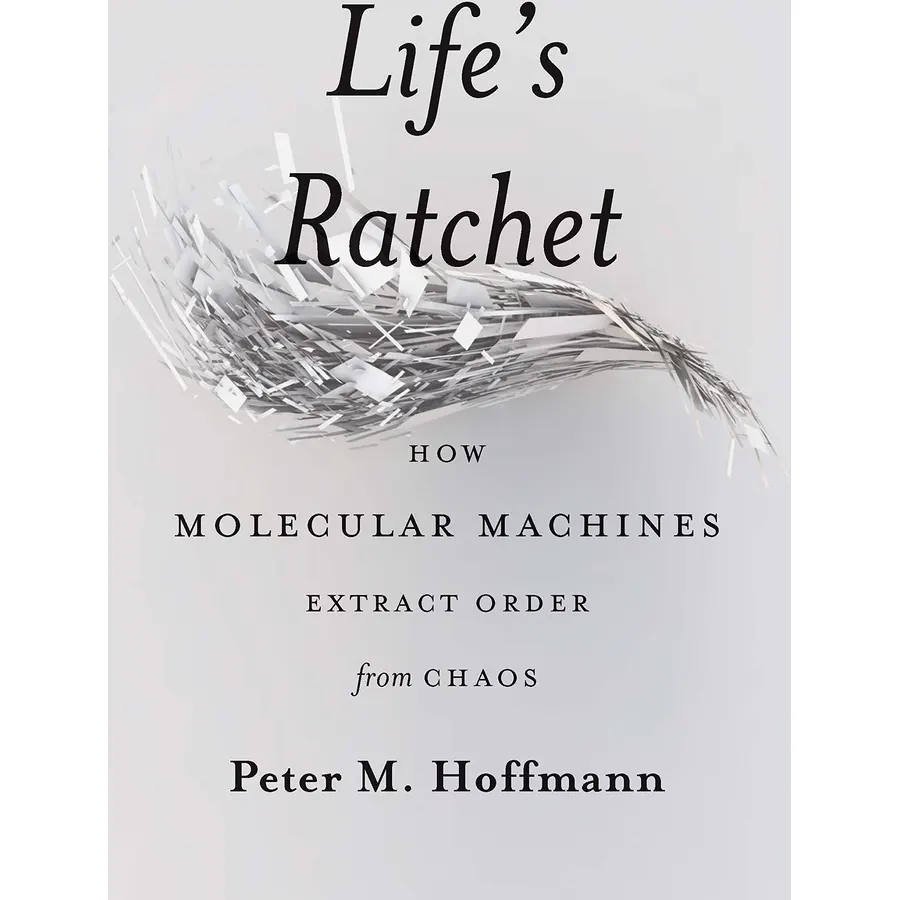
Quick answer The Life's Ratchet: How Molecular Machines Extract by by Peter M Hoffmann (Author) Format: Kindle Edition scores 9.0/10 with us. Amazon owners rate it 4.5 out of 5 across 292 reviews, in line with the 4.5 average of the 347 products we track in Books & Media.
Do Best Deal is a participant in the Amazon Services LLC Associates Program. As an Amazon Associate we earn from qualifying purchases. If you buy through links on this site we may earn a commission, at no extra cost to you. Learn more.
Product information
15 specifications
Publisher
Basic Books
Accessibility
Learn more
Publication date
October 30, 2012
Edition
1st
Language
English
File size
2.3 MB
Screen Reader
Supported
Enhanced typesetting
Enabled
X-Ray
Not Enabled
Word Wise
Enabled
Print length
290 pages
ISBN-13
978-0465033362
Page Flip
Enabled
Grade level
8 and up
Reading age
13 years and up
Life's Ratchet: How Molecular Machines Extract: questions & answers
Is the Life's Ratchet: How Molecular Machines Extract worth buying?
Yes, it is one of the stronger picks in its group. We score the Life's Ratchet: How Molecular Machines Extract 9.0 out of 10. Amazon owners rate it 4.5 out of 5 across 292 reviews, in line with the 4.5 average of the 347 products we track in Books & Media.
What are good alternatives to the Life's Ratchet: How Molecular Machines Extract?
Similar, well-rated products in our catalog: by Tom Walters (Author), Glen Cordoza (Author) Format: Hardcover Rehab Science: How to Overcome Pain and Heal (9.6/10, 4.8 stars from 1,263 owners); by Conrad Mason (Author), Colin King (Illustrator) Format: Board book See Inside How Things Work: A Usborne Flap Book (9.6/10, 4.8 stars from 108 owners); by Peter Renson (Author) Format: Paperback How Car Engines Work: A Clear (9.4/10, 4.7 stars from 33 owners).
Breakdown from the 10 most helpful reviews we imported.
A
A. Menon
Verified purchaseJanuary 4, 2014
Amazing investigation of the biological machinery used by our cells
Life's Ratchet- How Molecular Machines Extract Order from Chaos covers a host of topics. The author, a physicist by training, investigates what drives life and order at the cellular level. At its core, the book describes the mechanics of molecular machines which are defined as - molecules that can transfer energy from one form to another. But the book gives a history of biology a background in physics to help frame the investigation and finally a discussion of the machines that are the subject of investigation and their physical attributes. The non-expert can get a lot from this book.Life's ra
D
David L. Kirk
Verified purchaseJuly 18, 2014
An invigorating new view of the workings of a living cell.
Having taught cell and molecular biology at the college-freshman level for several years, I thought I had a pretty fair mental image of the conditions and metabolic activities that exist within various living cells. Truth is however, I had never imagined the magnitude of the random thermal motion (or 'molecular storm' as Hoffmann calls it) that is a constant feature of the cell interior, and that Hoffmann describes--and quantifies--in an entirely captivating manner. Even less did I ever entertain the possibility that such random thermal motion is exploited by enzymes and molecular motors withi
R
Russ Abbott
Verified purchaseDecember 20, 2013
It's all molecular machines
I liked this book a lot. Even though it has faults as other reviewers have pointed out, it contains a lesson that I had not found elsewhere, namely that a great deal of how life works is through the action of molecular machines.What is a molecular machine? Hoffmann defines it as a molecule that transforms energy from one form into another. Since this is his book, it's probably a correct definition. But the intuition I got is that a molecular machine is a molecule that performs a physical operation. Hoffmann describes the workings of a number of these molecular machines. Two of the most importa
K
Kaleberg
Verified purchaseMarch 18, 2013
The nanoscale - where biology meets physics meets chemistry
This is an absolutely amazing book.For millennia, there has been a sense that living matter is somehow different from ordinary matter. There had to be some kind of vital force, something outside the well understood laws of physics and chemistry. For centuries, the challenge stood, even as scientists discovered cells, organic synthesis, genes and protein structure.Then science reached the nanoscale. In the late 1980s and early 1990s a new class of microscope opened up the world of the nanometer. Individual molecules could be viewed, first statically, then in motion. New techniques could mark in
L
lefterisbax
Verified purchaseFebruary 7, 2020
Ratchets, Demons and Life
Aside from the amount of space the author devotes to science history, and how we got to where we are now (which in my opinion mostly helps to understand the huge amount of effort and difficulty that preceded major scientific advancements), the main point of the book is in the word 'ratchet', and specifically, in the 'reset mechanism', which is how molecular motors can extract energy out of chaos, and which explains away how the infamous Maxwell's demon, and biological systems, do not violate the 2nd law (Entropy).There is an eerie feeling with a graph that he shows from Physics Today showing t
T
The Spaz
Verified purchaseSeptember 10, 2015
Thank you Peter Hoffman
Wants to know how life began and where organic chemistry becomes purposeful life. This is the book. When I was done, I put it down and said to myself "Well there you have it, now I know how it got this way" . I have spent the last 20 years reading every science book I could find to try to really understand what it is that I'm looking at every day, how the hell did this happen? Well now I know. I may never have to pick up another book again in my life. The author writes in such a pleasant way as to avoid any kind of condescending undercurrent, he knows some stuff would be impossible for guys li
B
Bob Hyman
Verified purchaseApril 1, 2023
Science and philosophy, rolled into one
Started with a good summary of historical thought on life, atomism, the vital force and how that succumbed to scientific research and building a theory of biology based on elucidated facts. Continued with a really good explanation of details of biological nano machines using relatable physical intuition rather than jargon and mathematics. No mean feat, considering the basis of the field is just those offputting terminologies! But wrapped things up with a rushed return to philosophy, considering the implications of this new knowlege. This last was not well explored, though i think the author co
R
Richard Holland
Verified purchaseFebruary 19, 2013
A fantastic read! You won't want to put it down.
A truly wonderful read! Of the fundamental questions asked by humans (what is life?) is certainly one of most intriguing and perplexing of questions. This book does a remarkable job at answering one of humanities ultimate questions. The author takes the reader along a journey from early philosophers and their take on the question as to what is life, all the way to the scientists of modernity. This is the first book that I have read that not only explains life as a process, but also guides the reader through the inner workings of life’s processes, showing how Nano machines, are both constructed
Customer reviews are shown as published on Amazon and are not written by Do Best Deal.
More books & media we compared
Alternatives to the Life's Ratchet: How Molecular Machines Extract
!['80s Rock [DVD]](https://dobestdeals-img-2.pages.dev/80s-rock-dvd.webp)






![5-Minute Core Exercises for Seniors: Daily Routines to Build Balance and Boost Confidence [Spiral-bound]](https://dobestdeals-img-1.pages.dev/5-minute-core-exercises-for-seniors-daily-routines-to-build.webp)