A home water test kit answers the question a filter salesman will not: what is actually in your tap. Multi-parameter strips screen for lead, copper, iron, chlorine, nitrate, hardness and pH in about a minute, a few kits add a coliform bacteria vial for well owners, and plain pH strips do one job cheaply for drinking water, aquariums and brewing. We ranked the drinking water and pH test kits in our lab and scientific catalog by how many parameters each tests, how many strips you get, whether bacteria tests are included, the pH range and increments, how the color chart reads, and what hundreds to tens of thousands of owners report after testing their own taps and wells.
We have not run every kit against a laboratory ourselves; the verdicts rest on the spec sheets and on the owner review history, because Do Best Deal ranks on owner-review history and spec sheets, not samples. Prices are not printed because they change daily; every button opens the live Amazon page. If a test turns up chlorine taste or hardness, our refrigerator water filters guide covers the simplest fix.
How we picked
- Drinking water first. Every kit tests water; urine, ketone and aquarium-only products were excluded.
- Parameters stated. Multi-parameter kits list what they screen for, since lead and nitrate matter more than bromine.
- Bacteria where it counts. Well owners need a coliform test; we note which kits include one.
- Full-range pH on the strips. The pH picks cover 0 to 14 or 1 to 14 so they work on water, brewing and soil.
- Owner history. Every pick has at least a hundred and fifty owner reviews with a good rating; the pH leaders have thousands.
The picks
21 in 1 Accurate Drinking Water Test Kit, Well Water Testing Kit
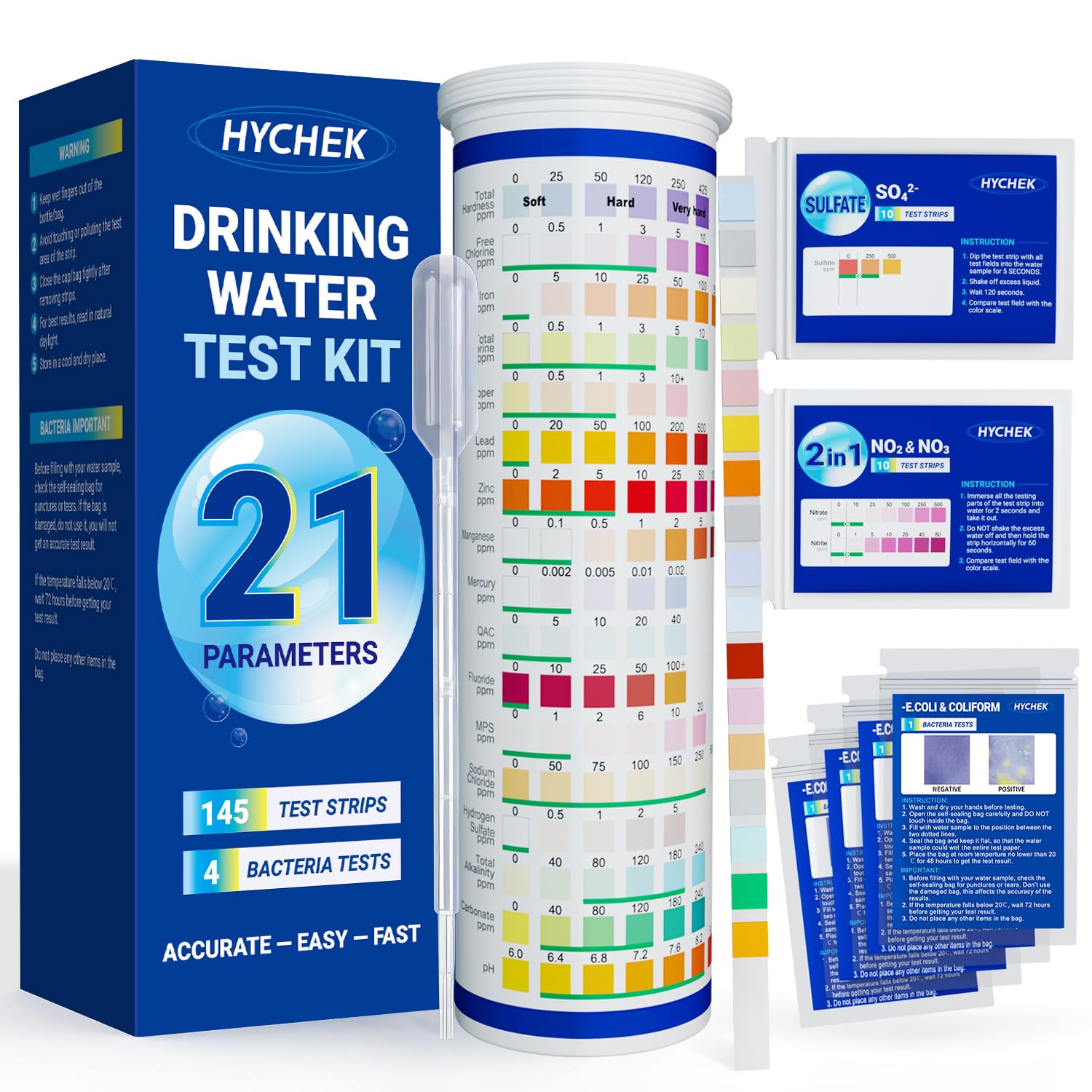
For a new house, a private well or a tap that tastes different lately, this 21-in-1 kit is the one to buy. The 145 strips screen for 21 parameters, including the ones that matter most, lead, nitrate, fluoride, chlorine, iron, hardness and pH, by dipping for a second, waiting 15 seconds and matching against a chart printed on the bottle, and four separate coliform and E. coli vials cover the bacteria that no strip can detect. Owners give it the best rating of any multi-parameter kit here, from a base of a couple of hundred, praising the clear color blocks. Be realistic about what strips do: they screen, and a reading that worries you should be confirmed by a certified lab. For routine checks and peace of mind, this kit does more than any other on the page.
- Best owner rating of the multi-parameter kits here
- Four bacteria tests, the most of any kit on the page
- 145 strips cover years of monthly testing
- Color chart printed on the bottle for quick matching
- A couple of hundred owner reviews so far
- Strips are screening tools, not lab-certified results
- Bacteria tests take 48 hours to develop
Just Fitter Alkaline Water pH Test Strips. Testing Kit for Home Drinking Water and Liquids.

Just Fitter’s pH strips have tens of thousands of owner reviews, more than every other kit on this page combined, because they do one simple job for a lot of people: tell you whether water, a pool, a fish tank or a batch of kombucha is acidic or alkaline. Dip, wait, compare to the chart, done. Owners rate them solidly and use them for filter checks, aquarium maintenance and fermentation as much as for drinking water. Two honest notes: the listing leans into alkaline-water health benefits that the evidence does not support well, so treat pH as information rather than a wellness score; and the strips are sensitive to heat, light and humidity, so keep the tube sealed and out of the bathroom. For anything beyond pH, you need a multi-parameter kit.
- Tens of thousands of owner reviews, by far the most of any kit here
- Works on tap water, filtered water, aquariums, pools and kombucha
- Simple single-pad reading
- Solid owner rating
- pH only; tells you nothing about lead, nitrate or bacteria
- Listing leans on alkaline-water health claims that are not well supported
- Strips degrade if left open in a humid bathroom
21-in-1 Drinking Water Test Kit, 145 Strips + 2 Bacteria Tests

AQUANEXO’s 21-in-1 kit is built for well owners in farming areas, where nitrate from fertilizer is the common problem. Alongside 125 multi-parameter strips that screen for lead, copper, iron, fluoride, chlorine, hardness, pH and more, it adds 20 dedicated nitrate, nitrite and sulfate strips for more frequent checks on those three, two coliform and E. coli bacteria tests, and a pipette and test tube so the bacteria sample is handled properly. A couple of hundred owners rate it well. It has two bacteria tests to the four in the kit above and costs slightly more, which is why it ranks third, but if nitrate is your concern the extra strips are exactly what you want. Dip for two seconds, wait thirty, and match against the included chart.
- Separate nitrate, nitrite and sulfate strips for farm and well water
- Pipette and test tube in the box
- Two bacteria tests included
- Good owner rating from a couple of hundred owners
- Two bacteria tests, half the kit above
- Slightly more expensive than the 21 in 1 Accurate kit
- Thirty-second wait is longer than rivals
16-in-1 Drinking Water Test Strips, 20 PCS - Home Testing Kit for Tap & Well Water
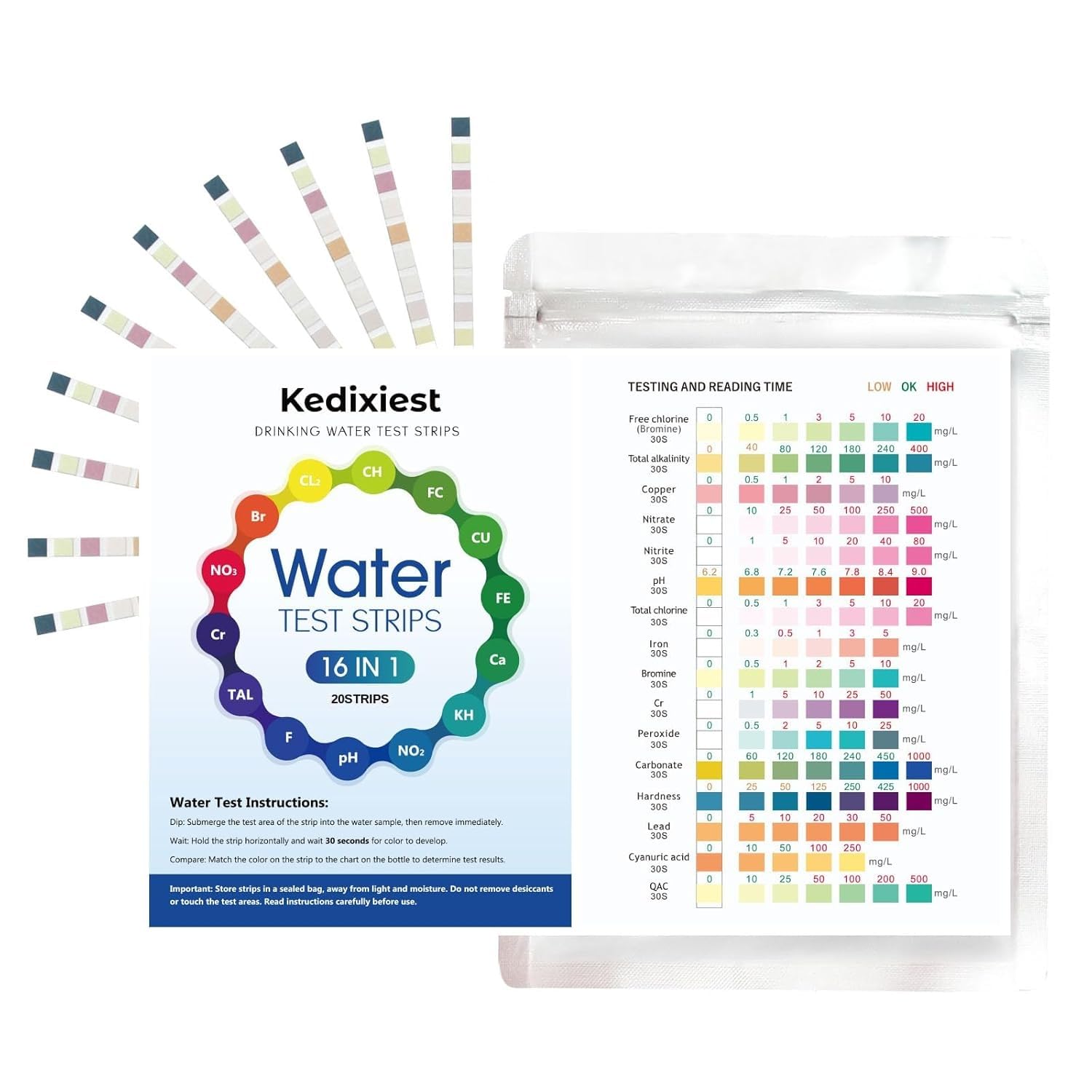
Twenty strips is all most households need to check a new home or a changed tap, and this 16-in-1 pack is the cheapest way to do it. Each strip screens for lead, iron, manganese, nitrate, nitrite, chlorine, fluoride, mercury, copper, pH, hardness, alkalinity, bromine, sulfate, sulfite and zinc, dipped for two seconds and laid flat for fifteen before matching the chart, and it works on tap, well, spring and RV water. A couple of hundred owners rate it well. The listing text contradicts itself about whether you get 20 or 50 strips, so expect 20, and the pads lose accuracy six months after opening, which is why a small pack suits a one-off check better than a bottle of 145. There is no bacteria test; well owners should pair it with a coliform vial or choose a 21-in-1 kit.
- Cheapest way to screen for lead and nitrate
- Includes mercury, which most strips skip
- Good owner rating from a couple of hundred owners
- Sized for a new-home check without waste
- Twenty strips only; the listing text is inconsistent about the count
- No bacteria test
- Strips must be used within six months of opening
16-in-1 Drinking Water Test Kit, 25 Strips for Tap & Well Water

This 16-in-1 kit is aimed at people on city water deciding whether they need a filter or a softener: the hardness, chlorine, pH and metals readings tell you in thirty seconds whether a jug filter, an under-sink unit or a whole-house softener is the sensible next purchase. Twenty-five strips screen for lead, copper, iron, fluoride, chlorine, hardness, pH, nitrate, nitrite, sulfate, manganese, zinc and alkalinity, and it works on well and RV water too. A couple of hundred owners rate it well, a notch below the Kedixiest pack. It does not test for mercury or bacteria, so it is a municipal-water tool rather than a well-water one. If you have a well, buy a 21-in-1 kit with coliform tests; if you are on town water and curious, this is enough.
- Twenty-five strips for regular checks
- Hardness and chlorine readings help size a filter or softener
- Good owner rating
- Clear, easy-to-read chart
- No mercury test and no bacteria test
- Slightly lower rating than the Kedixiest pack
- Thirty-second development

HomEnjoy’s 7-pack is the pH strip for people who test a lot: 560 litmus strips covering the full 1 to 14 range, reading in about five seconds, for aquariums, hydroponics, soil, rainwater, cleaning solutions and the kitchen chemistry of brewing and cheese making. Thousands of owners rate it solidly. The strips are filter paper rather than plastic-backed pads, which is why there are so many for so little, and the maker is clear about the consequence: do not immerse them, because the dye bleeds and gives a false reading; drop the liquid onto the strip with a pipette or a glass rod instead. Accuracy is to about a whole pH unit, fine for knowing whether a tank is drifting or a batch has soured, not for lab work. For drinking water, a multi-parameter kit tells you far more.
- Thousands of owner reviews with a solid rating
- 560 strips for the price of one small bottle
- Full 1 to 14 range for brewing, soil and cleaning solutions
- Five-second read
- Paper strips are coarser than plastic-backed ones; expect whole-unit accuracy
- Must be dripped on, not dipped, or the dye bleeds
- pH only
BACNUNN pH Test Strips 0-14: 200 Universal Litmus Paper pH Test Strips

BACNUNN’s strips answer the storage problem that ruins cheap pH paper: they come in a light-blocking bottle with the color chart printed on it, so each strip you pull out is as fresh as the first, provided you keep the lid on and your fingers dry. You get 200 strips covering 0 to 14, a dip-and-read method that gives a result in about a second, and an instruction manual; the maker is ISO 9001 certified and sells them for water, fermentation, soap making and classrooms. Hundreds of owners rate them solidly. Take the listing’s claim to be the most accurate strips available as marketing, since no home strip is lab-grade, and remember that they read pH alone. As a bottle to keep in the kitchen drawer for years of occasional checks, they are the sensible pH buy.
- Light-blocking bottle keeps strips accurate for longer
- Hundreds of owner reviews with a solid rating
- Chart on the bottle, instruction manual included
- 200 strips at a fair price
- Marketing claims of most accurate strips are not independently verified
- pH only
- Bottle must be kept dry; no wet fingers inside

The last pick is a plain 125-count bottle of 0 to 14 pH strips with a chart on the label, dipped for a second and read when the pads settle, sold for drinking water, fermentation, kombucha, pools, hot tubs and soap making. The count is the point: 125 strips is enough for a year of weekly checks and small enough to be used before the pads lose accuracy, which is the fate of most 500-strip packs. The maker gives unusually clear advice, including decolorizing a colored sample before testing and waiting longer on weak solutions. A few hundred owners rate it solidly. It is a smaller brand than BACNUNN or HomEnjoy and tells you nothing beyond pH, but as a cheap, sensibly sized bottle for the kitchen or the brew cupboard it does the job.
- 125 strips sized to be used up before they degrade
- Solid owner rating from a few hundred owners
- Clear guidance on colored and weak samples
- Cheapest bottled pH strips here
- Fewer reviews than the HomEnjoy or BACNUNN
- pH only
- Less-known brand
Compare the picks
| Product | Tests | Strips | Bacteria test | Best for | Our score | Our score | |
|---|---|---|---|---|---|---|---|
| 21 in 1 Accurate Drinking Water KitHYCHEK | 21 parameters | 145 | 4 vials | Well and tap water | 8.9/10 | 8.9 | See price |
| Just Fitter pH stripsJust Fitter | pH only | Not stated | No | Drinking water, pools, kombucha | 8.6/10 | 8.6 | See price |
| AQUANEXO 21-in-1AQUANEXO | 21 parameters | 125 + 20 nitrate | 2 vials | Farm wells, nitrate | 8.4/10 | 8.4 | See price |
| Kedixiest 16-in-1Kedixiest | 16 incl. mercury | 20 | No | One-off home check | 8.4/10 | 8.4 | See price |
| 16-in-1 25 stripsAQUANEXO | 16 parameters | 25 | No | City water, filter sizing | 8.3/10 | 8.3 | See price |
| HomEnjoy 7-pack pHHomEnjoy | pH 1-14 | 560 | No | Aquariums, soil, brewing | 8.8/10 | 8.8 | See price |
| BACNUNN pH 0-14BACNUNN | pH 0-14 | 200 | No | Kitchen drawer, fermentation | 8.8/10 | 8.8 | See price |
| Universal pH 0-14HOVIRAN | pH 0-14 | 125 | No | Weekly pH checks | 8.6/10 | 8.6 | See price |
What strips can and cannot tell you
A multi-parameter strip is a screening tool. Its pads change color in bands, so a lead reading of zero, 15 or 50 parts per billion is a useful warning but not a measurement, and strips cannot detect bacteria, pesticides, PFAS or radon at all. The right use is to screen regularly, spot a change, and then send a sample to a certified laboratory for anything that reads high. For a private well, the kits with coliform vials, the two 21-in-1 kits here, add the one test that matters most for safety, and local health departments often run low-cost lab tests too.
How to test properly
Run the cold tap for a minute or so to flush the pipe before filling a clean glass, unless you are specifically checking for lead from your own plumbing, in which case test first-draw water after six hours of no use. Dip the strip for the stated second or two, hold it level without shaking, and read at the stated time; reading early or late shifts the color. Compare under daylight, not warm bulbs. Keep strips in their sealed container with the lid on, away from heat, humidity and sunlight, and write the opening date on the bottle, since most packs lose accuracy within six months of opening.
Which kit for which water
Municipal water in a house with old plumbing: a 16-in-1 or 21-in-1 kit, testing first-draw water for lead and copper, then a lab test if either reads above zero. A private well: a 21-in-1 kit with coliform vials, tested at least once a year and after flooding or heavy rain. A filter or softener decision: the 16-in-1 25-strip kit for hardness and chlorine. Aquariums, hydroponics, kombucha and brewing: bulk pH strips such as the HomEnjoy or BACNUNN, used often. A reverse-osmosis or alkaline filter check: the Just Fitter or universal pH strips, remembering that pH alone says nothing about safety.
Are home water test strips accurate?
They are accurate enough to screen. Results come in color bands rather than precise numbers, and readings near a threshold should be confirmed by a certified lab. Follow the dip and wait times exactly and read in daylight.
Can test strips detect bacteria?
No. Bacteria need a culture vial that develops over about 48 hours. The 21 in 1 Accurate kit includes four coliform and E. coli vials and the AQUANEXO kit includes two; the strip-only kits do not test for bacteria.
How often should I test well water?
At least once a year for bacteria, nitrate and pH, and after flooding, nearby construction or a change in taste or smell. Most health departments recommend a certified lab test annually in addition to home screening.
What pH should drinking water be?
Public health guidance places tap water between about 6.5 and 8.5. Readings outside that range are a reason to look at plumbing or treatment, not a health emergency; claims that very alkaline water is healthier are not well supported.
Why do my strips give different results each time?
Usually old or damp strips, dipping too long, reading at the wrong time or comparing under warm lighting. Store strips sealed and dry, use a fresh glass, follow the timing exactly and read against the chart in daylight.
Prices and stock change daily. The buttons above open Amazon so you always see the current price. We may earn a commission if you buy through them, at no extra cost to you.
Do Best Deal is a participant in the Amazon Services LLC Associates Program. As an Amazon Associate we earn from qualifying purchases. If you buy through links on this site we may earn a commission, at no extra cost to you. Learn more.