Pool water goes wrong quietly. Sanitizer drifts down, pH drifts up, a salt cell stops producing because the salt level has slipped under its threshold, and the first sign is cloudy water or sore eyes. Test strips are the quick check that catches it: dip, wait a few seconds and compare the pads with the chart on the bottle. Multi-way strips read free chlorine, pH, alkalinity and stabilizer for day-to-day balance, while salt strips answer the one question a salt chlorine generator depends on. We ranked the pool and spa tests in our garden catalog by what they measure, the range they cover, how many strips are in the bottle, how the result is read, and what hundreds to tens of thousands of owners report after a season of testing.
We have not dipped every one of these ourselves; the verdicts rest on the spec sheets and the owner review history. Prices are not printed because they change daily; every button opens the live Amazon page. Drinking water and aquarium kits are out of scope here; for tap and well water, see our home water test kits guide. Once you have a reading, our pool chemicals and balancers and pool chlorine tablets and pool shock guides cover what to add. Always follow the label on any pool chemical and the manual for your pool equipment.
How we picked
- The right parameters for the pool type. Free chlorine, pH, alkalinity and stabilizer for balance; sodium chloride for salt systems.
- A stated measuring range, so you know the strip covers the level your equipment needs.
- Enough strips for a season of testing at least twice a week, or a kit with replaceable reagents.
- A clear way to read the result: a chart on the bottle, a titrator scale or an app.
- Owner feedback from well over a hundred to tens of thousands of reviews, with color-matching and shelf-life complaints noted.
The picks
Clorox Pool&Spa My Pool Care Assistant, 50 Test Strips

For an ordinary chlorine pool, this is the strip to keep by the back door. Each one reads six things in a single dip: free chlorine, the sanitizer actually working in the water; total chlorine; pH; total alkalinity; total hardness; and stabilizer. Those are the numbers that decide whether the water is comfortable and whether the chlorine can do its job. The useful extra is the free Clorox Pool app. You dip a strip at elbow depth, scan it with a phone, and the app reads the pads, explains the result and suggests a product and dose, which removes the squinting at a color chart that puts people off strips. Thousands of owners give it a very strong owner rating. It does not measure salt, the app naturally recommends its own brand, and fifty strips cover roughly 25 weeks of twice-weekly testing. For routine checks, it is the easiest to live with.
- Thousands of owner reviews with a very strong owner rating
- Six parameters on one strip covers routine balance
- App scans the strip, so there is less color guessing
- App suggests what to add and how much
- Does not measure salt
- App recommendations point toward the same brand of chemicals
- Fifty strips cover about 25 weeks at two tests a week

A salt chlorine generator only makes chlorine when the salt level is inside its working band, which the maker notes is 1,500 to 4,500 ppm for most systems, and both too little and too much cause trouble. EASYTEST’s strip answers that question faster than anything else here: dip it for one second, hold it level for five without shaking off the water, and match the pad against the chart. The range runs from 0 to 8,000 ppm, wide enough to catch a pool that has been over-salted as well as one that has been diluted by rain or backwashing. Tens of thousands of owners have reviewed it, by far the most in this guide, and give it a strong owner rating. The maker advises reading in natural daylight and using an opened bottle promptly. It measures salt and nothing else, with 25 strips per bottle. For quick salt checks, it is the default.
- Largest owner review base on this page by a wide margin
- Result in about five seconds, with no shaking and no long wait
- Wide 0 to 8,000 ppm range covers any salt system
- Simple color chart read
- Measures salt only
- Twenty-five strips per bottle
- Color-step reading is less fine than a titrator scale
AquaChek Salt Test Strip Titrators for Pools - Salt Water Pool Test Strips for Sodium Chloride - Quick and Accurate Results - Professional Water Quality Testing Kit (10 Strips)

AquaChek’s white titrator works differently from a color-pad strip. The strip draws the sample up a column and you read where the change stops against a scale, then convert that to parts per million, so the result is a position on a ruler and not a judgment between two shades. The maker says the method uses medical-industry technology and gives accuracy comparable to a liquid test, without measuring and counting drops, across 400 to 7,000 ppm of sodium chloride. It takes a few minutes to develop, slower than the EASYTEST, and the pack has only ten strips, which suits an occasional salt check more than daily use. Thousands of owners give it a very strong owner rating. The free AquaChek Connect app records results and builds a treatment plan from numbers you enter. When a salt cell reports low salt and you want a second opinion, this is the one to trust.
- Thousands of owner reviews with a very strong owner rating
- Titrator scale gives a finer reading than color blocks
- No drops to count, so less room for error
- Directions and a water chemistry insert included
- Only ten strips in this pack
- Takes a few minutes to develop
- Salt only
AquaChek Salt System Test Kit - for Pools and Spas - Salt Water Pool Test Strips for Sodium Chloride - Test Kit Includes Yellow 4-Way (25 Strips Each) and White Salt Test Strips (10 Strips Each)

A salt pool is still a chlorine pool; the generator just makes the chlorine on site. So the owner needs two kinds of test, and this kit puts both in one box. The white titrators are the same 400 to 7,000 ppm salt strips ranked above, ten of them, and the yellow 4-way strips, 25 of them, read free chlorine, pH, total alkalinity and cyanuric acid, the stabilizer that keeps sunlight from burning off chlorine and that salt pools in particular need to hold in range. Directions are included, and AquaChek recommends testing at least twice a week. Hundreds of owners give it a very strong owner rating. There is no hardness pad, which matters for plaster pools and for scale on salt cells, and the two bottles need to be kept capped and dry. For a new salt pool owner who wants one purchase, it is the sensible start.
- Covers salt and the four key balance readings in one box
- Hundreds of owner reviews with a very strong owner rating
- Cyanuric acid pad matters for outdoor salt pools
- Same titrators as the stand-alone AquaChek pack
- No hardness reading
- Two bottles to keep dry and in date
- Fewer balance strips than a 50-count bottle
Taylor Service Complete Pool Water Test Kit K-2006C

Strips are a quick screen. When the numbers matter, opening a pool, chasing an algae problem, or checking a strip result that looks wrong, a drop kit is the tool, and Taylor’s K-2006 is a long-standing reference kit. You fill a vial, add reagent and count drops until the sample changes color, so the answer is a number, not a shade. It covers free and total chlorine, bromine, pH, calcium hardness, total alkalinity and stabilizer, and adds acid demand and base demand tests that tell you how much chemical it will take to correct pH, which helps avoid overtreating. This service version carries 2 ounce reagent bottles. More than a thousand owners give it a very strong owner rating. It costs far more than strips, takes several minutes, and this version has no salt test. As a reference kit alongside strips, it is the best here.
- More than a thousand owner reviews with a very strong owner rating
- Drop-count results are more precise than strip colors
- Acid and base demand tests tell you how much to add
- Large 2 oz reagent bottles
- Costs many times what a bottle of strips does
- Slower: several minutes per full test
- Does not test salt in this version

This is the same AquaChek white titrator in a 40-strip bottle, the size that makes sense for a pool service round, a property with a pool and a spa, or anyone who has been burned by running out mid-season. The method is unchanged: dip, wait a couple of minutes, read where the column stops and look the value up on the comparator chart, which is printed on the side of the bottle and so stays with the strips. Hundreds of owners give it a very strong owner rating, in line with the ten-strip pack. The listing for this bottle is shorter on detail than the small pack. The practical question is whether you will use 40 salt tests before the expiry date; a single residential pool checked now and then will not, so the ten-strip pack ranked third is the better buy for most homes. For frequent testers, the bigger bottle costs less per test.
- Forty titrators, four times the small pack
- Hundreds of owner reviews with a very strong owner rating
- Chart is printed on the bottle, so it cannot be lost
- Same titrator method as the smaller AquaChek pack
- Salt only
- More strips than a single pool uses in a season
- Strips must be used before they expire
Pool Salt Test Strips Kit, 8 Way 125CT Water Test Strips for Saltwater Pool
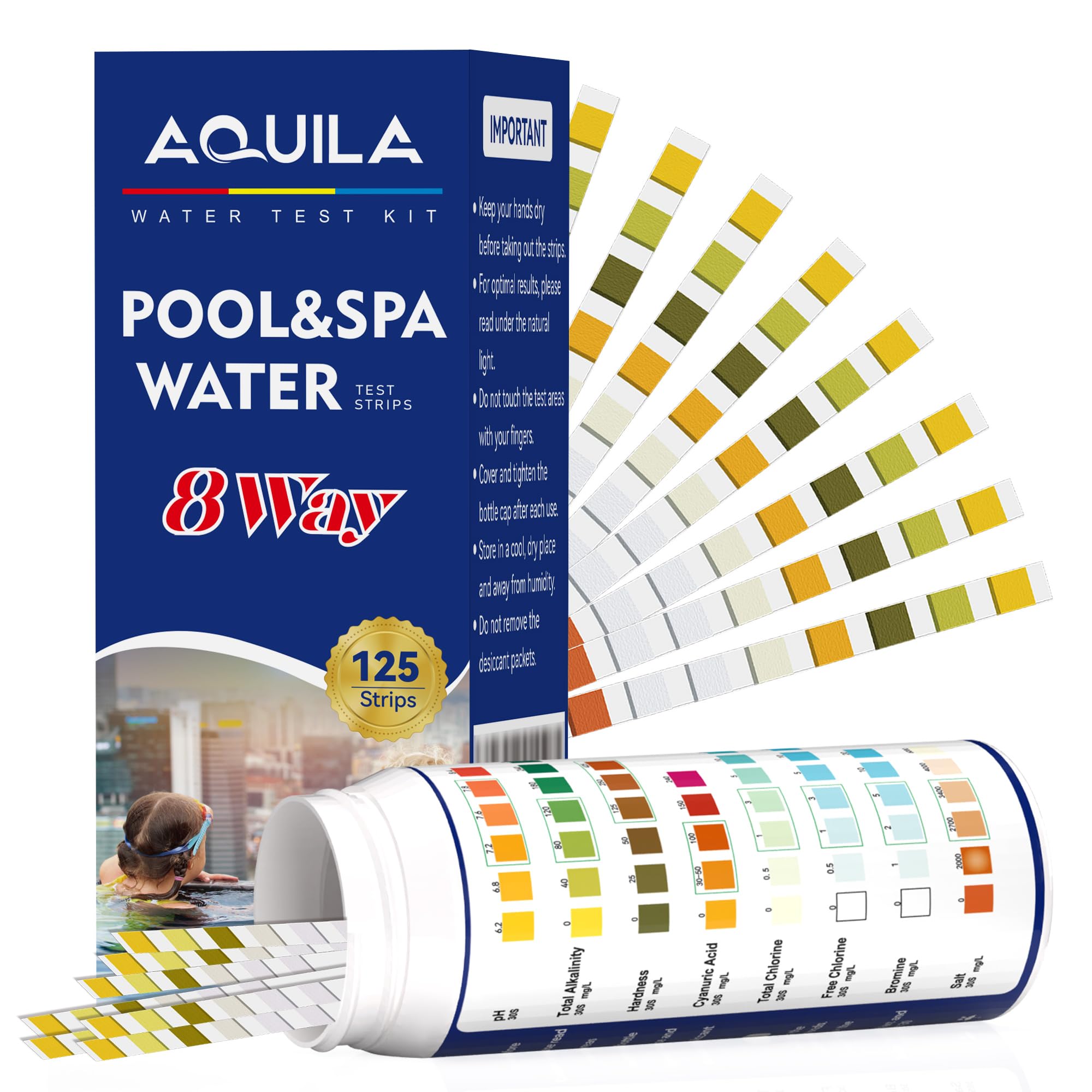
One strip for everything is the appeal here. Each of the 125 strips in the bottle carries eight pads: pH, total alkalinity, hardness, cyanuric acid, total chlorine, free chlorine, bromine and salt, so a single dip gives a salt pool owner the whole picture, and the bromine pad makes the same bottle usable on a hot tub. The routine is a two-second dip, a shake and a read against the bottle chart within 15 to 20 seconds. At twice a week, 125 strips outlast a season comfortably. More than a hundred owners give it a strong owner rating. The compromise is resolution: eight small pads in a row are harder to match by eye than one dedicated strip, and a color-block salt reading is coarser than the AquaChek titrator, so confirm an out-of-range salt result with a dedicated test before adding bags of salt. As a routine all-rounder, it is good value.
- Salt plus seven balance readings on a single strip
- A bottle of 125 strips covers more than a season
- Bromine pad makes it suitable for hot tubs
- More than a hundred owner reviews with a strong owner rating
- Eight small pads are harder to match than a dedicated strip
- Salt reading is coarser than a titrator
- Newer listing with a modest review base
2026 Salt Water 8-in-1 Pool Test Strips Kit | 150 Strips Pool Salt Test Strips | Salt Water Pool Testing Kit for Pools, Hot Tubs & Spas Quick Accurate Tests Salt, Chlorine, pH, Cyanuric Acid

This 150-strip bottle is the highest count in the guide and is built specifically around saltwater systems. Like the 8-way strip above it combines salt with seven other readings in one dip, among them chlorine, pH and cyanuric acid, but its salt pad is tuned to 1,500 to 5,000 ppm, the band in which salt generators normally operate, which spreads the color steps across the part of the scale that matters. You dip for one second, lay the strip flat for 15 and read it against the bottle, and the maker says the pads are made not to bleed into each other. More than a hundred owners give it a strong owner rating. The narrower range cuts both ways: it will not put a number on a badly over-salted pool or on one that has dropped below 1,500 ppm, where the EASYTEST or an AquaChek titrator will. For frequent routine checks on a salt pool, it lasts longest.
- Largest strip count on this page
- Salt pad tuned to the range salt systems actually run in
- More than a hundred owner reviews with a strong owner rating
- Pads are designed not to bleed into each other
- Salt range stops at 5,000 ppm, so it will not quantify heavy over-salting
- Does not read below 1,500 ppm
- Newer listing
Compare the picks
| Product | Type | Measures | Count | Read by | Our score | Our score | |
|---|---|---|---|---|---|---|---|
| Clorox Pool&Spa 6-WayCLOROX Pool&Spa | Multi-way strip | 6 balance readings, no salt | 50 | App scan or chart | 9.2/10 | 9.2 | See price |
| EASYTEST SaltwaterEASYTEST | Salt strip | Salt, 0 to 8,000 ppm | 25 | Color chart | 8.8/10 | 8.8 | See price |
| AquaChek Salt Titrators 10AquaChek | Salt titrator | Salt, 400 to 7,000 ppm | 10 | Titrator scale | 9/10 | 9.0 | See price |
| AquaChek Salt System KitAquaChek | Salt titrator plus 4-way strip | Salt and 4 balance readings | 10 and 25 | Scale and chart | 9/10 | 9.0 | See price |
| Taylor K-2006CTaylor | Drop titration kit | Chlorine, bromine, pH, hardness, alkalinity, stabilizer | Reagent bottles | Drop count | 9/10 | 9.0 | See price |
| AquaChek Salt Titrators 40AquaChek | Salt titrator | Salt | 40 | Titrator scale | 9/10 | 9.0 | See price |
| 8-Way 125 CountA QUILA | 8-way strip | Salt plus 7 readings, with bromine | 125 | Color chart | 8.6/10 | 8.6 | See price |
| 8-in-1 150 StripsAKSBTEC | 8-in-1 strip | Salt 1,500 to 5,000 ppm plus 7 readings | 150 | Color chart | 8.6/10 | 8.6 | See price |
What each reading means
Free chlorine is the sanitizer available to work; total chlorine includes the used-up portion, and a wide gap between the two is a sign the pool needs attention. pH controls comfort and how well chlorine works, and total alkalinity is the buffer that keeps pH from swinging. Cyanuric acid, also called stabilizer, protects chlorine from sunlight in outdoor pools. Calcium or total hardness matters for plaster, heaters and salt cells. Salt is only relevant if you have a salt chlorine generator. The target for each depends on your pool surface, sanitizer and equipment, so use the ranges in your pool or salt system manual, and the ideal bands printed on the strip bottle as a guide.
Strips, titrators or drops?
Color-pad strips are fastest and cheapest per test and are accurate enough to tell you whether a reading is low, fine or high. Titrator strips, like the AquaChek salt tests, replace color matching with a scale and give a finer number for one parameter. Drop kits such as the Taylor take longest and cost most, and give the most repeatable result. A sensible routine uses strips for the twice-weekly check and a titrator or drop test to confirm anything surprising before you add a large dose of chemical or several bags of salt.
Getting a reliable result
Take the sample at about elbow depth, away from return jets and skimmers, with the pump running. Keep fingers off the pads, do not shake the strip unless the directions say to, and read it at the stated time, since pads keep changing afterwards. Compare colors in daylight, not under a yellow bulb. Close the bottle straight away, store it cool and dry, never put a wet strip back in, and check the expiry date at the start of each season. After adding chemicals, let the water circulate for the time on the product label before testing again.
How often should I test pool water?
AquaChek recommends testing at least twice a week, and more often in hot weather, after heavy use or after rain. Salt level changes more slowly than chlorine or pH, so check it as often as your salt system manual says and whenever the generator reports a fault.
Are pool test strips accurate?
They are accurate enough to show whether a reading is low, in range or high, which is what routine maintenance needs. For a precise number, for example before a large correction, confirm with a titrator strip or a drop kit such as the Taylor K-2006C.
Do I need special test strips for a saltwater pool?
You need a salt test in addition to the usual chlorine and pH tests, because a salt pool is still a chlorine pool. Use a dedicated salt strip such as the EASYTEST or AquaChek titrators with a multi-way strip, or an 8-in-1 strip that includes a salt pad.
Can I use pool test strips in a hot tub?
Yes, as long as the strip reads the sanitizer you use. For a bromine spa choose a strip with a bromine pad, such as the 8-way 125-count strip, or use the Taylor kit, which tests bromine. The Clorox strips are labeled for pools and spas.
Do pool test strips expire?
Yes. The reagent pads degrade with time, heat and moisture, so check the date on the bottle, keep the cap closed and store it cool and dry. The EASYTEST maker advises using an opened bottle as soon as possible for the most accurate results.
Prices and stock change daily. The buttons above open Amazon so you always see the current price. Do Best Deal may earn a commission if you buy through them, at no extra cost to you.
Do Best Deal is a participant in the Amazon Services LLC Associates Program. As an Amazon Associate we earn from qualifying purchases. If you buy through links on this site we may earn a commission, at no extra cost to you. Learn more.