Chlorine keeps a pool sanitary, but it does not keep it clear by itself. Two supporting chemicals handle the problems chlorine leaves behind. A clarifier is a coagulant: it gathers the microscopic particles that make water look dull or milky into clumps big enough for the filter to catch. An algaecide kills and prevents algae, the green, yellow-mustard or black growth that takes hold when sanitizer dips in hot weather. They do different jobs, they are dosed differently, and using the wrong one wastes a weekend. We ranked the clarifiers and algaecides in our garden catalog by what they treat, the dose and the volume a bottle covers, whether they foam or stain, compatibility with salt and vinyl pools, and what hundreds to thousands of owners report over a season.
We have not dosed a pool with every one of these ourselves; the verdicts rest on the label information and the owner review history. Prices are not printed because they change daily; every button opens the live Amazon page. Sanitizer and shock are covered in our pool chlorine tablets and pool shock guide, pH and alkalinity products in our pool chemicals and balancers guide, and you will need our pool and spa test strips guide before adding anything.
How we picked
- Clarifiers and algaecides only. Chlorine, shock, pH adjusters, metal removers and test kits are covered in other guides.
- A clear dose and coverage on the label, so you can work out what a bottle does for your pool volume.
- Non-foaming, non-staining formulas preferred for algaecides, with metal-free products noted.
- Stated compatibility with saltwater systems, vinyl liners and common sanitizers.
- Owner feedback from several hundred to many thousands of reviews, with slow results, foaming and overdosing complaints noted.
The picks
Clorox Pool&Spa Swimming Pool Super Water Clarifier, Creates Crystal Clear Pool Water, 1 Quart (Pack of 1)

The Clorox Super Water Clarifier is the product most pool owners reach for when the water has lost its sparkle, and many thousands of them give it an excellent owner rating. It is a concentrated liquid that makes the tiny suspended particles behind dull, hazy water stick together into larger clumps, which the filter can then trap. You add a measured dose weekly as part of routine care, or before and after a heavy-use day, and let the pump run. A quart goes a long way at maintenance doses, and the Clorox Pool app will calculate the amount from your pool volume and test results. A clarifier is a helper, not a cure. If the filter is dirty, the pump runs too few hours or the chlorine is low, the cloudiness will return, and adding more than the label says can make the water worse. Used as directed on a balanced pool, it is the dependable choice.
- Many thousands of owner reviews with an excellent owner rating
- Concentrated, so a quart lasts many weekly doses
- Works as routine maintenance or a pre-party polish
- App gives dosage for your pool size
- Will not fix cloudiness caused by poor filtration or low chlorine
- Overdosing a clarifier can make water cloudier
- Small bottle for very large pools
Clorox Pool&Spa XTRABLUE Plus Swimming Pool Algaecide, All-in-One Algae Killer, Non-Foaming, 40 Ounce (Pack of 1)

When a pool has already turned, XtraBlue Plus is the Clorox product made for it. The label describes an all-in-one algaecide that kills green, mustard and black algae in 24 hours and then keeps working as a preventative, and a 40 ounce bottle treats up to 25,000 gallons. The formula is non-foaming, which matters in pools with water features or attached spas where cheaper algaecides whip up suds, and it is described as non-staining and suitable for all pool types including salt systems. Thousands of owners give it an excellent owner rating. No algaecide works alone on a serious bloom: brush the walls and floor, bring the sanitizer up with shock, run the pump around the clock and clean the filter as the dead algae collects. It costs more per ounce than bulk polyquat. For clearing a green pool with a product from a familiar brand, it is the pick.
- Thousands of owner reviews with an excellent owner rating
- Covers all three common algae types
- Non-foaming, so no suds in the skimmer or spa jets
- Also works as a weekly preventative
- Heavy blooms still need brushing, shock and filter cleaning
- Costs more per ounce than bulk algaecide
- One bottle is a single treatment for a large pool
Doheny's Algaecide 60 | Pro-Grade, Metal-Free & Non-Foaming | Prevents All Algae Types | No Stains or Clouding | Safe for Salt, Chlorine & Bromine Pools | Treats 160,000 Gallons | 4 x 40oz (160oz)

Doheny’s Algaecide 60 is what a pool professional would choose for prevention, and hundreds of owners give it the highest rating in this guide. The 60 refers to a concentrated, metal-free formula: there is no copper in it, so it cannot leave blue-green stains on plaster or tint light hair, and it does not foam or cloud the water the way cheaper quat algaecides can. The pack holds four 40 ounce bottles, 160 ounces in all, which the maker says treats up to 160,000 gallons at maintenance doses, and each bottle has a dosage stripe on the side so you can pour without a measuring cup. It is compatible with salt, chlorine and bromine pools and is made in the United States by a family-owned company. The four-pack is a bigger purchase than one bottle and is more than a small above-ground pool needs. For a weekly dose that keeps algae from starting, it is the best value here.
- Highest owner rating on this page
- Metal-free, so no copper staining or green hair
- Does not foam or cloud the water
- Four bottles cover a full season for most pools
- Larger upfront purchase than a single bottle
- Prevention-focused; an established bloom still needs shock
- More than a small above-ground pool will use in a year
Clorox Pool&Spa Swimming Pool Crazy Clarifier, Creates Crystal Clear Pool Water, 128 Fl Oz (Pack of 1)

Crazy Clarifier is the same idea as our top pick in a size for people with big pools or a long season. The dose is easy to remember, one ounce for every 5,000 gallons, with no dilution: you pour it slowly around the edges with the pump running. At that rate a 128 fluid ounce jug holds well over a hundred doses for a typical backyard pool, enough for several summers. It suits in-ground and above-ground pools and is meant for weekly use to keep fine particles moving into the filter. Many hundreds of owners give it an excellent owner rating. The cautions are the ones that apply to every clarifier. Measure the dose, because a splash too much can leave the water hazier than before, and do not expect it to compensate for a clogged filter or unbalanced water. If you have a small pool, the quart is the more sensible buy. For a large pool, the jug is the economical one.
- Simple dose of one ounce per 5,000 gallons
- Gallon size covers several seasons for most pools
- No pre-mixing needed
- Many hundreds of owner reviews with an excellent owner rating
- Large jug is more than a small pool needs before it ages
- Easy to overpour without a measuring cup
- Does the same job as the quart at a bigger commitment
EASYCARE 30064 Pooltec Algaecide, Clarifier and Chlorine Salt Cell Booster, 64 Fl. Oz Bottle

Pooltec is the pick for owners who want fewer bottles on the shelf. It is a combined algaecide and clarifier that the maker also describes as a chlorine and salt cell booster: it kills and prevents algae, improves water clarity and, by keeping the water cleaner, is said to raise the efficiency of whatever sanitizer you use, which can mean less chlorine demand and less work for a salt chlorine generator. It works with chlorine and salt systems, and the maker says you can drop separate algaecides and clarifiers from the routine. Many hundreds of owners give it a very strong owner rating, and salt-pool owners are its keenest fans. It costs more per bottle than a single-purpose product, and one combined dose means you cannot raise the algaecide without raising the clarifier. The label claims are also less specific than those from Clorox or HTH. For a simple weekly pour on a salt pool, it earns its place.
- One product in place of a separate algaecide and clarifier
- Designed to help a salt cell work more efficiently
- Many hundreds of owner reviews with a very strong owner rating
- Simplifies a weekly routine to a single pour
- Costs more per bottle than single-purpose products
- A combined dose cannot be adjusted for algae and clarity separately
- Label detail is thinner than Clorox or HTH

HTH’s Advanced Clarifier is at its best as the last step of a clean-up. After you shock a pool and treat it with algaecide, the water is full of dead algae and fine debris that the filter struggles to catch, and the HTH label gives a specific instruction: add the clarifier 4 to 12 hours after those products. It gathers the particles so the filter can remove them, and the label says it improves filter efficiency without affecting pH, so you are not chasing balance afterward. You can pour it straight into the pool or through the skimmer, and it suits all pool surfaces and saltwater systems. Hundreds of owners give it an excellent owner rating. The review base is smaller than the Clorox clarifiers, and this listing is the one-quart size. As with any clarifier, the filter must be clean and the pump running for it to work. For finishing off a shocked pool, it is well judged.
- Clear timing guidance for use after shock and algaecide
- Does not shift pH
- Works on all surfaces and with salt systems
- Hundreds of owner reviews with an excellent owner rating
- Fewer reviews than the Clorox clarifiers
- Quart size only in this listing
- Still depends on a clean, running filter
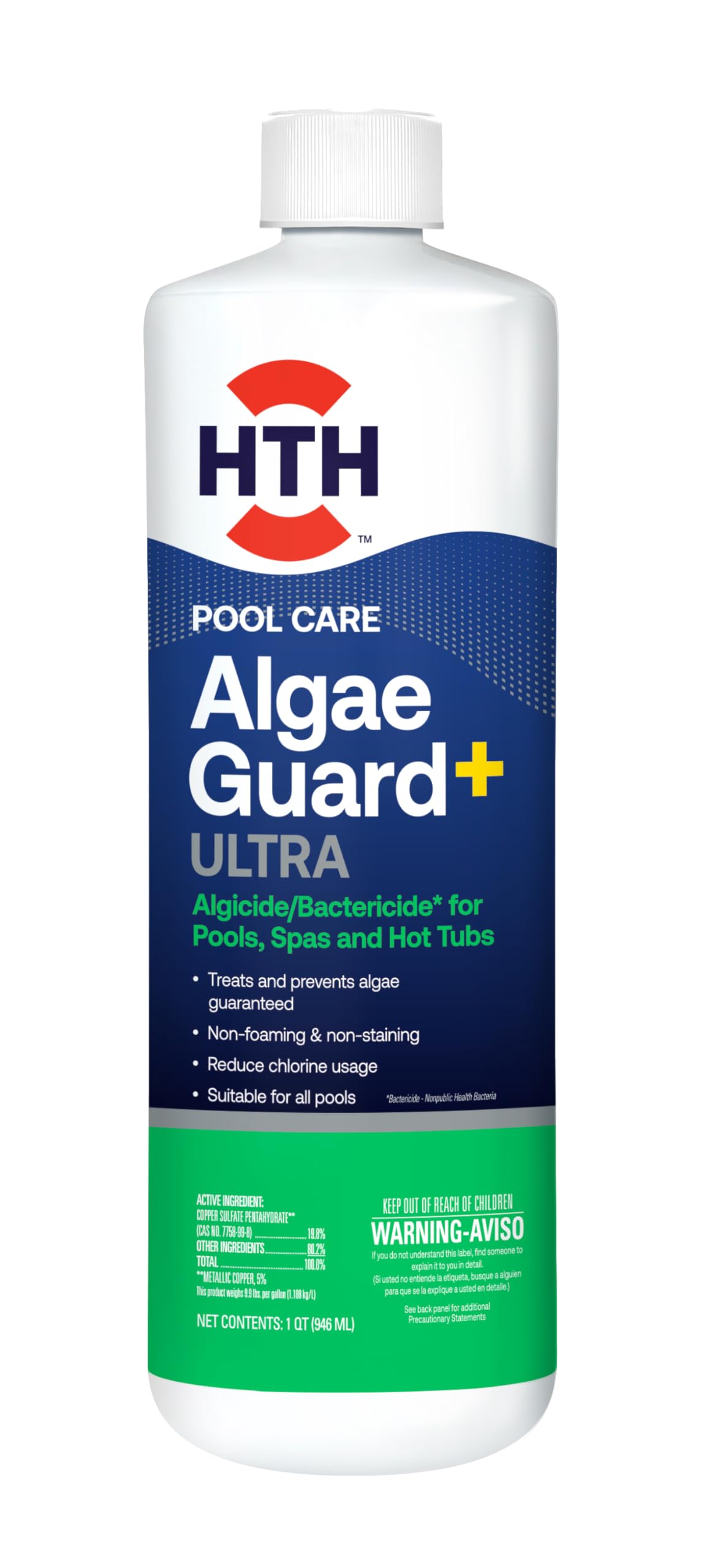
Algae Guard Ultra is HTH’s strongest algae control and it takes a different approach from the weekly products above. The label says it kills heavy green, black and mustard algae and then protects against regrowth for up to three months, so the routine becomes one application per quarter instead of a dose every weekend. It is non-foaming and non-staining, compatible with all pools including vinyl-lined and saltwater, and the label says you can add it directly to the water and swim right away. HTH recommends pairing it with its shock products. Hundreds of owners give it an excellent owner rating, though it has the smallest review base here, which is why it ranks last. A long interval is easy to forget, so set a reminder, and it costs more per ounce than a weekly algaecide. Long-lasting protection still depends on keeping sanitizer in range. For owners who travel, it is the low-effort choice.
- Up to three months of protection from one application
- Swim right away after adding, per the label
- Non-foaming and non-staining
- Hundreds of owner reviews with an excellent owner rating
- Smallest review base in this guide
- Three-month schedule needs a calendar reminder
- Stronger product costs more per ounce than weekly algaecide
Compare the picks
| Product | Type | Size | Dose or coverage | Notes | Our score | Our score | |
|---|---|---|---|---|---|---|---|
| Clorox Super Water ClarifierCLOROX Pool&Spa | Clarifier | 1 quart | Weekly maintenance dose | Concentrated; app dosing | 9.2/10 | 9.2 | See price |
| Clorox XtraBlue Plus AlgaecideCLOROX Pool&Spa | Algaecide | 40 oz | Treats up to 25,000 gallons | Green, mustard, black; non-foaming | 9.2/10 | 9.2 | See price |
| Doheny Algaecide 60 four-packDoheny's | Algaecide | 4 x 40 oz | Treats up to 160,000 gallons | Metal-free, non-foaming | 9.4/10 | 9.4 | See price |
| Clorox Crazy ClarifierCLOROX Pool&Spa | Clarifier | 128 fl oz | 1 oz per 5,000 gallons | No dilution; weekly | 9.2/10 | 9.2 | See price |
| EasyCare PooltecEASYCARE | Algaecide plus clarifier | 64 fl oz | Weekly, per label | Sanitizer and salt cell booster | 9/10 | 9.0 | See price |
| HTH Clarifier AdvancedHTH | Clarifier | 1 quart | Use 4 to 12 hours after shock | Does not affect pH | 9.1/10 | 9.1 | See price |
| HTH Algae Guard UltraHTH | Algaecide | 32 oz | One application lasts up to 3 months | Swim right away, per label | 9.1/10 | 9.1 | See price |
Clarifier or algaecide: which do you need?
Look at the water. If it is cloudy, gray or milky but not colored, and the walls are not slippery, the problem is suspended particles and you need a clarifier, plus a check on the filter and the chlorine level. If the water has a green tint, or there are green, yellow-brown or black patches on the walls and steps that feel slimy, the problem is algae and you need shock, brushing and an algaecide. The two often follow each other: kill the algae first, then use a clarifier to help the filter remove what is left. A combined product such as Pooltec covers both in routine use but is not a substitute for a proper clean-up of a green pool.
How to clear a green or cloudy pool
Test the water and correct pH first, because chlorine and algaecide both work poorly when pH is high. Brush the walls, steps and floor to break up the algae. Shock the pool at dusk, add the algaecide as its label directs, and run the pump continuously. The water will usually turn from green to cloudy blue-gray as the algae dies. Clean or backwash the filter as the pressure rises, then add a clarifier, 4 to 12 hours after shock if you follow the HTH guidance, and keep filtering until the water is clear. Vacuum settled debris to waste if your system allows. Once clear, a weekly preventative dose of algaecide keeps it that way.
Using pool chemicals safely
Read and follow the label on every product; algaecides are regulated pesticides and the label directions are the rules for use. Never mix pool chemicals together, in a bucket or in the skimmer, and add each one to the pool separately with the pump running. Wear gloves and eye protection when pouring, and rinse measuring cups in pool water afterward. Store bottles upright, closed, cool and dry, away from chlorine products and out of reach of children and pets. Follow the label for how long to wait before swimming. More is not better: overdosing a clarifier clouds the water, and overdosing some algaecides causes foam or stains.
What is the difference between a pool clarifier and an algaecide?
A clarifier clumps tiny suspended particles together so the filter can remove them, which clears cloudy water. An algaecide kills and prevents algae. They solve different problems, and a green pool usually needs shock and algaecide first, then a clarifier to help clear the dead algae.
How long does a pool clarifier take to work?
Expect a visible improvement within one to three days with the pump running and a clean filter. If nothing changes, check filtration time, filter condition and sanitizer level before adding more, because extra clarifier can make water cloudier.
Can I use algaecide and shock at the same time?
Follow the labels of the products you are using. A common approach is to shock first and add algaecide once the chlorine level has started to fall, since very high chlorine can break down some algaecides. HTH suggests adding its clarifier 4 to 12 hours after shock and algaecide.
Are these products safe for saltwater and vinyl pools?
The Clorox XtraBlue Plus, the Doheny Algaecide 60, EasyCare Pooltec, and both HTH products state compatibility with salt systems, and HTH Algae Guard Ultra names vinyl-lined pools. Always confirm on the label for your pool surface and sanitizer.
How often should I add algaecide to my pool?
Most preventative algaecides, including the Doheny Algaecide 60 and Clorox XtraBlue Plus, are dosed weekly during the swimming season. HTH Algae Guard Ultra is designed for one application every three months. Dose by your pool volume and the label.
Prices and stock change daily. The buttons above open Amazon so you always see the current price. Do Best Deal may earn a commission if you buy through them, at no extra cost to you.
Do Best Deal is a participant in the Amazon Services LLC Associates Program. As an Amazon Associate we earn from qualifying purchases. If you buy through links on this site we may earn a commission, at no extra cost to you. Learn more.

