A sanding sponge is sandpaper bonded to a block of foam, and that small change fixes most of what is annoying about hand sanding: it wraps around a chair spindle, it tucks into a corner, it does not tear, you can rinse it and use it again, and it is the right tool for wet sanding filler or a clear coat without a soggy sheet of paper falling apart. We ranked the sanding sponges in our abrasives catalog by the grit range in the pack, the number and size of pads, whether the abrasive is on two or four faces, wet and dry capability, how clearly the grit is marked, and what hundreds to thousands of owners report after a few projects.
We have not sanded with every pack ourselves; the verdicts rest on the spec sheets and on the owner review history. Prices are not printed because they change daily; every button opens the live Amazon page. The picks here are all different from the ones in our sanding blocks guide, which covers rigid hand blocks as well as sponges, and if you are feeding a power sander instead, see our sandpaper sheets and rolls guide. Do Best Deal ranks on owner history and spec sheets, not samples.
How we picked
- Owner history. Every pick has hundreds to well over a thousand owner reviews and a high rating; we ranked the biggest, best-rated packs first.
- Grit range stated. Each pack lists its grits, and we favoured sets with two of each grit so you are not stranded mid-job.
- Wet and dry. All eight work wet or dry and rinse clean, which is the point of a sponge over a sheet.
- Size that fits a hand. Most are around 4 by 3 inches and about half an inch to three quarters thick; the ultra-fine pads are thinner and smaller by design.
- Grit marked on the pad. Printed numbers or colour coding so you can tell 120 from 220 after they have all turned grey.
The picks
YNZDRWA 8 Pack Sanding Sponge, 60/80/120/220 Grit Sanding Blocks Assortment

The YNZDRWA eight-pack is the box most people should keep in the drawer: two sponges each in 60, 80, 120 and 220 grit, which runs from stripping old paint and knocking down filler to a final pass before primer. The abrasive is brown corundum applied electrostatically, which the maker says resists tearing and shedding, and in practice the owners who have put well over a thousand reviews behind it, with a strong rating, mostly agree. The marking is what sets it apart from identical-looking competitors: each grit is a different colour of foam and the number is printed on the pad, so you can still tell them apart after they are all covered in dust. They work wet or dry, rinse clean and can be cut down for tight spots. The range stops at 220, so for paint between coats you will want the Tonmp or Jamiikury below, and the foam compresses a little on sharp edges, where a rigid block holds a flatter line.
- Four grits from coarse to fine, two of each, so you can rough and finish from one box
- Colour coding plus printed grit numbers, the clearest marking here
- Washable and reusable, and the pads can be cut to size
- Well over a thousand owner reviews with a strong owner rating
- Nothing finer than 220, so paint and clear coat need another pack
- Foam is medium density and compresses on hard edges
- Generic brand with a long product name
8 Pack Sanding Sponge Block, Wet Dry Sandpaper Sand Paper for Drywall Wood

This eight-pack is the YNZDRWA’s closest rival and often the cheaper of the two. You get the same two sponges each of 60, 80, 120 and 220 grit on a high-elastic foam core with brown corundum abrasive, printed grit numbers, and the same wet-or-dry, rinse-and-reuse behaviour. The pads are slightly smaller at 4 by 2.75 inches and a touch thicker at 0.65 inch, which makes them easier to grip for detail work on trim, spindles and putty patches, and a little slower on a big door panel. Well over a thousand owners rate it highly, and the common praise is that it does not shed grit or tear at the corners the way cheap sponges do. It lacks the colour coding of the first pick and, like it, tops out at 220, but for drywall patching and furniture prep at the lowest possible price it is hard to argue with.
- Same four-grit, two-each layout as the YNZDRWA at a lower price
- Compact 4 by 2.75 inch size suits small hands and tight spots
- Grit numbers printed on the pads
- Well over a thousand owner reviews with a strong owner rating
- Smaller pad means more strokes on a large flat panel
- No colour coding, numbers only
- Stops at 220 grit

Do not let the listing’s shorthand put you off: this is the F-210 Sanding Sponge Variety Pack, four large 5.5 by 4.5 inch pads in Fine, SuperFine, UltraFine and MicroFine grades, and it is the finishing pack that more than a thousand owners rate excellently. Where the four-grit sets above stop at 220, this one starts around there and goes much finer, which is exactly what you want for rubbing out a varnish or lacquer between coats, de-nibbing a painted door, or taking the sheen off a clear coat before the next layer. The big pads cover a tabletop fast and wrap around mouldings. The weaknesses are the listing and the quantity: the maker gives grade names rather than grit numbers, so you are working by feel, and there is only one pad of each grade. Pair it with a coarse four-grit set and you have the whole range.
- Four finishing grades from fine to micro-fine in one pack
- Large 5.5 by 4.5 inch pads cover a panel quickly
- Excellent owner rating from more than a thousand reviews
- The pick for lacquer, varnish and clear coat between coats
- Terse listing with no grit numbers, only grade names
- Only one pad per grade
- Not for shaping or removing material
12 Pack Sanding Sponge, Washable and Reusable Sanding Blocks 60/80/120/220/320/400 Grit Wet Dry Sand Paper Assortment Pack
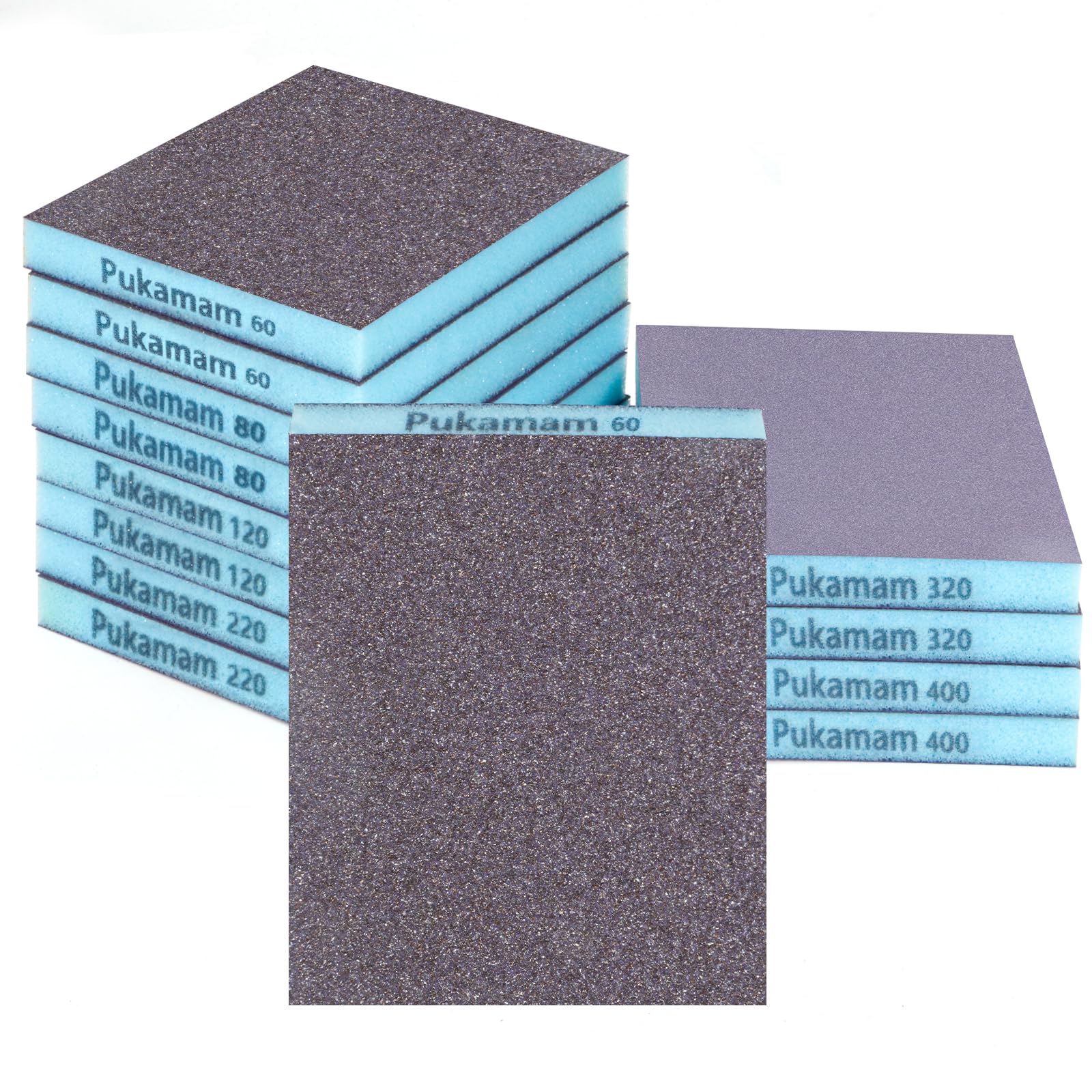
If you only want to buy one box, this twelve-pack is the one with the widest useful range: two sponges each in 60, 80, 120, 220, 320 and 400 grit, so you can strip, shape, smooth and then prep for paint without switching products. The abrasive is aluminum oxide on both faces of a high-density foam that bends and folds, which is what you want when you are sanding the inside of a drawer or the fluting on a table leg. It works wet or dry and rinses clean. Several hundred owners rate it highly and single out the 320 and 400 pads as the reason to pick it over a four-grit set. It has a smaller review base than the two eight-packs, the printed grit labels fade with use, and 400 is still a long way from the 2000 and 3000 grits in the polishing sets below, but as a single all-purpose box it is the best balance here.
- Six grits from 60 to 400 covers rough shaping through pre-paint finishing
- Two of each grit, double-sided abrasive
- Foam bends and folds into grooves and corners
- Strong owner rating from several hundred reviews
- Fewer reviews than the eight-packs
- Grit identification relies on printed labels that wear
- Still not fine enough for polishing clear coat
Sanding Sponge, 60/80/120/220 Grit 4-Pack with Protective Gloves, Coarse Fine Medium Grit Sanding Block by Afruxy

The Afruxy four-pack is the kit for someone who has never bought a sanding sponge and has one project in mind. You get one sponge each in 60, 80, 120 and 220 grit on an aluminum oxide block that is rated for wet or dry use and non-clogging, plus a pair of work gloves that will save your knuckles on a rough board. Several hundred owners rate it highly and the reviews are full of first-time furniture flips and drywall patches done with this exact box. The compromise is quantity: one sponge per grit means you will run out of 120 before you run out of 60, and the listing is stronger on adjectives than on measurements. For a one-off job, or as a gift to go with a tin of chalk paint, it is the tidy option; for regular use, buy one of the eight-packs instead.
- One of each core grit plus a pair of work gloves, a sensible first kit
- Aluminum oxide abrasive rated non-clogging wet or dry
- Strong owner rating from several hundred reviews
- Compact, inexpensive
- Only one sponge per grit
- Listing is heavy on marketing, light on dimensions
- Gloves are basic
16Pcs 220 Grit Sanding Sponge, Jamiikury Sanding Blocks Washable and Reusable, Wet Dry Sandpaper Sponge for Wood Metal FurniturePaint and Drywall

Anyone who has finished a room of drywall knows that the job eats 220-grit pads, and this Jamiikury box is sixteen of them. Each pad is a generous 4.7 by 3.9 inches and about half an inch thick, with brown alumina abrasive on both faces of a blue sponge that the maker rates resistant to water, wear, acid and alkali, so you can wet-sand joint compound to keep the dust down and rinse the pad in a bucket between walls. It is also the right grit for scuffing paint between coats and for a final pass on bare wood before stain. Several hundred owners rate it highly, mostly for value and for the pads not falling apart. It is a single-grit product, so you still need a coarse pack for shaping and filler, the thinner profile flexes more than a chunky block, and the listing’s talk of multiple grades is a translation wobble: everything in the box is 220.
- Sixteen pads of the one grit most jobs end on
- Large 4.7 by 3.9 inch pads for ceilings and walls
- Washable, double-sided, resistant to water and chemicals
- Strong owner rating from several hundred reviews
- Single grit only, so you need another pack for shaping
- Thin at 0.47 inch, so it flexes more than a block
- Listing wording about grades is confusing
Tonmp 20 Pcs 3 x 4 Inch 400-3000 Grit Sanding Sponge Set, Ultra Fine Sanding Sponges Pads, Soft Foam Hand Sander Block Wet Dry Sandpaper for Model Drywall Metal Wood Furniture Polishing

The Tonmp set is for the end of the job, not the start. Twenty thin 3 by 4 inch pads, four each in 400, 600, 1000, 2000 and 3000 grit, take a surface from pre-paint smooth to a polish-ready sheen, and because the foam is only a fifth of an inch thick the pads wrap around curves that a thick block cannot follow, which is why model builders, pen turners and anyone wet-sanding resin or acrylic rate it so highly. Auto and marine refinishers use the 2000 and 3000 pads to level clear coat before compound. Every pad has its grit printed on the backing and all of them work wet, which at these grits you should. Several hundred owners give it a strong rating. It will not remove material, the small pads go through quickly on a large panel, and the thin foam gives little protection on sharp edges, so keep it for finishing and buy a coarse set for everything else.
- Five ultra-fine grits from 400 to 3000, four pads each
- Thin 0.2 inch pads follow curves on models, pens and car panels
- Grit printed on the backing
- Strong owner rating from several hundred reviews
- Too fine for any shaping or material removal
- Small 3 by 4 inch pads wear through quickly on big areas
- Thin foam offers little cushioning on edges
28 Pcs 180-3000 Grit Sanding Sponge,Ultra Fine Sandpaper,Soft Foam Hand Sander Block Wet Dry Sanding Pads for Automobile Wood Furniture Metal Drywall Polishing
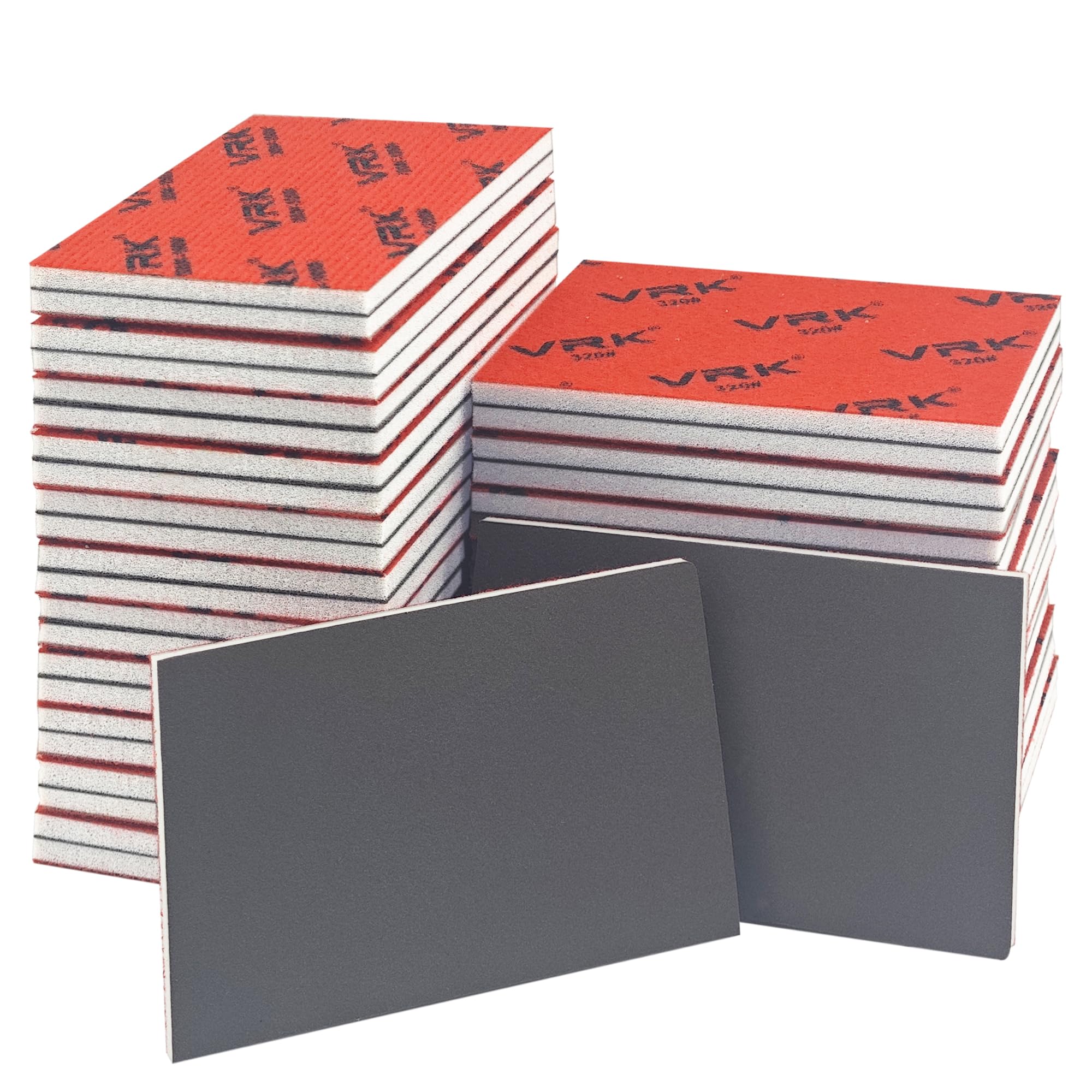
This 28-piece set bridges the gap between the four-grit shop packs and the Tonmp polishing set: four pads each in seven steps from 180 through 320, 500 to 600, 800 to 1000, 1200 to 1500, 2000 and 3000. That is enough to take a filled scratch on a car door from feathered to polish-ready, or a varnished tabletop from flat to glassy, without changing products. The soft foam base is rated to absorb vibration and to conform to curves, and every pad works wet or dry. Several hundred owners rate it highly, with automotive touch-up and furniture refinishing the two uses that come up most. The grits are quoted as ranges for several steps, which is honest but imprecise, there is nothing coarse enough for shaping, and the review base is smaller than the eight-packs. As a single box for wet sanding and polishing, though, it has the broadest reach here.
- Seven grit steps from 180 to 3000, the widest span of any pick
- Four pads per grit, 28 in total
- Soft foam cushions the hand and follows curves
- Strong owner rating from several hundred reviews
- Some grits are given as ranges rather than exact numbers
- Starts at 180, so no coarse shaping
- Smaller review base than the top picks
Compare the picks
| Product | Count | Grits | Size | Wet or dry | Our score | Our score | |
|---|---|---|---|---|---|---|---|
| YNZDRWA 8-packYNZDRWA | 8, 2 per grit | 60, 80, 120, 220 | Standard block, colour coded | Both | 9.0/10 | 9.0 | See price |
| 8 Pack Sanding Sponge BlockMOWPOG | 8, 2 per grit | 60, 80, 120, 220 | 4 x 2.75 x 0.65 in | Both | 9.0/10 | 9.0 | See price |
| F-210 fine variety pack3M | 4, 1 per grade | Fine to MicroFine | 5.5 x 4.5 in | Both | 9.4/10 | 9.4 | See price |
| 12-pack 60 to 400Pukamam | 12, 2 per grit | 60 to 400, six steps | Standard block, double-sided | Both | 9.2/10 | 9.2 | See price |
| Afruxy 4-pack with glovesAfruxy | 4, 1 per grit, plus gloves | 60, 80, 120, 220 | Standard block | Both | 9.2/10 | 9.2 | See price |
| Jamiikury 16-pack 220Jamiikury | 16, single grit | 220 only | 4.7 x 3.9 x 0.47 in | Both | 9.2/10 | 9.2 | See price |
| Tonmp 20-piece 400 to 3000Tonmp | 20, 4 per grit | 400 to 3000, five steps | 3 x 4 x 0.2 in | Both, wet recommended | 9.1/10 | 9.1 | See price |
| 28-piece 180 to 3000VRKET | 28, 4 per grit | 180 to 3000, seven steps | Soft foam block | Both | 9.1/10 | 9.1 | See price |
Which grits you actually need
For bare wood and drywall the four-grit sets cover it: 60 or 80 to remove material and level filler, 120 to smooth, 220 before primer or stain. Painted or clear-coated surfaces need finer: 320 to 400 to scuff between coats, and 600 and up only if you are wet-sanding a finish flat before polishing, which is auto body and fine furniture territory. The fine-grit variety pack and the Tonmp and 28-piece sets live in that second world. A good rule is to never jump more than one step; 80 to 220 leaves scratches that 220 cannot remove, and you end up going back. Buy a coarse set and a fine set rather than hunting for one box that does both badly.
Wet or dry, and how to make them last
Every sponge here can be used wet, and for anything finer than 220 you should: water floats the dust away, stops the abrasive clogging and leaves a smoother scratch pattern, and on drywall compound it turns a cloud of dust into a little sludge you wipe up. Keep a bucket beside you, dip the pad, and rinse it when it stops cutting. Dry sanding is fine for coarse work on bare wood. To make a sponge last, rinse it the moment you finish so dried compound or paint does not lock into the foam, squeeze it rather than wringing it, and let it dry flat. A sponge that has gone glassy is finished; no amount of rinsing brings the grit back.
Sponge or rigid block?
A sponge flexes, which is the whole point for curves, spindles, inside corners and rounded edges, and the foam spreads your finger pressure so you do not dig grooves. A rigid block does the opposite: it bridges low spots and keeps a surface flat, which is what you want on a tabletop or a filled dent that must disappear. Most jobs want both, which is why our sanding blocks guide exists alongside this one. If you must choose a single tool for a small flat area, a thick four-grit sponge like the 8-pack block, used with light pressure, is the better compromise than a rigid block on a curve.
Can sanding sponges be washed and reused?
Yes, every pick here is rated washable. Rinse under a tap or in a bucket as soon as the pad clogs or when you finish, squeeze it out and let it dry flat. The abrasive eventually wears smooth, at which point the sponge is done.
What grit sanding sponge is best for drywall?
120 to level joint compound and 220 for the final pass before primer. The Jamiikury 16-pack of 220 is the bulk choice for finishing a room; use it wet to control dust.
Which sanding sponge should I use between coats of paint or varnish?
320 to 400 grit, used lightly and ideally wet, to scuff the surface without cutting through. The 12-pack 60 to 400 set and the fine variety pack both cover this; the Tonmp set goes finer for rubbing out a clear coat.
Are sanding sponges better than sandpaper?
For hand sanding curves, corners and profiles, yes: they conform, do not tear, and can be rinsed. For large flat surfaces a sheet on a rigid block or a power sander is faster and flatter. Most people want sponges for hand work and sheets for the machine.
Why do my sanding sponges clog so quickly?
Usually because the finish is still soft or the pad is dry. Give paint and varnish the full cure time, then sand wet; water carries the dust away and the sponge will cut far longer between rinses.
Prices and stock change daily. The buttons above open Amazon so you always see the current price. We may earn a commission if you buy through them, at no extra cost to you.
Do Best Deal is a participant in the Amazon Services LLC Associates Program. As an Amazon Associate we earn from qualifying purchases. If you buy through links on this site we may earn a commission, at no extra cost to you. Learn more.