Family game night fails for predictable reasons. The rules take twenty minutes to explain, the youngest player cannot keep up, or the adults are bored by the second round. A good family game is taught in a few minutes, keeps a child and an adult interested in the same turn, and ends before anyone asks how long is left.
The short answer: Azul is the best family board game in our catalog for households with children of about eight and up. It plays two to four people in 30 to 45 minutes, won the 2018 Spiel des Jahres, and holds 4.8 stars from more than 16,000 owners. If you regularly have five or more at the table, buy Blank Slate instead; if your children are under six, start with Zingo.
We compared the 92 board games in our toys and games catalog and chose five that cover different ages and group sizes. We did not play-test them for this guide. The picks rest on what each box says (players, ages, playing time, contents) and on owner ratings and written reviews in our data. Prices change daily and are not printed; every button opens the live Amazon page.
How we picked
- One game per situation. A strategy game, a party game, an abstract puzzle, a preschool game and a team game for large groups.
- Rated 4.8 stars. All five have the same average, from 6,345 ratings for the least reviewed to 17,353 for the most.
- Box facts from the listing. Player counts, ages, playing times and contents are taken from the product data. Where the data gives no playing time, we say so.
- Low cost. Each was under $32 in our data at the time of writing.
- Five publishers. Licensed character editions and junior spin-offs of other games were skipped in favor of games that stand on their own.
The picks
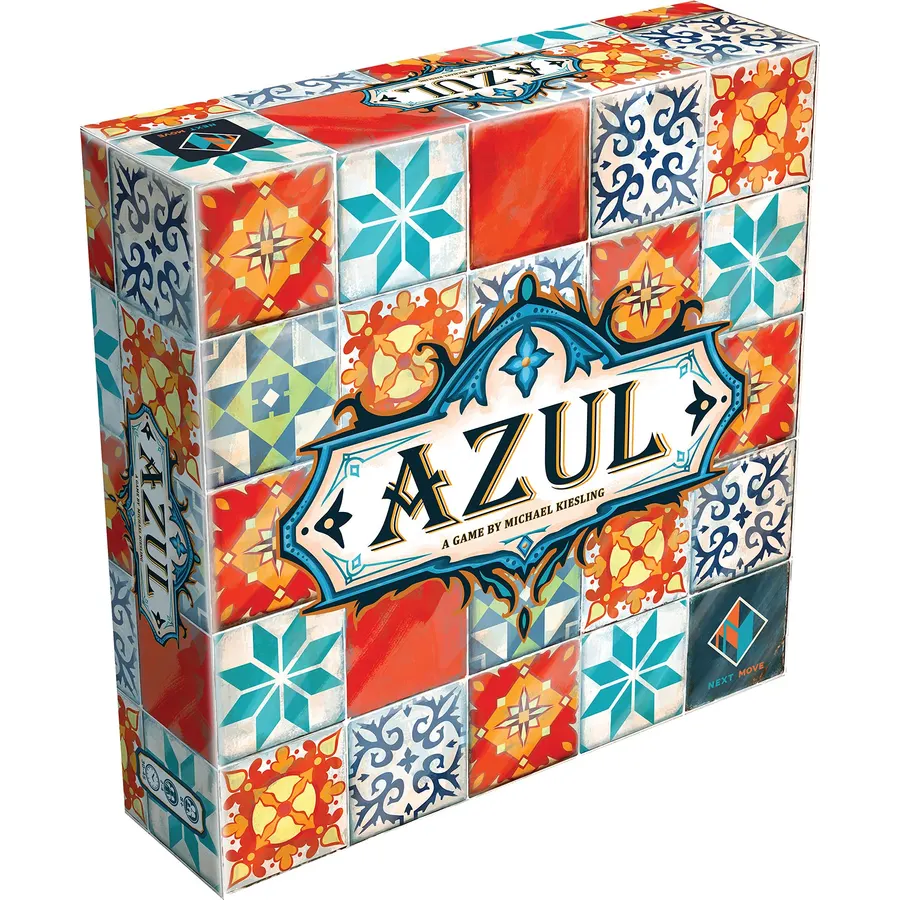
In Azul you take colored tiles from shared displays in the middle of the table and fit them into rows on your own board; full rows move onto a mosaic wall and score, and tiles you cannot place count against you. That is nearly the whole game, and every tile you take is one your neighbor cannot. The box holds 100 resin tiles, four player boards, nine factory displays and a linen bag to draw from. Owners in our data praise the weight and color of the tiles and how well it plays with two. One parent notes that the scoring quietly exercises a child’s arithmetic and that an adult can play gently without throwing the game. The only criticism in the reviews we hold is a rulebook that takes a careful first read.
- Winner of the 2018 Spiel des Jahres
- Works well with two players, which many family games do not
- A parent can ease off and still enjoy the game, as one owner describes
- 4.8 stars from 16,655 owners
- Four players at most
- One owner in our data found the instructions a little complicated
- The highest price of the five at the time of writing
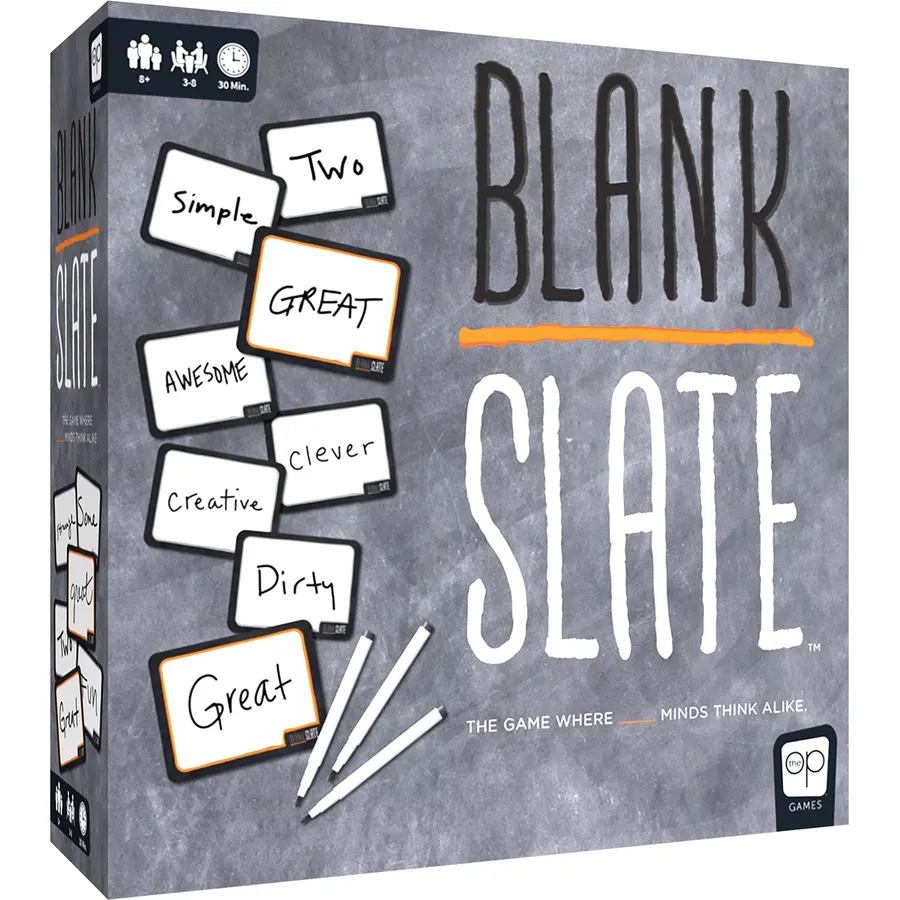
Blank Slate is the easiest game here to bring to a table of relatives. A card shows half a phrase with a blank. Everyone secretly writes the word they think completes it, and you score when your word matches another player’s. There are no right answers, only guesses about how other people think, which is why it works across generations. The set includes a scoreboard, eight dry-erase slates and 250 double-sided cue cards, and a game runs 20 to 35 minutes. Owners in our data call it easy, funny and good for mixed ages; one says it needs four to six people to come alive. A four-star review reports dry-erase markers that did not work, so test them before the guests arrive.
- Seats up to eight and takes a minute to explain
- 250 double-sided cards give 500 word cues
- Low pressure: no trivia and no drawing
- 4.8 stars from 13,470 owners
- Needs at least three players; owners say it is best with four to six or more
- Two reviewers mention markers that arrived dry or dry out if left uncapped
- Everyone must be able to read and write a word
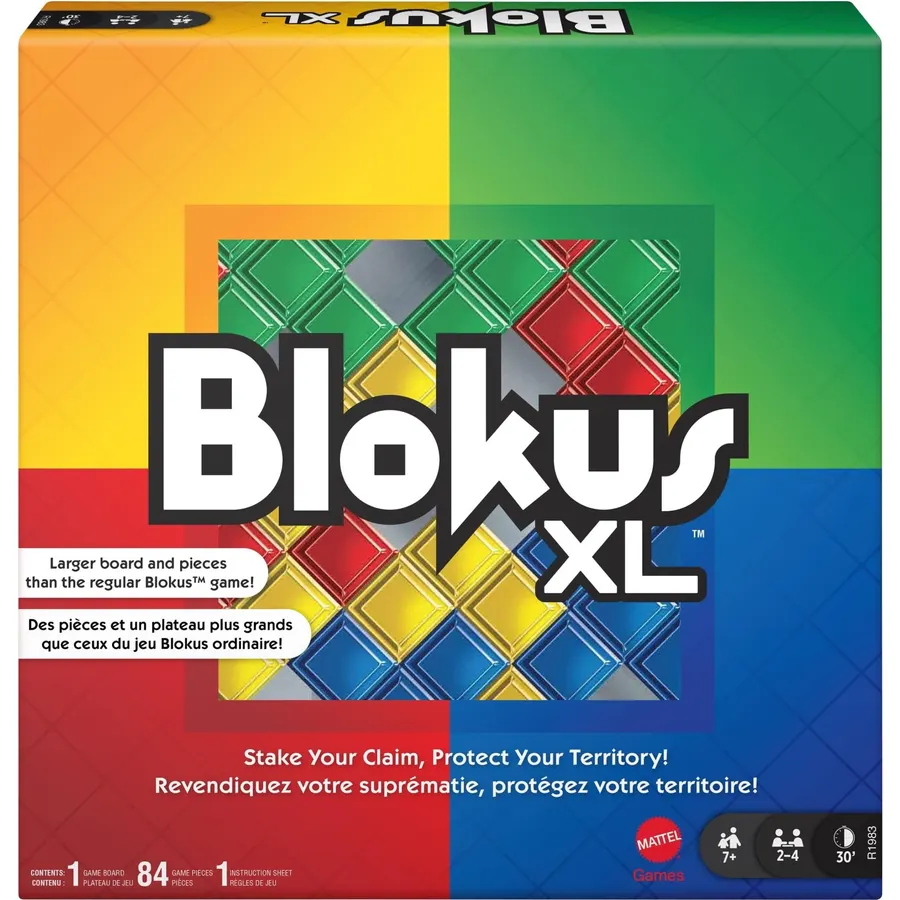
Blokus takes less than a minute to learn. Each player has 21 pieces in one color and places one per turn; a new piece must touch another of your own color, but only corner to corner. The board fills, space runs out, and the winner is whoever is left holding the least. The XL edition has a 12 x 12 inch board, almost two inches larger than the regular game, and bigger pieces. One owner in our data calls it competitive Tetris. Several play it with children younger than the box suggests: five-year-olds who follow the rule but miss the long-term plan. A family with teenagers and college students reports it being played over and over on a holiday weekend. The consistent advice is that four players is the best count, and that you should read the rules for two or three.
- One rule: your pieces may touch each other only at the corners
- XL board is 12 x 12 inches with larger pieces that are easy to pick up
- No reading, so language and age matter less
- 4.8 stars from 10,828 owners
- Owners say it is at its best with exactly four
- Two and three-player games use slightly different rules
- One reviewer would put the real starting age nearer nine
ThinkFun Zingo Bingo Award Winning Preschool Game for Pre-Readers and Early Readers Age 4 and Up
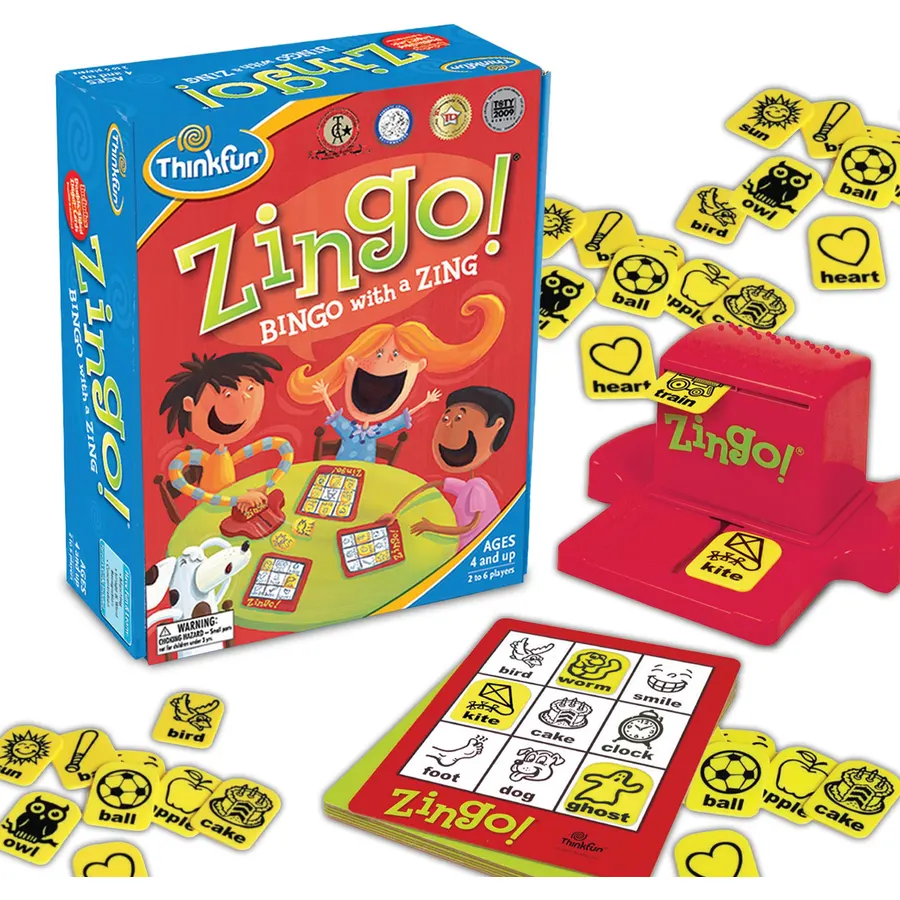
Zingo is bingo rebuilt for small children. Players slide the Zinger to reveal picture tiles and race to match them to the pictures on their own card until a card is full. The listing describes it as a pre-reading game that builds language and matching skills through fast play, and credits it with an Oppenheim Gold Award and a Parents’ Choice Gold Award. Owners in our data play it with children from three to seven and call it sturdy; a grandparent notes the dispenser takes a lot of abuse. One reviewer who uses it in sessions with young children finds that the youngest want to open the slider and handle the tiles instead of playing, so expect some of that under four.
- Made for children who cannot read yet
- The sliding Zinger dispenser is the part children love, owners say
- Two difficulty levels on double-sided cards
- 17,353 owner ratings at 4.8 stars, the most reviewed pick
- Adults and older children will tire of it sooner
- Very young players may just play with the tiles and slider, one reviewer warns
- The listing and spec table disagree on whether six or seven can play
Sequence in a Tin - Five-in-a-Row Fun for Everyone by Jax, 2-12 Players
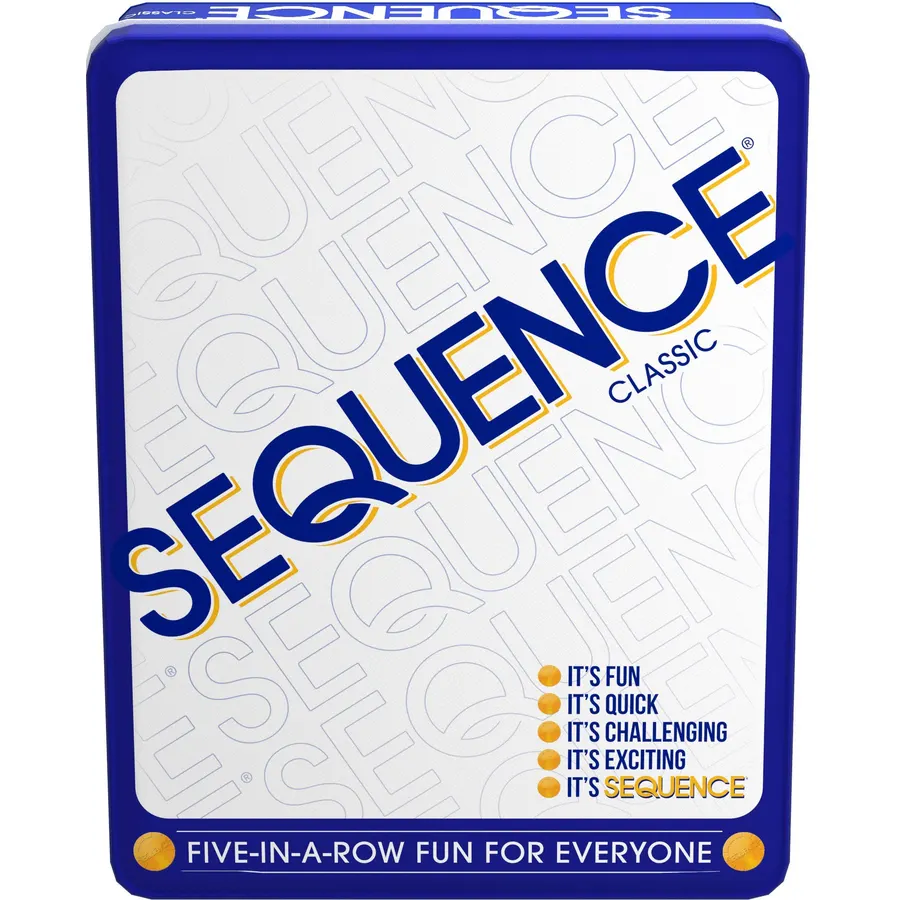
Sequence joins a card game to a board. You play a card from your hand, put a chip on the matching space, and try to line up five in a row before the other side does. Jacks are wild, and you can block opponents or remove their chips. The listing allows 2 to 12 players from age seven, which makes it the pick for holidays when cousins and grandparents all want a seat. The tin stores the folding board, 135 chips and two decks. Owners in our data play it with an eleven-year-old, with adult children and with elderly parents who prefer card games. The single one-star review we hold is from a buyer whose copy did not arrive in a tin.
- Up to twelve can play
- Card play is familiar to grandparents, and children of seven can follow it
- Tin keeps the folding board, chips and cards together
- 4.8 stars from 6,345 owners, and the lowest price here at the time of writing
- Luck of the draw matters more than in Azul or Blokus
- One buyer in our data received it without the tin shown
- Fewest ratings of the five
Compare the picks
| Product | Players | Ages | Playing time | Owner rating | Our score | |
|---|---|---|---|---|---|---|
| AzulAsmodee | 2-4 | 8+ | 30-45 min | 4.8 / 16.7k | 9.6 | See price |
| Blank SlateUSAOPOLY | 3-8 | 8+ | 20-35 min | 4.8 / 13.5k | 9.6 | See price |
| Blokus XLMattel Games | 2-4 | 7+ | Not listed | 4.8 / 10.8k | 9.6 | See price |
| ThinkFun ZingoThinkFun | 2-6 | 4+ | Not listed | 4.8 / 17.4k | 9.6 | See price |
| Sequence in a TinJax | 2-12 | 7+ | Not listed | 4.8 / 6.3k | 9.6 | See price |
How to choose a game your family will actually play
Count the chairs first. A game that tops out at four is no use to a family of five. Azul and Blokus XL stop at four players. Blank Slate takes eight, and Sequence takes twelve. Blank Slate also needs at least three, so it is the wrong buy for a parent and one child.
Let the youngest player set the age. The age on the box is a guide, and owner reviews show it bends both ways: five-year-olds manage Blokus with help, while one reviewer would wait until nine. If anyone at the table is under seven, Zingo is the only pick here built for them.
Check who has to read. Zingo is designed for pre-readers. Blokus, Azul and Sequence involve no reading during play. Blank Slate requires every player to read a cue and write a word, which rules out the smallest children and makes it a strong choice for families practising spelling or English.
Decide how much luck you want. Luck keeps weaker players in the game; skill rewards the person who thinks ahead. Zingo is nearly all luck and speed. Sequence mixes the cards you are dealt with the choices you make. Blokus and Azul are mostly skill, which suits older children and can discourage younger ones who keep losing to a parent.
Buying for a child who prefers making things to competing? Our guides to kids cameras and jewelry making kits cover that ground, and tech gifts under $50 has ideas in a similar budget.
What is the best board game for a family with young children?
Zingo, for ages four and up. It needs no reading, a round is quick, and owners in our data play it with children from three to seven. Once the youngest is about seven, Blokus XL is the natural next step because it has a single rule.
Which of these games work with only two players?
Azul is the strongest two-player game here; its listing highlights head-to-head play and owners agree. Blokus XL and Sequence also allow two, though Blokus owners say four is better and the two-player rules differ slightly. Blank Slate needs at least three.
Which game is best for a large group?
Sequence in a Tin takes up to 12 players and Blank Slate up to 8. Blank Slate is the livelier of the two and owners say it improves with more people; Sequence is calmer and suits groups that include grandparents.
How long does a game take?
Blank Slate is listed at 20 to 35 minutes and Azul at 30 to 45 minutes. The product data we hold for Blokus XL, Zingo and Sequence in a Tin does not state a playing time.
Have any of these games won awards?
According to their listings, Azul won the 2018 Spiel des Jahres, the German Game of the Year award, and Zingo has received an Oppenheim Gold Award and a Parents' Choice Gold Award.
Bottom line
Buy Azul if your family is two to four people and the children are eight or older; it is the game on this list adults ask to play again. Choose Blank Slate for a full table, Blokus XL for a fast game with one rule, Zingo for the under-sixes, and Sequence in a Tin when three generations want to play together.
Prices and stock change daily. The buttons above open Amazon so you always see the current price. We may earn a commission if you buy through them, at no extra cost to you.
Do Best Deal is a participant in the Amazon Services LLC Associates Program. As an Amazon Associate we earn from qualifying purchases. If you buy through links on this site we may earn a commission, at no extra cost to you. Learn more.