Japanese rice cookers cost two to five times what a one-switch pot costs, and the reason people pay is the rice: a micom (microcomputer) controller soaks, boils, steams and rests the grain in timed phases, so short grain and sushi rice come out glossy and separate instead of gummy, and brown rice is actually tender. The induction models go further by heating the whole pot rather than a plate under it. We ranked the Japanese-brand and Japanese-style cookers in our home and kitchen catalog by heating technology, rice programs, capacity, inner pot and lid design, and by what thousands of owners say after years of nightly use, since these are machines people keep for a decade.
We have not cooked in every one ourselves; the verdicts rest on the spec sheets and on the owner review history. Prices are not printed because they change daily; every button opens the live Amazon page. For cheaper cookers of all sizes see our rice cookers guide, and for 2 to 4 cup models the small rice cookers guide.
How we picked
- Japanese brands or Japanese-style micom tech. Zojirushi, Tiger and Toshiba, all with fuzzy-logic or induction control. Korean pressure cookers and one-switch pots were left for other guides.
- Programs that matter. White, sushi, brown, mixed and porridge at minimum; we noted GABA brown rice, steam and synchro-cooking extras.
- Heating method. Induction ranks above a triple heater, which ranks above a single bottom plate, because it shows in the rice.
- Capacity spread. From 3 cups for couples to 10 cups for a large household, so there is a pick for each kitchen.
- Owner ratings of 4.4 stars or better, with seven of eight picks past 3,000 reviews.
The picks
Zojirushi Ns ZCC10 Neuro Fuzzy Rice Cooker and Warmer (White)
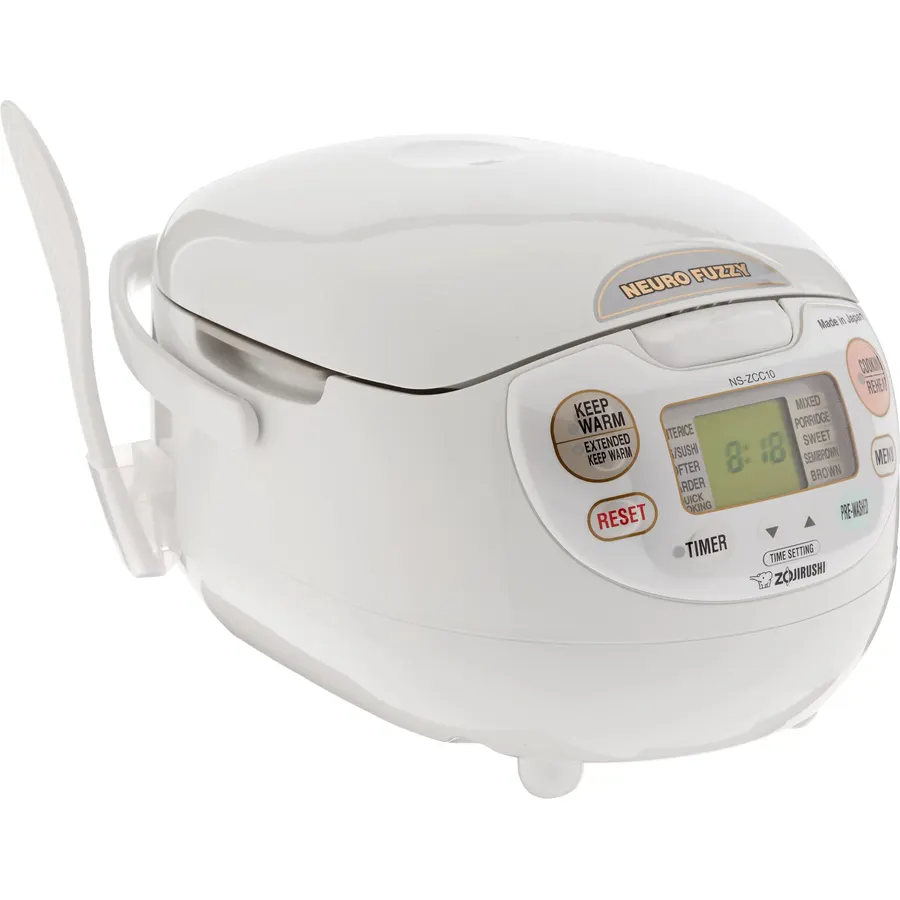
The NS-ZCC10 is the Japanese rice cooker everyone else is compared to, and 12,000 owners rating it 4.7 stars after many years on sale is the evidence. Its Neuro Fuzzy controller adjusts the soak, boil and rest phases to the batch, and it is the only pick here that lets you choose softer or harder for white and sushi rice. Mixed, porridge, sweet, semi-brown, brown, rinse-free and quick programs cover everything a Japanese or Korean kitchen cooks, the spherical nonstick pan heats evenly from a single bottom heater, and extended keep warm plus a reheat cycle keep rice good for a full day. The cycle is slow at close to an hour, so most owners set the LCD timer the night before, and the white plastic body is more 2005 than 2026. None of that stops it being the one to buy.
- 12,000 owners at 4.7 stars, the benchmark Japanese cooker for two decades
- Softer and harder texture options for white and sushi rice
- Spherical pan heats evenly; rinse-free and semi-brown programs
- Extended keep warm and reheat hold rice for a day
- Regular cycle takes 50 to 60 minutes; use the timer
- Bottom heater only, no induction
- Plain white plastic body looks dated next to the stainless models
Zojirushi Ns TSC10 5.5 Cup Micom Rice Cooker and Warmer, 1.0l
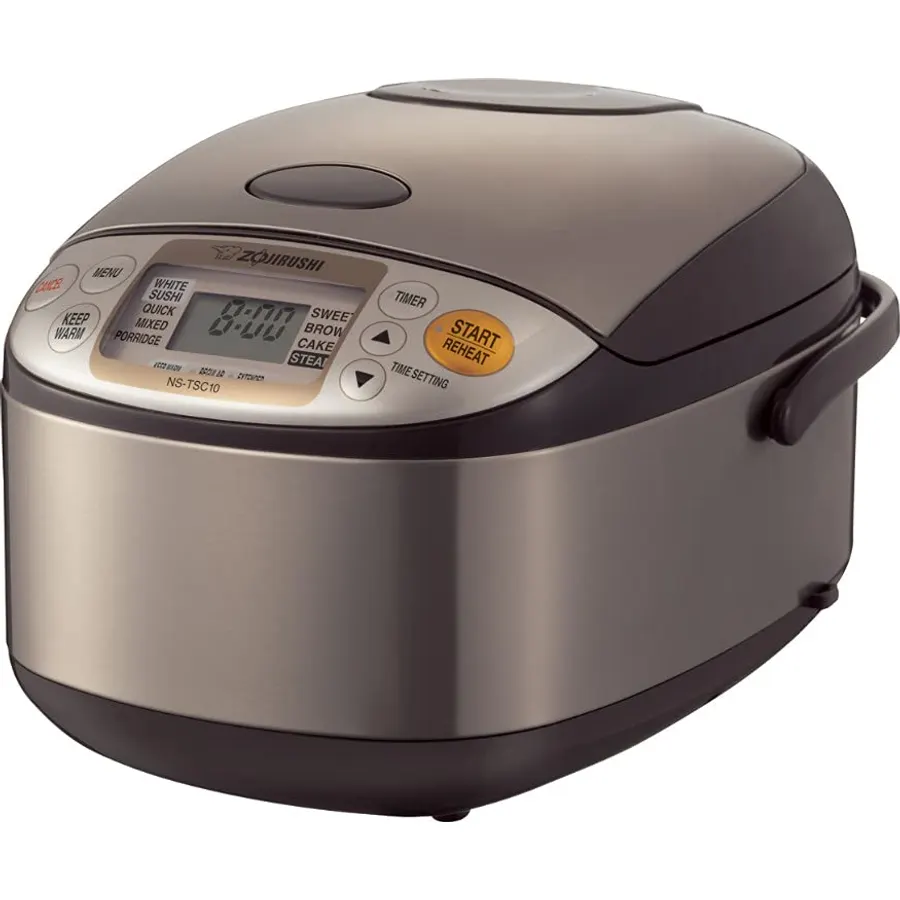
The NS-TSC10 is the Zojirushi for people who want the brand without the Neuro Fuzzy price, and with 14,000 reviews at 4.6 stars it is the most-reviewed cooker on this page. It cooks the same 5.5 cups with micom fuzzy logic, offers white, sushi, mixed, porridge, sweet, brown and quick programs, and adds a steam menu the NS-ZCC10 lacks, so it doubles as a steamer for vegetables and dumplings. The clear-coated stainless body is easier to live with than the white plastic, two delay timers cover breakfast and dinner, and the keep warm, extended keep warm and reheat cycles are the same as its sibling. You lose the softer and harder texture settings and the rinse-free program, and the steam basket is small. For most households the trade is sensible and the savings are real.
- 14,000 owner reviews at 4.6 stars, the most-reviewed cooker here
- Steam menu doubles it as a vegetable and dumpling steamer
- Stainless exterior wipes clean and looks the part
- Two preset timers and the full Zojirushi keep warm suite
- Fewer rice programs than the Neuro Fuzzy; no texture choice
- Single bottom heater
- Steam basket is modest in size
TIGER JBV-S10U 5.5-Cup (Uncooked) Micom Rice Cooker and Warmer with Tacook Food Steamer Cooking Tray Technology, White
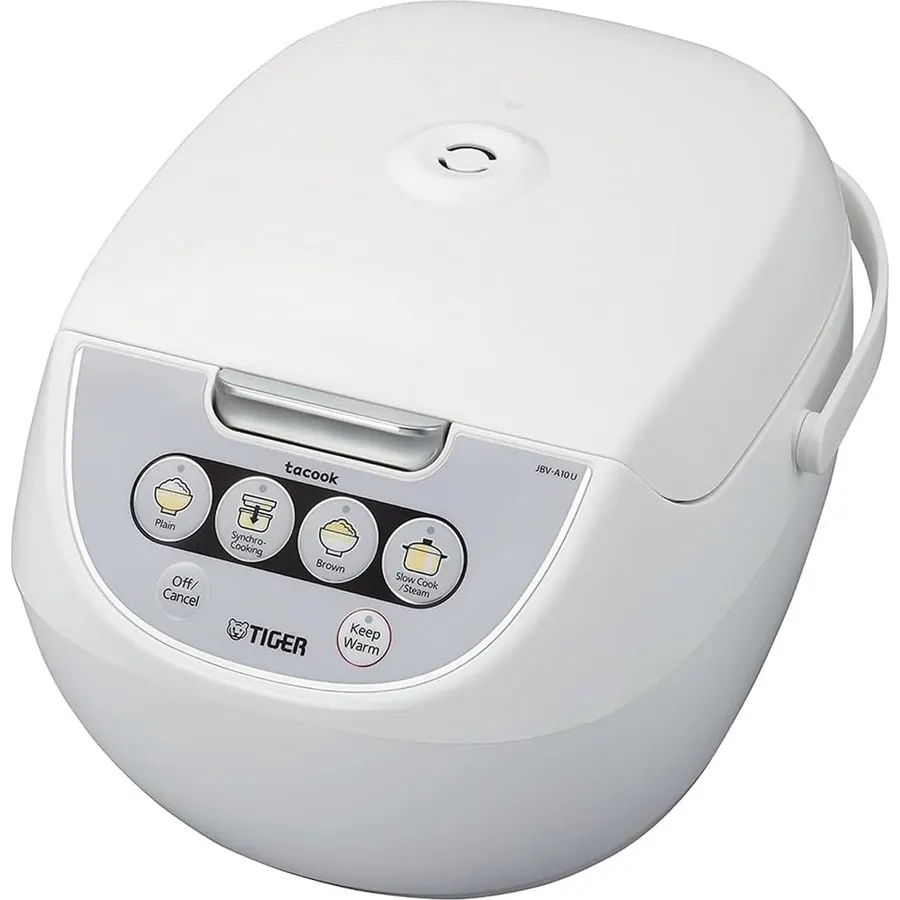
The Tiger JBV-S10U is the entry point to a Japanese micom cooker and the pick for a busy household: its tacook tray sits over the rice and steams chicken, fish or vegetables in the same cycle, and Tiger designed it so the two do not swap flavors. Underneath, a microcomputer runs plain rice, brown rice, slow cook and steam settings for up to 5.5 cups, and the fluorine-coated aluminum pot has clear water markings. Owners rate it 4.6 stars across 6,800 reviews and mostly talk about one-button dinners. The limits are the short program list, with no sushi, porridge or mixed grain setting, a thinner pot than the premium Tigers, and a plastic body. If you want Zojirushi-grade rice programs, look above; if you want dinner done in one appliance for less, this is it.
- Tacook tray cooks rice and a main dish at the same time without mixing flavors
- Micom control at a price well under the Zojirushis
- 6,800 owners at 4.6 stars
- Simple four-setting panel anyone can use
- Only four programs; no sushi, porridge or mixed rice setting
- Thinner 1.7 mm pot than the premium Tigers
- Plastic body and basic display
Zojirushi NP-HCC10XH Induction Heating System Rice Cooker and Warmer, 5.5-Cup, Stainless Dark Gray
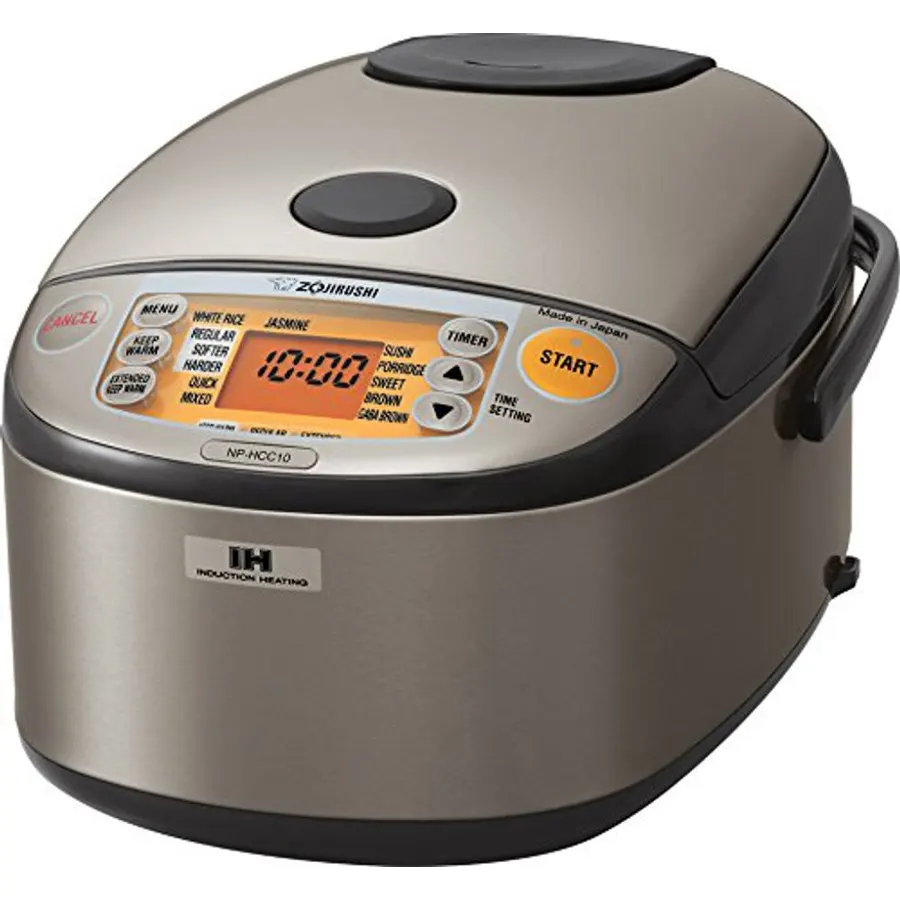
The NP-HCC10XH is the step from very good rice to the best rice a home cooker makes. Induction heating turns the whole inner pan into the heating element, so the grain cooks evenly from edge to center without the slightly firmer bottom layer a plate heater leaves, and Zojirushi adds a jasmine program, a GABA brown rice program that activates brown rice before cooking, and softer or harder settings for white rice. It holds 5.5 cups, has two delay timers and extended keep warm, and owners rate it 4.7 stars across 4,500 reviews with the common remark that they did not expect rice to taste different. The price is the barrier, roughly double the Neuro Fuzzy, and it is a large, heavy appliance for its capacity. For a household that eats rice daily and notices texture, it is worth it.
- Induction heats the whole pan, the most even rice on this page
- Jasmine and GABA brown rice programs the micom models lack
- 4.7 stars from 4,500 owners
- Softer and harder texture settings
- Costs close to double the Neuro Fuzzy
- 1,230 W draw; cycles still run 45 to 60 minutes
- Heavy and large for its 5.5 cup capacity
Zojirushi Micom 3-Cup Compact Size, Multiple Settings, Stainless Steel Made, Built-In Retractable Power Cord and Easy to Transport Rice Cooker and Warmer
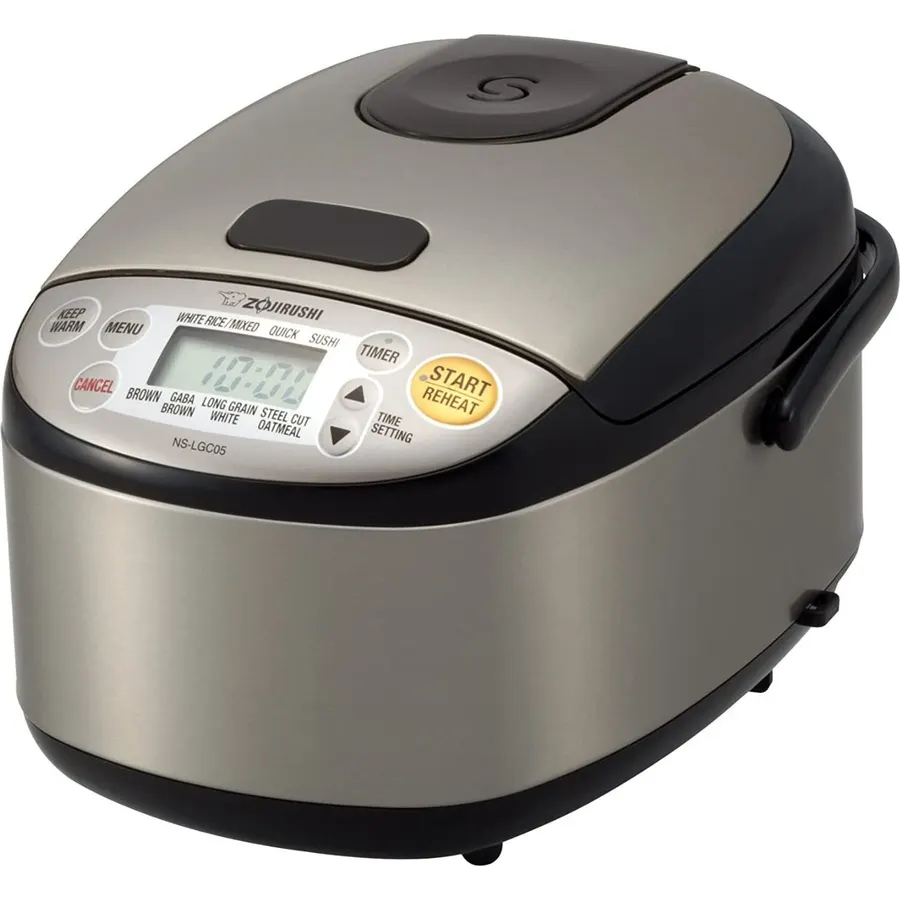
The 3-cup Zojirushi micom is the small cooker for people who want full Japanese rice programs without a 5.5 cup footprint. It cooks from half a cup to 3 cups, has separate settings for short grain white, long grain white, sushi, mixed, porridge, brown and GABA brown rice plus a steel-cut oatmeal mode, and folds its handle down and retracts its cord for storage. Owners give it 4.7 stars across 8,100 reviews, with couples and solo cooks saying it replaced a larger cooker that handled small batches badly. The price is the catch: it costs about what the 5.5 cup Tiger does, there is no steam setting, and cycles run 45 to 60 minutes. For one or two daily rice eaters it is the right size, and the quality is pure Zojirushi.
- 8,100 owners at 4.7 stars in a 3 cup size
- GABA brown rice and steel-cut oatmeal programs rarely seen this small
- Cooks half a cup well, which most 5.5 cup cookers cannot
- Fold-down handle and retractable cord for small kitchens
- Costs as much as the 5.5 cup Tiger
- No steam program
- Slow cycles like every Zojirushi
Tiger JNP-0550-FL 3-Cup (Uncooked) Rice Cooker and Warmer, Floral White
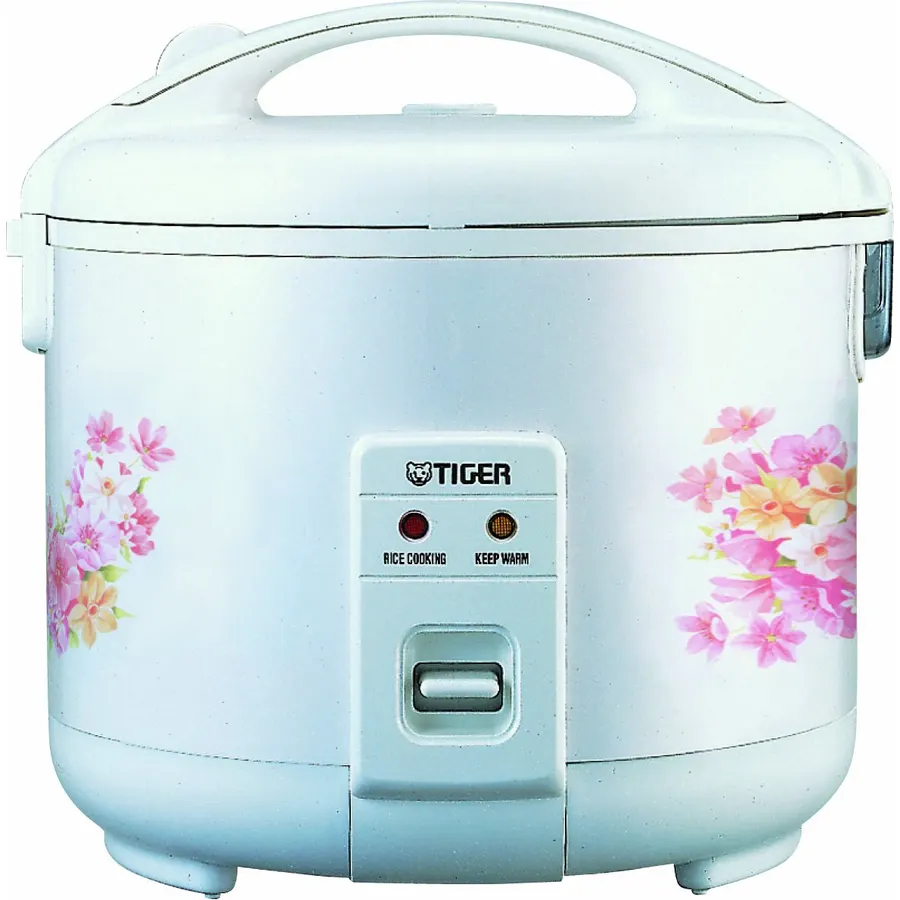
The JNP-0550 is the odd one on this page: a conventional one-switch cooker, not a micom, that earns its place by being built in Japan to a standard the budget switch cookers are not. You add up to 3 cups of rice, press the lever, and it cooks and switches to a keep warm that holds for 12 hours; owners rating it 4.5 stars across 4,200 reviews frequently mention 10 and 20 year old units still in service. The removable steam vent washes, the cord retracts and the floral white body is unmistakably Tiger. What it cannot do is adjust: brown rice, porridge and mixed rice have no setting and come out as well as your water ratio allows, and it costs more than a digital Aroma that does more. It is for people who want white rice done perfectly by a machine that will outlive the kitchen.
- Made in Japan, and owners report decades of use
- One switch; nothing to program or break
- Keeps rice warm for up to 12 hours
- 4,200 owners at 4.5 stars
- No micom: white rice only, no brown or porridge program
- Expensive for a one-switch cooker
- Lid is not removable for washing
Toshiba Rice Cooker 6 Cup Uncooked Japanese Rice Cooker with Fuzzy Logic Technology, 7 Cooking Functions, Digital Display, 2 Delay Timers and Auto Keep Warm, Non-Stick Inner Pot, White
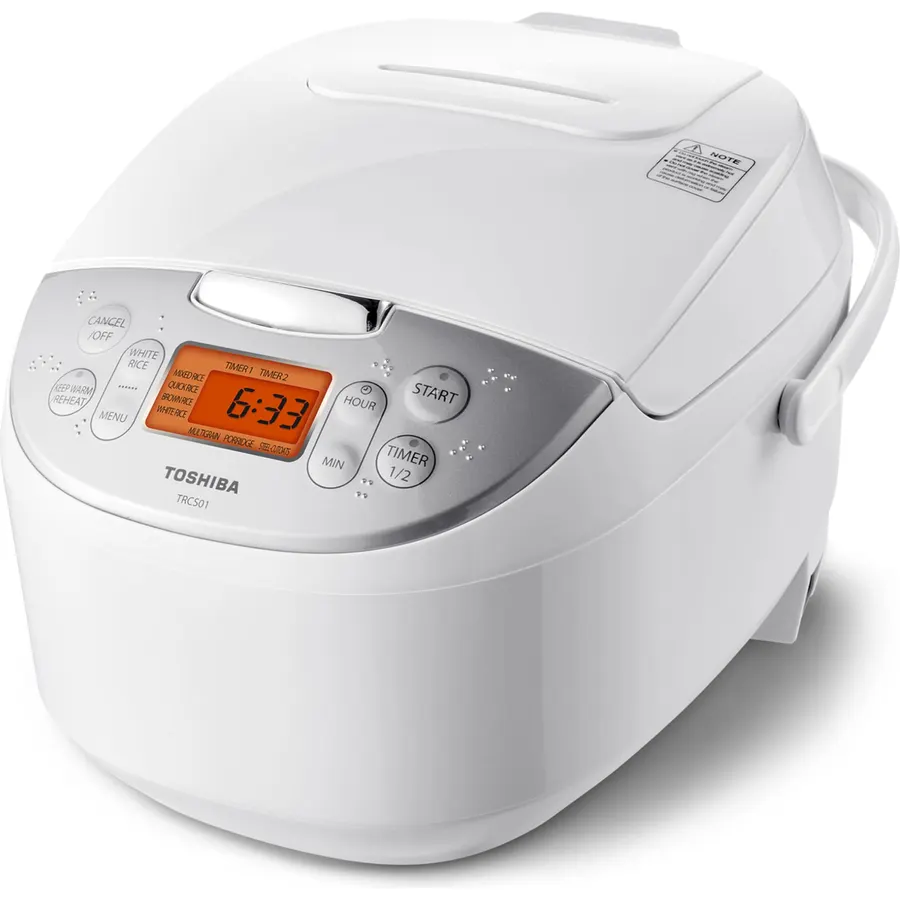
The Toshiba 6-cup is the budget way into Japanese-style fuzzy logic: a microcomputer runs a six-step cycle with programs for white, brown, mixed, multi-grain, quick rice, porridge and steel-cut oats, two delay timers cover breakfast and dinner, keep warm holds 15 hours, and a steam basket comes in the box. Six cups uncooked feeds a family, and 3,400 owners rate it 4.6 stars, most of them comparing the rice favorably to a switch cooker they replaced. Be clear about what it is: a licensed Toshiba design built to a price, not a Zojirushi, so the pot is thinner and should be hand washed, and the lid locks during cooking. For a family that wants fuzzy-logic rice and has a Zojirushi-shaped hole in the budget, it is the sensible pick.
- Fuzzy logic and seven programs at roughly half the Zojirushi price
- Steam basket and two delay timers
- 15-hour keep warm; 3,400 owners at 4.6 stars
- Family-size 6 cup capacity
- Toshiba brand licensed; not built to Zojirushi or Tiger standards
- Nonstick pot should be hand washed
- Locking lid cannot be opened mid-cycle
Tiger Jax T18u K 10 Cup Micom Rice Cooker (Stainless Steel)
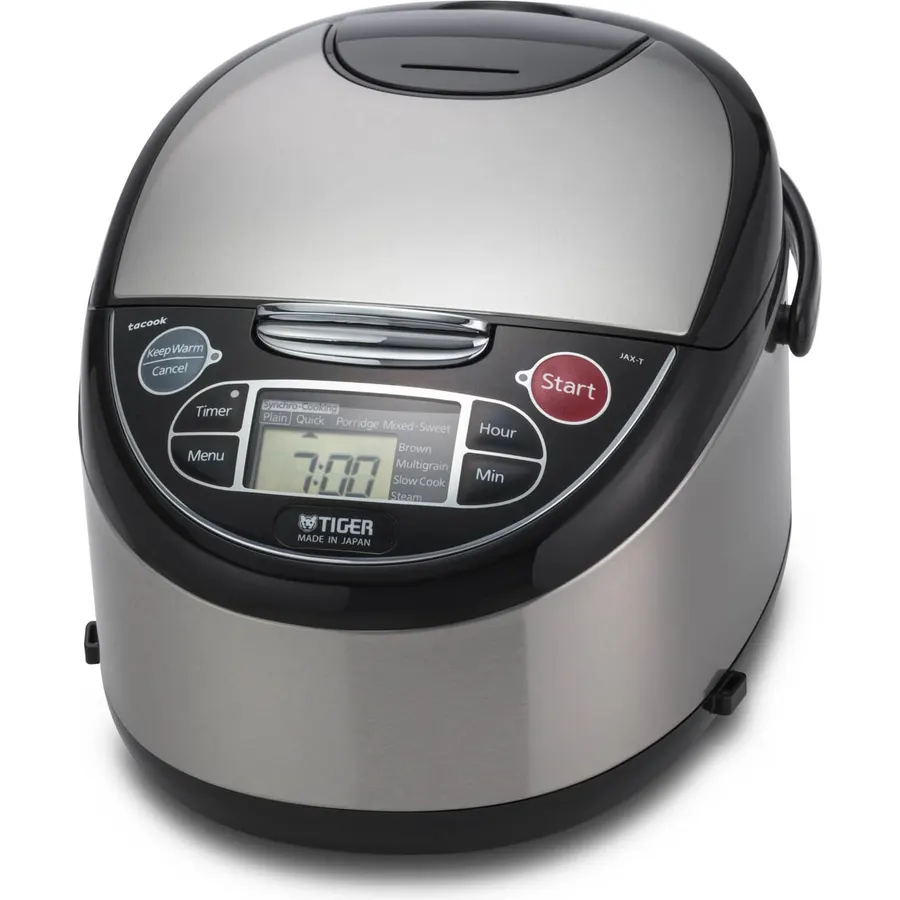
The JAX-T18U is the Japanese cooker for a big household: 10 cups uncooked is 20 cups cooked, enough for a family of six with lunches or a dinner party. Tiger gives it micom control with 10 menu settings and four functions, a thicker 1.8 mm pot than its 5.5 cup JBV sibling, and the tacook synchro-cooking plate so vegetables or a protein steam over the rice. The inner lid and steam cap come off for washing, which matters more at this size. Owners rate it 4.5 stars, though with about 1,300 reviews it has less history than the rest of the page. The practical warnings are footprint, since it is a large stainless box, and the usual big-cooker caveat that one or two cups cook less evenly than a full pot. For large batches it is the one.
- 10 cup capacity for large families and entertaining
- Tacook plate cooks a side or main over the rice
- 1.8 mm pot, thicker than the 5.5 cup Tiger
- Removable inner lid and steam cap for cleaning; 4.5 stars
- Fewer reviews than the others here, about 1,300
- Large footprint; measure the counter
- Cooking small batches in a 10 cup pot is less even
Compare the picks
| Product | Capacity | Heating | Rice programs | Extras | Owner rating | Our score | |
|---|---|---|---|---|---|---|---|
| Zojirushi NS-ZCC10 Neuro FuzzyZojirushi | 5.5 cups | Micom, bottom heater | 9 incl. texture choice | LCD timer, reheat | 4.7 (12,000+) | 9.4 | See price |
| Zojirushi NS-TSC10Zojirushi | 5.5 cups | Micom, bottom heater | 7 plus steam | 2 timers, steam menu | 4.6 (14,000+) | 9.2 | See price |
| Tiger JBV-S10UTiger | 5.5 cups | Micom | 4 settings | Tacook tray | 4.6 (6,800+) | 9.2 | See price |
| Zojirushi NP-HCC10XHZojirushi | 5.5 cups | Induction, 1,230 W | 10 incl. jasmine, GABA | 2 timers | 4.7 (4,500+) | 9.4 | See price |
| Zojirushi 3-Cup MicomZojirushi | 3 cups | Micom | 9 incl. GABA, oats | Fold handle, cord | 4.7 (8,100+) | 9.4 | See price |
| Tiger JNP-0550Tiger | 3 cups | Conventional switch | White rice | 12 h keep warm | 4.5 (4,200+) | 9.0 | See price |
| Toshiba 6-CupTOSHIBA | 6 cups | Fuzzy logic | 7 | 2 timers, steam basket | 4.6 (3,400+) | 9.2 | See price |
| Tiger JAX-T18UTiger | 10 cups | Micom | 10 menus | Tacook plate | 4.5 (1,300+) | 9.0 | See price |
Micom, induction or conventional?
A conventional cooker (Tiger JNP-0550) has one heating plate and one switch: it boils until the water is gone and clicks off. A micom cooker (every Zojirushi and Tiger here except the JNP, plus the Toshiba) puts a microcomputer in charge of that plate and runs the rice through soak, boil, steam and rest phases whose lengths change with the batch, which is why it can offer brown, porridge and sushi programs and why the rice is more even. Induction (Zojirushi NP-HCC10XH) replaces the plate with a magnetic field that heats the whole pan, so there is no hot spot at all and the controller can change temperature almost instantly. Most people are very happy at the micom level; induction is for the household that eats rice every day and will notice.
Which capacity?
Japanese cookers measure in 180ml rice cups of uncooked rice. Three cups (Zojirushi 3-cup, Tiger JNP-0550) suits one or two people and cooks a half cup properly, which the larger cookers do not. The 5.5 cup size that Zojirushi and Tiger built their reputations on makes about 10 to 11 cups cooked and is right for three to five people or a couple who batch-cook. Six cups (Toshiba) is a hair bigger, and 10 cups (Tiger JAX-T18U) is for six or more or for entertaining. Buy for the amount you cook most nights, not the most you might ever cook; a half-full pot cooks worse than a right-sized one.
Keep warm, timers and daily use
The reason these cookers are kept rather than replaced is the keep warm: Zojirushi and Tiger hold rice at serving temperature for 12 hours or more without drying it, and the Zojirushis add an extended keep warm and a reheat cycle for rice that has been sitting. Delay timers matter because micom cycles are slow, 45 to 60 minutes for regular white rice; owners set the timer at night for breakfast porridge or in the morning for dinner. The Tigers add the tacook tray so a main dish cooks over the rice, and the NS-TSC10 and Toshiba add a steam menu. For the pot, use the plastic paddle and hand wash the nonstick pan, and the cooker will likely be the longest-lived appliance in the kitchen. If you want one pot that pressure cooks and also makes rice, see our electric pressure cookers guide.
Is Zojirushi better than Tiger?
Zojirushi offers more rice programs and texture settings and has the deeper review history; Tiger offers the tacook tray that cooks a main dish over the rice and generally costs less at the same size. Both make excellent rice and both are built to last.
Is an induction rice cooker worth the extra money?
If you eat rice daily and care about texture, yes: induction heats the whole pan so the rice is even from edge to center. For most households a micom cooker like the Neuro Fuzzy is already a big step up and costs about half.
Why do Japanese rice cookers take so long?
A micom cooker soaks the rice, brings it up slowly, steams and rests it, which takes 45 to 60 minutes. That schedule is what makes the rice better. Use the quick program when in a hurry or set the delay timer so it finishes when you want to eat.
Can these cookers make brown rice and porridge?
Every micom pick has brown rice and porridge programs, and the Zojirushi 3-cup and NP-HCC10XH add GABA brown rice. The conventional Tiger JNP-0550 has no programs and is best kept for white rice.
Which Japanese rice cooker is best for two people?
The Zojirushi 3-cup micom: it cooks from half a cup to 3 cups with the full program list and folds up for storage. If you want a cheaper simple option, the Tiger JNP-0550 is also 3 cups.
Prices and stock change daily. The buttons above open Amazon so you always see the current price. We may earn a commission if you buy through them, at no extra cost to you.
Do Best Deal is a participant in the Amazon Services LLC Associates Program. As an Amazon Associate we earn from qualifying purchases. If you buy through links on this site we may earn a commission, at no extra cost to you. Learn more.