Five hundred dollars is the ceiling for most gaming PC budgets and the price band where graphics cards get interesting: it buys a card that runs every current game at 1080p with high settings and most of them at 1440p, with enough video memory to not choke on the newest texture packs. It is also the band where three vendors compete, so the choice between AMD, Nvidia and Intel is real rather than theoretical. We ranked the graphics cards in our PC parts catalog that sat at or under the cap at the time of writing by the performance tier of the GPU, how much memory it has and on what bus width, the cooler and card length, the power connectors it needs, and what hundreds to thousands of owners report after building with them.
We have not benchmarked these cards ourselves; the verdicts rest on the spec sheets, the known performance tier of each GPU and the owner review history. Prices are not printed because they move daily and this category moves more than most; every button opens the live Amazon page so you can check the card is still under your cap. For cheaper cards, see our budget graphics cards guide; for the supply to feed one of these, see power supplies for gaming PCs; and for a screen to match, see budget 1440p gaming monitors.
How we picked
- Under the cap at the time of writing. We dropped excellent cards that had drifted above it and cards with no live price.
- At least 6GB of VRAM, and we rank 12GB cards above 8GB cards at the same tier because new games are hungry for memory.
- A current or last-generation GPU. No GT 710 or GTX 1650 rebrands; every pick does hardware ray tracing and upscaling (FSR, DLSS or XeSS).
- Honest cooling and size. Dual-fan or better, with card length noted where the maker states it.
- Owner ratings of 4.4 stars or better, with review counts from a few hundred to two thousand.
The picks
XFX Speedster SWFT210 Radeon RX 7600 Graphics Card with 8GB GDDR6 HDMI 3xDP, AMD RDNA 3 RX-76PSWFTFA
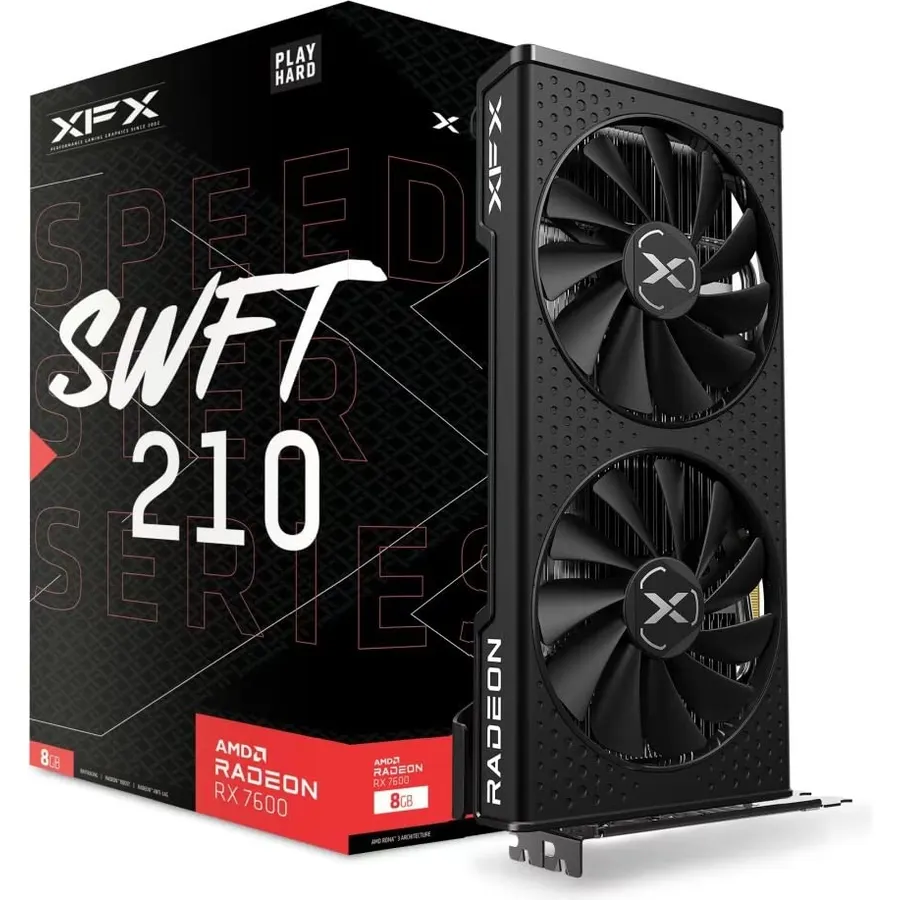
The RX 7600 is the sensible 1080p card and the one that leaves the most budget for the rest of the build. It is a current-generation RDNA 3 GPU with 8GB of GDDR6, a boost clock up to 2655 MHz and support for FSR 3 upscaling and frame generation, which is what lets it hold high refresh rates at 1080p in new releases. The XFX SWFT210 version uses a dual-fan cooler on a card short enough for most mid-tower and many compact cases, with one HDMI and three DisplayPort outputs. Its limits are the same as every 8GB card: at 1440p with ultra textures it starts to run out of memory, and ray tracing is weaker than on Nvidia cards at this tier. Owners rate it 4.4 stars from 510 reviews and mostly describe it as a clean, quiet upgrade from older GTX cards.
- Current-generation RDNA 3 card well under the cap
- FSR 3 upscaling and frame generation
- Dual-fan SWFT cooler is compact and quiet
- 510 owners at 4.4 stars
- 8GB is the minimum for new games at 1440p
- Ray tracing performance trails Nvidia at this tier
- Only one HDMI port
ASRock Intel Arc B580 Challenger 12GB OC Graphics Card, 2740 MHz GPU Clock, 12GB GDDR6, DisplayPort 2.1, HDMI 2.1a, Dual Fan Cooling, 0dB Silent Operation
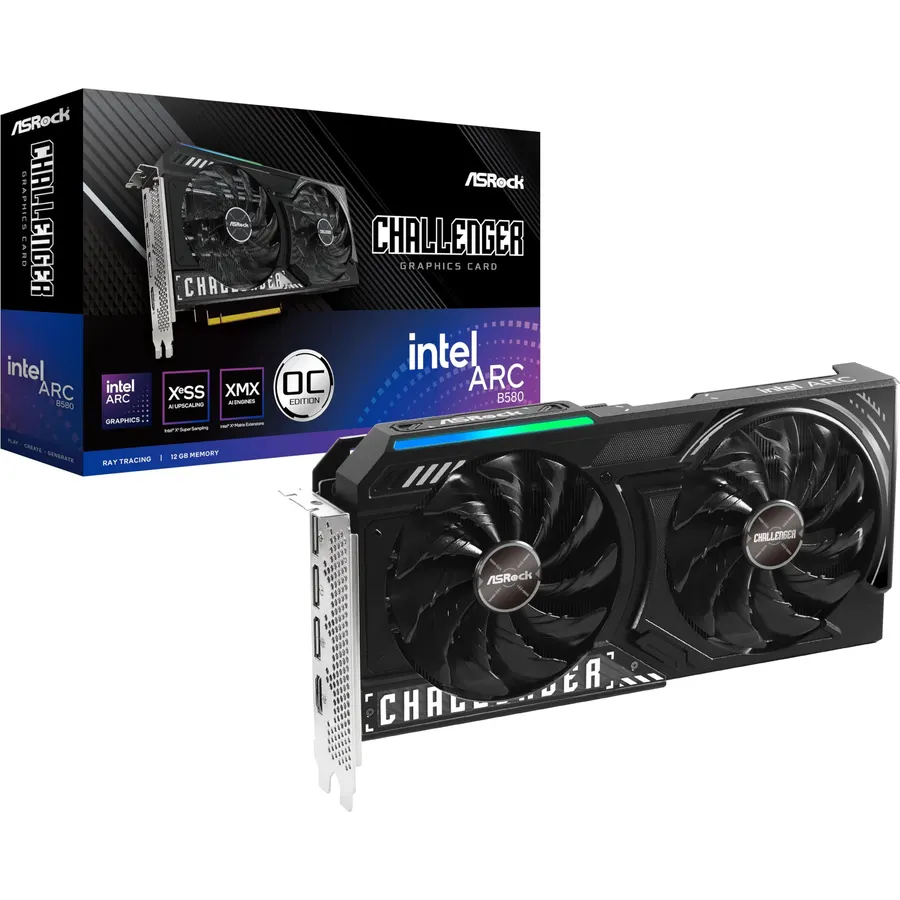
The Arc B580 is the card that reset expectations for this price band: 12GB of GDDR6 on a 192-bit bus at 19 Gbps, a 2740 MHz clock on ASRock’s overclocked Challenger board, and XeSS 2 upscaling driven by 160 XMX engines, for a price that undercuts every 12GB Nvidia card. It is the pick for 1440p on a budget because the memory does not run out where the RX 7600 does. The caveats are real: Intel drivers have improved enormously but older DirectX 9 and 11 titles can still perform below the card’s class, and the B580 wants a recent CPU with Resizable BAR enabled or it loses a chunk of performance. ASRock’s dual-fan cooler stops spinning at idle, the card is 249mm long and takes one 8-pin connector. It has 410 reviews at 4.4 stars.
- 12GB on a 192-bit bus for less than any 12GB Nvidia card
- XeSS 2 upscaling with 160 XMX AI engines
- DisplayPort 2.1 and HDMI 2.1a, newest outputs here
- 0dB fan stop; 410 owners at 4.4 stars
- Intel drivers are still maturing; older DirectX 9 and 11 games can be uneven
- Needs a modern CPU with Resizable BAR enabled to perform properly
- Fewer reviews than the Nvidia veterans
ASRock Radeon RX 7700 XT Challenger 12GB OC Graphics Card, AMD RDNA 3 Architecture, 12GB GDDR6, 2584 MHz Boost Clock, 3X DisplayPort 2.1, 1x HDMI 2.1, Dual Fan Cooling
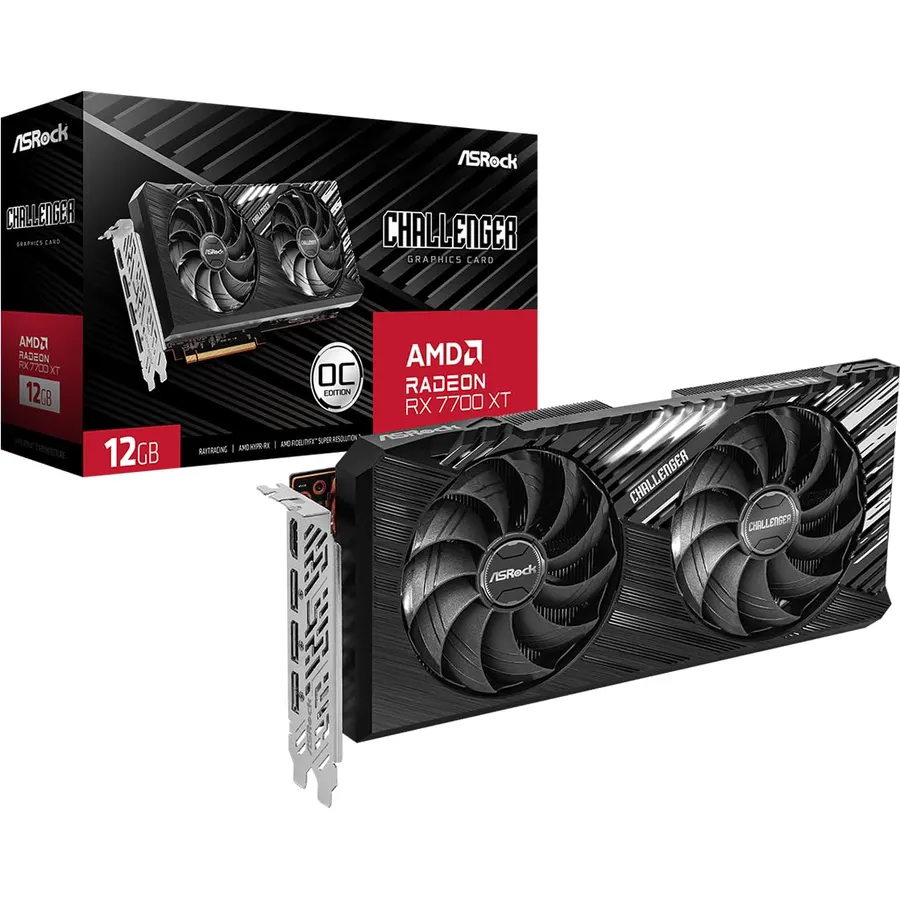
If the budget stretches to the very top of the band, the RX 7700 XT is a clear step above everything else here: 54 RDNA 3 compute units, 12GB of GDDR6 backed by 48MB of Infinity Cache, and a boost clock of 2584 MHz, which together make it a genuine 1440p high-settings card and a comfortable 1080p ultra card with FSR 3 in reserve. ASRock’s Challenger board uses dual striped-ring fans that stop at idle, a metal backplate and two 8-pin power connectors, and it is a 10.5-inch card so measure the case. The catch is that it sat just under the cap when we checked and it drifts; if it has crept over, the Arc B580 is the fallback. Owners rate it 4.6 stars from 240 reviews, a smaller sample than the older Nvidia cards but a consistent one.
- The most GPU performance that fit under the cap at the time of writing
- 12GB and Infinity Cache for 1440p high settings
- 0dB silent cooling at idle, metal backplate
- 4.6 stars from 240 owners
- Price hovers near the cap; check before buying
- Needs two 8-pin connectors and a solid 650W-class supply
- Only two product photos in the listing
ZOTAC GAMING GeForce RTX™ 3060 Ti Twin Edge OC LHR 8GB GDDR6 256-bit 14 Gbps PCIE 4.0 Gaming Graphics Card, IceStorm 2.0 Advanced Cooling, Active Fan Control, FREEZE Fan Stop ZT-A30610H-10MLHR
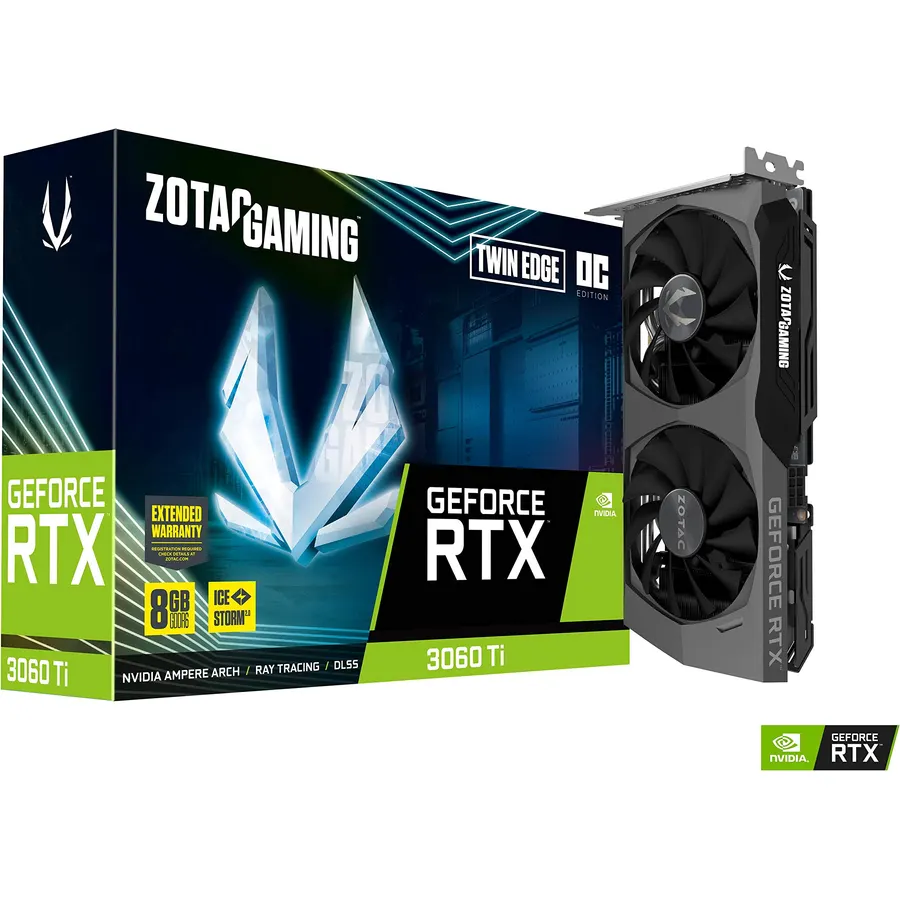
The RTX 3060 Ti was the value king of its generation and it still earns a place here because it beats the RTX 3060 and RX 7600 in both rasterised and ray-traced games, and because 2,000 owners have rated this ZOTAC version 4.6 stars, by far the largest sample on the page. The Twin Edge is a compact dual-slot card with ZOTAC’s IceStorm 2.0 cooler, fan stop at idle and a metal backplate, with three DisplayPort 1.4a and one HDMI 2.1 output and a 200W rating. You get DLSS 2 and Nvidia’s encoder for streaming, but not DLSS 3 frame generation, and 8GB of memory on a 256-bit bus is adequate rather than generous for 1440p. The LHR tag only matters to crypto miners. It is the pick if you want Nvidia drivers and features and a card thousands of people have already vouched for.
- 2,000 owner reviews at 4.6 stars, the most on this page
- Faster than the RTX 3060 and RX 7600 in raster and ray tracing
- DLSS and Nvidia encoder for streaming
- Compact twin-fan card with fan stop
- 8GB on a two-generation-old card
- No DLSS 3 frame generation (Ampere)
- Price has drifted up and down around the cap; check the listing
EVGA GeForce RTX 3060 XC Gaming, 12G-P5-3657-KR, 12GB GDDR6, Dual-Fan, Metal Backplate
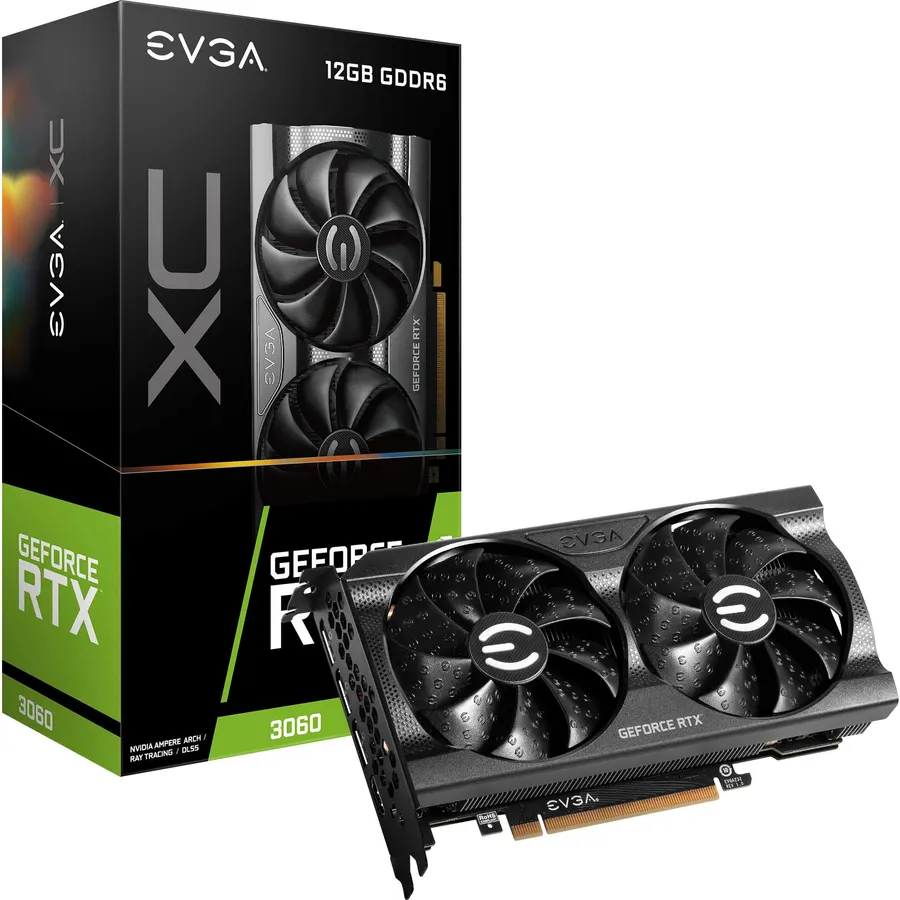
The RTX 3060 12GB is the odd card that has more memory than the faster 3060 Ti, and that is why it still sells: 12GB is enough for every current game at 1440p without texture compromises, and the GPU behind it is a comfortable 1080p ultra and 1440p high performer with DLSS. EVGA’s XC Gaming version is a short dual-fan card with an all-metal backplate and a 1882 MHz boost clock, and it is the best-rated card on this page at 4.7 stars from 1,500 owners, who praise its quiet cooler and reliability. Two things to weigh: EVGA no longer makes graphics cards, so warranty support depends on remaining stock and the seller, and it sat right at the cap when we checked. If it has risen, the MSI version below is the same GPU.
- 12GB of VRAM, more than the 3060 Ti above it
- 4.7 stars from 1,500 owners, the best score here
- EVGA build quality and a short dual-fan card
- Ray tracing and DLSS
- Slower GPU than the 3060 Ti and RX 7700 XT
- EVGA has left the graphics card business, so long-term support is a question
- Sat right at the cap when we checked
MSI Gaming GeForce RTX 3060 12GB 15 Gbps GDRR6 192-Bit HDMI/DP PCIe 4 Torx Twin Fan Ampere OC Graphics Card
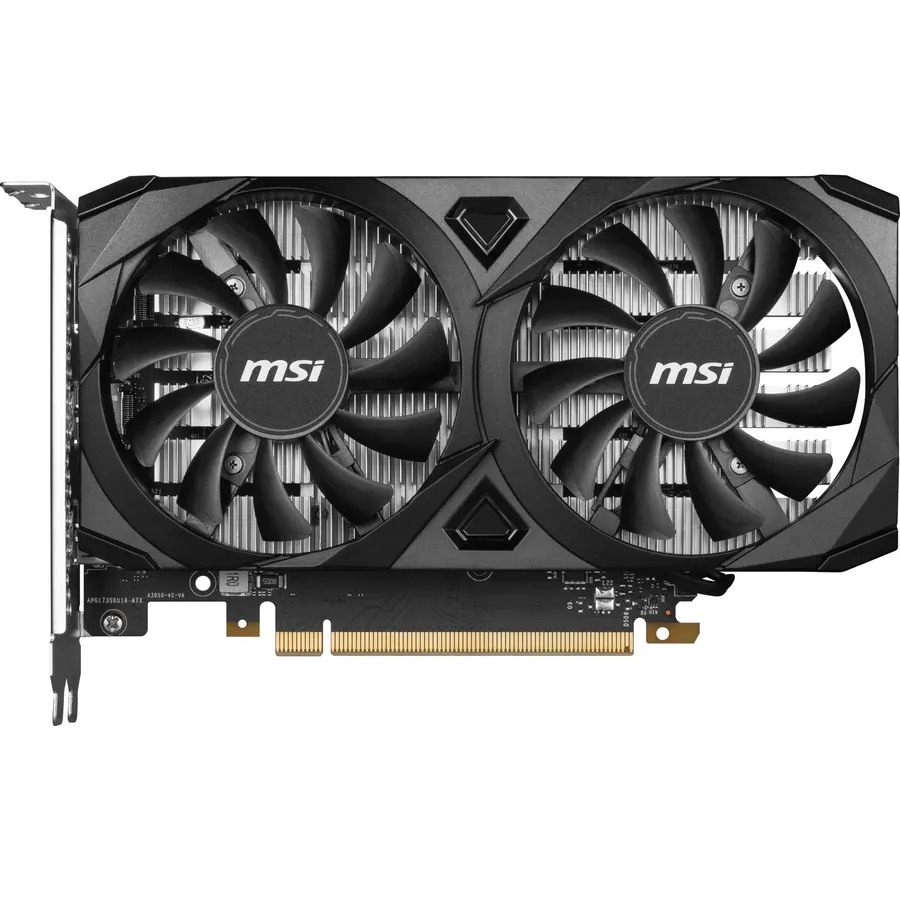
MSI’s Ventus-style RTX 3060 12GB is the same GPU and memory as the EVGA card above from a company that is still in the graphics card business, which is the main reason to pick it. You get 12GB of GDDR6 at 15 Gbps on a 192-bit bus, a 1710 MHz GPU clock, three DisplayPort 1.4a outputs and an HDMI 2.1 port, and MSI’s Torx twin-fan cooler, which owners describe as quiet under load. Performance is the standard RTX 3060 recipe: 1080p ultra with ray tracing and DLSS, 1440p high without it, and enough memory that textures are never the bottleneck. It has 300 reviews at 4.6 stars. As with every RTX 3060 in 2026, check the live price before buying, because the card has swung above and below the cap more than once.
- Same 12GB RTX 3060 as the EVGA from a vendor still making cards
- Torx twin-fan cooler owners describe as quiet
- HDMI 2.1 plus three DisplayPort
- 4.6 stars from 300 owners
- Lower 1710 MHz clock than the EVGA XC
- Fewer reviews than the EVGA
- Price has been volatile; verify it is under the cap
ASUS Dual GeForce RTX 3050 6GB GDDR6 OC Edition Gaming Graphics Card
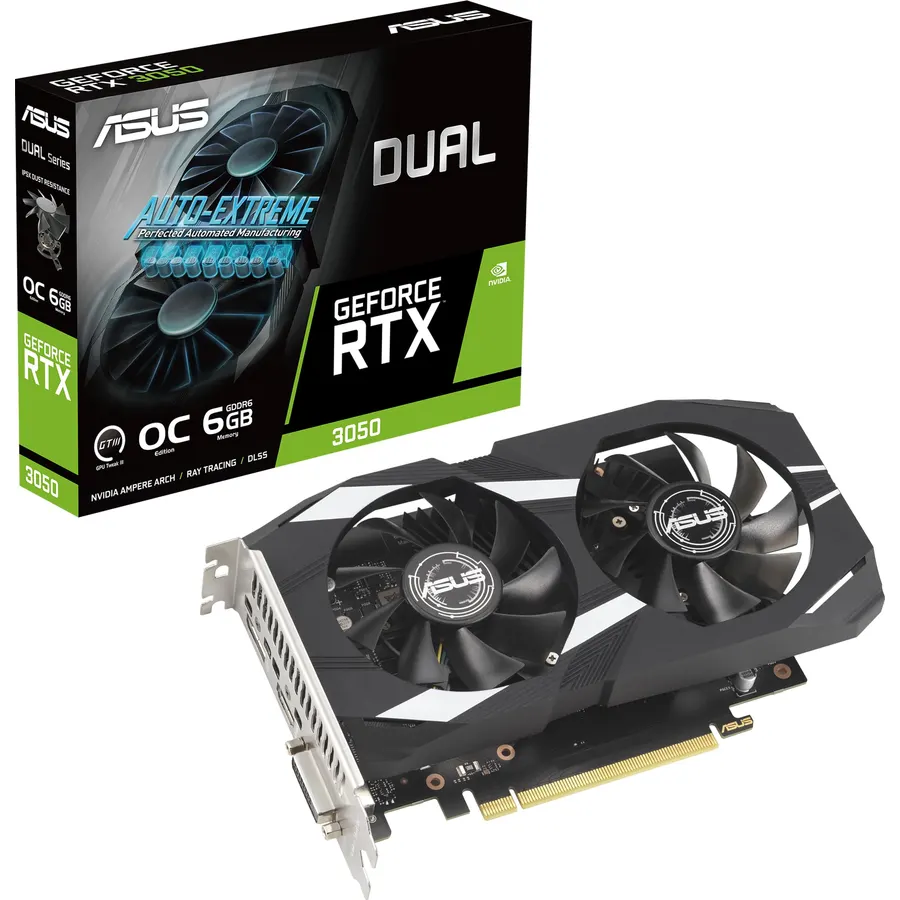
The 6GB RTX 3050 is a different kind of pick: not the fastest card you can buy for the money, but the one that drops into an office PC or a small-form-factor build that cannot feed a 200W card. Nvidia rates this cut-down 3050 at roughly 70W, and the ASUS Dual version is a 20 cm, two-slot card with two Axial-tech fans and a 1500 MHz OC-mode boost clock. It plays esports titles and older games at high settings at 1080p, and newer games at medium with DLSS helping, with hardware ray tracing that is technically present but rarely worth turning on. More than 1,100 owners rate it 4.6 stars, usually as an upgrade for a prebuilt with a weak power supply. If your case and PSU can take a bigger card, buy the RX 7600 instead.
- Very low power draw; Nvidia rates the 6GB RTX 3050 around 70W
- Only 20 cm long and two slots for small cases
- ASUS Axial-tech cooling; 1,100 owners at 4.6 stars
- DLSS and hardware ray tracing in a budget card
- 6GB on a narrow bus is 1080p medium territory in new games
- Much slower than every card above it
- Not a card to pair with a 1440p monitor
GIGABYTE GeForce RTX 3050 WINDFORCE OC V2 6G Graphics Card, 2X WINDFORCE Fans, 6GB GDDR6 96-bit GDDR6, GV-N3050WF2OCV2-6GD Graphics Card
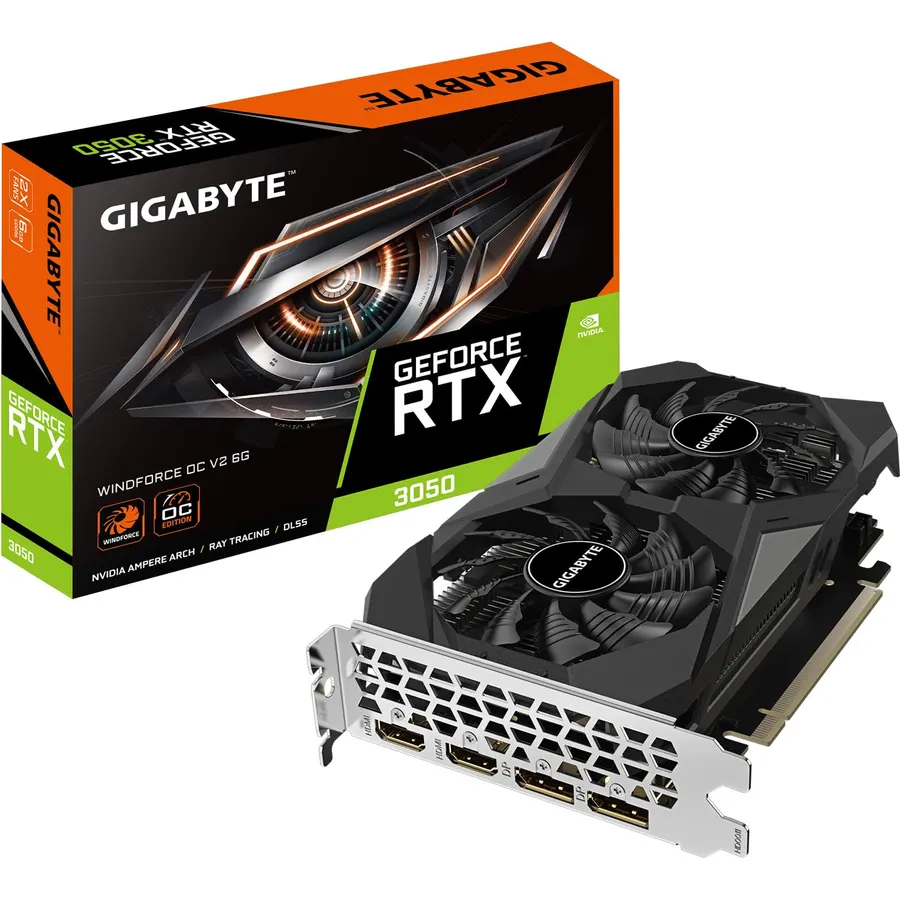
Gigabyte’s WINDFORCE OC V2 is the same 6GB RTX 3050 as the ASUS Dual at a lower price, with two WINDFORCE fans in place of the Axial-tech pair and the same low power draw that lets it run in a prebuilt without a spare power connector. Gigabyte lists the memory bus honestly at 96 bits, which is the number that tells you this is a 1080p card for esports, indie games and older titles rather than a 1440p card for new releases. It has the second-generation RT cores and third-generation Tensor cores of the Ampere family, so DLSS works and ray tracing exists. Owners rate it 4.6 stars from 300 reviews. Buy it when the budget is tight and the case is small; for anything else on this page, spend the extra on more GPU.
- Cheapest card on this page
- WINDFORCE dual-fan cooler
- Same low-power 6GB RTX 3050 as the ASUS
- 4.6 stars from 300 owners
- 96-bit memory bus limits it to 1080p
- Slower than the RX 7600 by a wide margin
- Fewer reviews than the ASUS version
Compare the picks
| Product | GPU | Memory | Power | Best for | Owner rating | Our score | |
|---|---|---|---|---|---|---|---|
| XFX RX 7600 SWFT210XFX | RX 7600, RDNA 3 | 8GB GDDR6 | 1x 8-pin | 1080p high refresh | 4.4 (510+) | 8.8 | See price |
| ASRock Arc B580 ChallengerASRock | Arc B580, Xe2 | 12GB GDDR6, 192-bit | 1x 8-pin, 650W PSU | 1440p on a budget | 4.4 (410+) | 8.8 | See price |
| ASRock RX 7700 XT ChallengerASRock | RX 7700 XT, RDNA 3 | 12GB GDDR6, 192-bit | 2x 8-pin | 1440p high settings | 4.6 (240+) | 9.1 | See price |
| ZOTAC RTX 3060 Ti Twin EdgeZOTAC | RTX 3060 Ti, Ampere | 8GB GDDR6, 256-bit | 200W | Nvidia features, 1440p | 4.6 (2,000+) | 9.2 | See price |
| EVGA RTX 3060 XCEVGA | RTX 3060, Ampere | 12GB GDDR6 | 1x 8-pin | 1080p ultra, 1440p high | 4.7 (1,500+) | 9.4 | See price |
| MSI RTX 3060 12GBmsi | RTX 3060, Ampere | 12GB GDDR6, 192-bit | 1x 8-pin | Same as EVGA, current vendor | 4.6 (300+) | 9.1 | See price |
| ASUS Dual RTX 3050 6GBASUS | RTX 3050 6GB, Ampere | 6GB GDDR6 | About 70W, slot power | Small or prebuilt PCs | 4.6 (1,100+) | 9.2 | See price |
| Gigabyte RTX 3050 WINDFORCE 6GGIGABYTE | RTX 3050 6GB, Ampere | 6GB GDDR6, 96-bit | About 70W, slot power | Cheapest 1080p option | 4.6 (300+) | 9.1 | See price |
8GB, 12GB and why the bus width matters
Video memory is the spec that ages a card fastest. Games released in the last two years regularly use more than 8GB at 1440p with high textures, and when a card runs out it stutters rather than slowing gracefully. That is why the 12GB Arc B580, RX 7700 XT and RTX 3060 rank above the faster-on-paper RTX 3060 Ti for anyone planning to keep the card three years. Bus width is the second number: 192-bit cards (B580, RX 7700 XT, RTX 3060) move data faster than 128-bit cards (RX 7600) and far faster than the 96-bit RTX 3050 6GB, which is why that card is a 1080p card no matter how it is clocked.
AMD, Nvidia or Intel
Nvidia brings DLSS, the best ray tracing at each tier and the most polished drivers, but the RTX 3060 and 3060 Ti are two generations old and lack DLSS 3 frame generation. AMD’s RX 7600 and RX 7700 XT are current-generation with FSR 3 frame generation, more raster performance per dollar and weaker ray tracing. Intel’s Arc B580 is the newest architecture and the best memory per dollar, but it needs a modern platform with Resizable BAR and its drivers still trip over some old games. For a mix of new and old titles with no surprises, buy Nvidia or AMD; for new games at 1440p on a budget, the B580 is hard to beat.
Power supply and case fit
The RX 7700 XT needs two 8-pin connectors and a quality 650W-class supply; the Arc B580, RX 7600 and both RTX 3060 cards want one 8-pin and 550W to 650W; the 200W RTX 3060 Ti wants 650W. The RTX 3050 6GB cards draw about 70W from the slot alone, which is why they suit office prebuilts with 300W supplies. Measure the case too: the RX 7700 XT is 10.5 inches long, the Arc B580 249mm, the ASUS RTX 3050 only 20 cm. See our power supplies for gaming PCs and PC cases for gaming builds guides.
What is the best graphics card under 500 dollars for 1440p?
The ASRock RX 7700 XT if it is under the cap when you look, otherwise the Intel Arc B580. Both have 12GB of memory on a 192-bit bus, which is what 1440p with high textures needs. The RTX 3060 12GB also works at 1440p with DLSS.
Is the RTX 3060 Ti still worth buying in 2026?
For Nvidia features at this price it is still a strong 1080p and entry 1440p card, and it has by far the most owner reviews here. Its 8GB of memory is the limitation; if you play new games with high textures, prefer a 12GB card.
Does the Intel Arc B580 work with an older CPU?
It runs, but it loses a noticeable share of its performance without Resizable BAR, which needs a 10th-gen Intel or Ryzen 3000 or newer CPU and a BIOS setting. Check your motherboard before buying.
Do I need a new power supply for these cards?
The RTX 3050 6GB cards run from the PCIe slot with no cable and work in most prebuilts. The RX 7600, Arc B580 and RTX 3060 need one 8-pin cable and a 550W or better supply; the RX 7700 XT needs two 8-pin cables and about 650W.
Why are prices for these cards not listed?
Graphics card prices change daily and several of these picks have crossed the 500 dollar line in both directions this year. Every button opens the live Amazon page so you can confirm the current price before deciding.
Prices and stock change daily. The buttons above open Amazon so you always see the current price. We may earn a commission if you buy through them, at no extra cost to you.
Do Best Deal is a participant in the Amazon Services LLC Associates Program. As an Amazon Associate we earn from qualifying purchases. If you buy through links on this site we may earn a commission, at no extra cost to you. Learn more.