A bench power supply is the tool that lets you feed a circuit exactly the voltage you choose and no more current than you allow. That second part is what separates it from a wall adapter: set a current limit, and a wiring mistake makes the display blink instead of making smoke. The catalog splits into two families. Variable supplies sweep from zero to about 30 volts with constant-voltage and constant-current modes, for electronics repair, LED and motor testing and plating. Fixed 13.8-volt supplies stand in for a car battery and run CB, ham and marine radios indoors. We ranked the bench power supplies in our PC parts catalog by output range, how the controls work, protection, connections, and what hundreds to thousands of owners report.
We have not loaded every one of these on our own bench; the verdicts rest on the spec sheets and the owner review history. Prices are not printed because they change daily; every button opens the live Amazon page. ATX supplies for building a computer are a different product and live in our power supplies for gaming PCs guide, and plug-in bricks for a single device are in our 12V power adapters guide.
How we picked
- A stated, regulated output. Zero to 30 or 32 volts on the variable units, 13.8 volts on the fixed units, with the maker listing continuous current.
- Protection built in. Short-circuit and overload protection on every pick; overcurrent cut-off with an alarm where offered.
- Controls you can set precisely. Encoder knobs or coarse and fine pots, an output on/off switch, and a display to 0.01 V and 0.001 A on the variable units.
- Useful terminals. Banana or binding posts, screw terminals, Anderson or lighter sockets, and a USB port where included.
- Owner feedback from a few hundred to several thousand reviews, with fan noise, overshoot and accuracy complaints noted.
The picks
DC Power Supply Variable, 32V 10A Adjustable Switching Regulated DC Bench Power Supply with Intelligent Charging Mode, 18W USB Interface, Precision Encoder Knob

This 32-volt, 10-amp supply is the best-proven variable unit left in our catalog, and its controls are the reason. Instead of a pair of potentiometers that creep, it uses an encoder: press the knob to step to the digit you want, turn it to change that digit from 0 to 9, and the voltage or current lands exactly where you asked. An output button keeps the terminals dead while you set up, so the load never sees a wrong value, and overcurrent protection has its own switch, on for delicate boards where a short should trip the supply, off for motors and capacitive loads that pull a surge. The four-digit display shows voltage, current and calculated power together in constant-voltage or constant-current mode, and an 18-watt USB port charges a phone. Thousands of owners give it a strong owner rating. It is a switching supply, so ripple is higher than a linear unit, and the fan is audible.
- Encoder sets each digit exactly, with no drifting potentiometer
- Output button lets you set values before the load sees them
- OCP can be switched on for fragile circuits or off for inrush loads
- Thousands of owner reviews with a strong owner rating
- Switching design is noisier electrically than a linear supply
- Fan is audible under load
- Generic brand with a short manual
Pyramid PS9KX Universal Compact Bench Power Supply-5 Amp Linear Regulated Home Lab Benchtop Converter w/ 13.8 Volt DC 115V AC 70 Watt Input, Screw Type Terminal, 12V Car Cigarette Lighter

The Pyramid PS9KX has been a quiet fixture of hobby benches for years. It does one thing: turn 115-volt mains into a steady 13.8 volts DC, the voltage a running car supplies, at 5 amps continuous and 7 amps surge. Because it is a linear regulated design built around a transformer rather than a switching circuit, it does not spray radio-frequency hash across the bands, which is why CB and scanner users favor it. Connections are screw terminals for bare wire or ring lugs plus a cigarette lighter socket, so tire inflators, dash cams and car chargers can be tested indoors. Overload and short-circuit protection are electronic, with an auto-resetting fuse, and a cabinet heatsink and fan keep it cool. Thousands of owners give it an excellent owner rating. It is fixed-voltage, modest in current and heavier than it looks.
- Linear design gives clean, low-noise power for radios
- Lighter socket runs car accessories on the bench
- Thousands of owner reviews with an excellent owner rating
- Simple: plug in, switch on
- Fixed voltage; not for general electronics work
- 5 A continuous is too little for a 100 W transceiver
- Heavy for its size because of the transformer
DC Power Supply Variable, 0-30V 0-10A Adjustable Switching DC Regulated Bench Power Supply with High Precision 4-Digit LED Display, 5V/2A USB Port, Coarse and Fine Adjustment SPS-3010

Jesverty’s SPS-3010 is the straightforward 30-volt, 10-amp supply for a first electronics bench. Voltage and current each get coarse and fine knobs, the traditional layout that makes it easy to sweep a value smoothly while watching a circuit respond, and a bright four-digit display reads volts, amps and watts together to 0.01 V, 0.001 A and 0.1 W. It moves between constant-voltage and constant-current automatically at the limits you set. The upright case is 7.1 by 3.35 by 6.1 inches and about 2.5 pounds, so it takes a hand-width of bench, and a power cord and test leads are in the box. Short-circuit and overload protection are built in. Thousands of owners give it a strong owner rating. Potentiometers cannot match an encoder for hitting an exact figure, there is no separate output switch in the listed features, and the USB port is a basic 5-volt, 2-amp outlet.
- Coarse and fine knobs are quick to sweep by hand
- Shows volts, amps and watts at once
- Small upright case weighs about 2.5 lb
- Thousands of owner reviews with a strong owner rating
- No output on/off button in the listed features
- Pots are less exact than an encoder
- 5 V 2 A USB port is slow by current standards
Pyle Universal Compact Bench Power Supply - 30 Amp Regulated Home Lab Benchtop AC-to-DC Converter w/ 13.8 Volt DC 115/230V AC Switchable, Screw Type Terminals, Cooling Fan - Pyle PSV300

The Pyle PSV300 is the workhorse choice for a radio shack: 13.8 volts at up to 30 amps from a case small enough to sit beside the rig. That is enough current for a 100-watt HF or mobile transceiver on transmit, a linear amplifier for CB, or a bank of 12-volt accessories, and the input is switchable between 115 and 230 volts. Heavy screw terminals take ring lugs or bare wire, electronic overload and short-circuit protection shut it down before a fault does damage, and a built-in fan handles the heat. Thousands of owners give it a very strong owner rating. It is deliberately plain: there are no volt or amp meters on the front, no lighter socket and no Anderson Powerpole outlets, and the voltage is not adjustable. If you want those extras, look at the SPS-50II below; if you want dependable amps, this is the one.
- 30 A runs a 100 W mobile transceiver with room to spare
- Switchable 115/230 V input
- Thousands of owner reviews with a very strong owner rating
- Compact for its output
- Fixed 13.8 V only
- No meters, lighter socket or Anderson connectors
- Fan runs whenever it is working hard
DC Power Supply Variable, Bench Power Supply with Encoder Adjustment Knob, Output Enable/Disable Button, Adjustable Power Supplies with USB Quick-Charge, Short Circuit Alam (30V 10A Black)

This NANKADF supply is a close cousin of our top pick, and for many benches the two are interchangeable. It delivers 0 to 30 volts and 0 to 10 amps, set by an encoder knob you press to choose a digit and turn to change it, on a four-digit display that resolves 0.01 V and 0.001 A in constant-voltage or constant-current mode. The detail that sets it apart is the alarm: with overcurrent protection switched on, a short across the load stops the output and sounds a buzzer, which is useful when you are probing a board with your eyes on the work and not on the meter. An output enable button and an 18-watt USB fast-charge port round it out. Thousands of owners give it a strong owner rating. It tops out 2 volts lower than the first pick, and the buzzer is not subtle.
- Buzzer sounds when OCP trips on a short
- Output enable button protects the load during setup
- Encoder adjustment to 0.01 V and 0.001 A
- Thousands of owner reviews with a strong owner rating
- Very similar to the top pick with 2 V less range
- Buzzer cannot be ignored in a quiet room
- Switching ripple, as with all compact units
Pyramid 7A Bench Power Supply | AC DC 12V DC Power Supply with USB
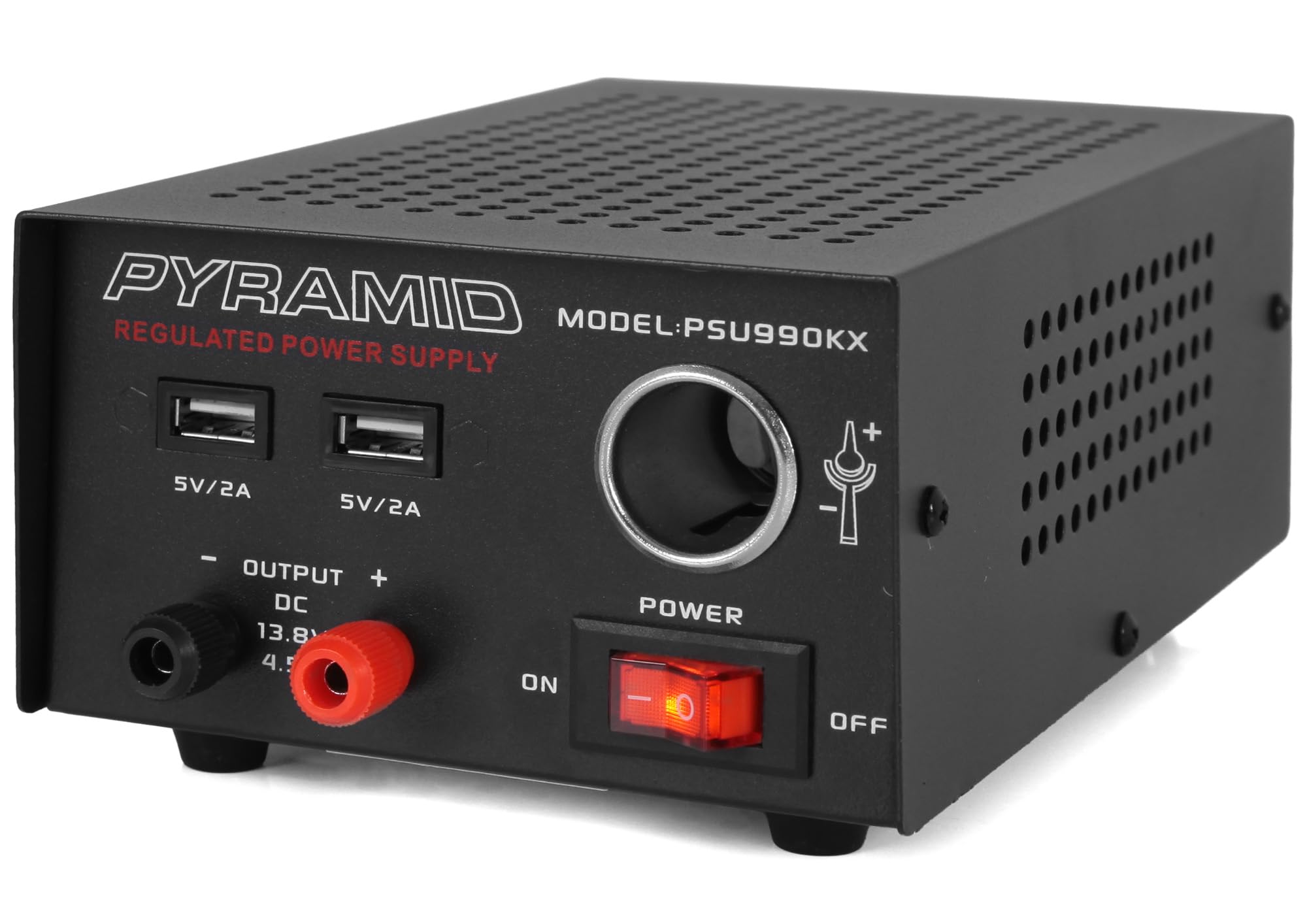
Pyramid’s 7-amp unit is the most convenient of the small fixed supplies. The front panel carries banana plug terminals, a cigarette lighter socket and two USB charging ports, so a handheld radio charger, a dash cam, a 12-volt LED strip and a phone can all be powered or tested without making up a single cable. Output is a regulated 13.8 volts at 7 amps peak and 4.5 amps continuous from 120-volt mains, with electronic overload and short-circuit protection, a rugged metal housing and an integrated heat sink. A power switch on the front saves reaching for the plug. Hundreds of owners give it an excellent owner rating. The continuous rating is the thing to respect: 4.5 amps suits scanners, CB receivers and accessories, not a transceiver keyed at full power. For a hobby bench that mostly tests car gadgets, it is the handiest box here.
- Banana terminals, lighter socket and two USB ports on the front
- Metal case with a heat sink
- Hundreds of owner reviews with an excellent owner rating
- Front power switch
- 4.5 A continuous limits it to small loads
- Fixed voltage
- Not enough for a transmitting ham rig
Universal Compact Bench Power Supply- 50 Amp Regulated Home Lab Benchtop AC-to-DC Converter 13.8 Volt/9-15Volt, Cooling Fan, Screw Type Terminals - Jesverty SPS-50II

Jesverty’s SPS-50II is the step up when 30 amps is not enough or when you want to see what the load is doing. It supplies a fixed 13.8 volts or, at the turn of a knob, anything from 9 to 15 volts, which helps when testing equipment at low-battery and charging voltages. Twin analog meters show volts and amps in real time, the main screw terminals are large enough for heavy cable, and the front adds two pairs of snap-in terminals and a lighter socket. For radio operators the noise offset circuit matters: it moves the switching noise to another frequency if it lands on the signal you are listening to. Forced-air cooling, short-circuit protection and automatic current limiting are built in. Hundreds of owners give it an excellent owner rating, the highest here. It costs more than the Pyle and has a shorter track record.
- Adjustable 9 to 15 V as well as fixed 13.8 V
- Noise offset control for radio use
- Twin analog meters show load at a glance
- Highest owner rating on this page, from hundreds of reviews
- Costs more than the 30 A units
- Smaller review base than the Pyle
- Fan is noticeable under heavy load
FNIRSI DPS-150 DC Power Supply Variable 30V 5A, 4-Digit IPS Flip Display

The FNIRSI DPS-150 is a different animal: a pocketable module that takes its input from a USB-C charger or a DC brick and turns it into an adjustable 30-volt, 5-amp, 150-watt output. A 2.8-inch IPS color screen, which flips 90 degrees for upright or flat use, shows numbers or live curves of voltage and current, six groups of settings can be stored and recalled, and the output can be programmed from a PC. Stated ripple is under 20 millivolts, constant-voltage and constant-current modes are both there, and eight protection mechanisms cover overvoltage, overcurrent, short circuit and overheating. Hundreds of owners give it a strong owner rating. Its ceiling is 5 amps, its real output depends on the charger feeding it, and the maker recommends adding a reverse-current diode when charging batteries. For a small desk or a travel kit, it is the clever choice.
- Six presets and PC-programmable output
- Color screen plots voltage and current curves
- Low stated ripple for a small switching unit
- Takes banana plugs, U-shaped terminals and bare wire
- 5 A maximum, half the full-size units
- Needs an external power source such as a USB-C charger
- Maker advises a reverse-current diode when charging batteries
Compare the picks
| Product | Output | Current | Controls | Connections | Our score | Our score | |
|---|---|---|---|---|---|---|---|
| 32V 10A encoder supplyDIAIARY | 0 to 32 V variable | 10 A | Encoder, OCP switch, output button | Output posts, 18 W USB | 9.0/10 | 9.0 | See price |
| Pyramid PS9KXPyramid | 13.8 V fixed, linear | 5 A, 7 A surge | Power switch | Screw terminals, lighter socket | 9.4/10 | 9.4 | See price |
| Jesverty SPS-3010Jesverty | 0 to 30 V variable | 10 A | Coarse and fine knobs | Output posts, 5 V 2 A USB | 9.0/10 | 9.0 | See price |
| Pyle PSV300Pyle | 13.8 V fixed | 30 A | Power switch | Screw terminals | 9.2/10 | 9.2 | See price |
| NANKADF 30V 10ANANKADF | 0 to 30 V variable | 10 A | Encoder, OCP alarm, output button | Output posts, 18 W USB | 9.0/10 | 9.0 | See price |
| Pyramid 7A with USBPyramid | 13.8 V fixed | 4.5 A, 7 A peak | Power switch | Banana, lighter socket, 2 USB | 9.3/10 | 9.3 | See price |
| Jesverty SPS-50IIJesverty | 13.8 V or 9 to 15 V | 50 A class | Voltage knob, noise offset, analog meters | Screw, snap-in, lighter socket | 9.5/10 | 9.5 | See price |
| FNIRSI DPS-150FNIRSI | Up to 30 V variable | 5 A | Color screen, 6 presets, PC control | Banana, U-terminal, bare wire | 8.8/10 | 8.8 | See price |
Variable supply or fixed 13.8 volts?
Buy a variable supply if you build, repair or test electronics: you will want 3.3, 5, 9, 12 and 24 volts on different days, and a current limit to protect what you are working on. Buy a fixed 13.8-volt supply if the job is running equipment designed for a vehicle, such as a CB or ham radio, a marine VHF, a car stereo or a 12-volt fridge, at a steady voltage with plenty of current. A 30-volt variable unit can be set to 13.8 volts, but only up to 10 amps here, and a fixed supply cannot do bench work. Many shacks end up with one of each.
How many amps do you need?
Add up what the load draws at its worst and leave a margin of a quarter or more. A 100-watt transceiver pulls around 20 amps on transmit, so a 30-amp supply is the usual match; a CB or scanner needs only a few amps and is happy on the Pyramid units. For electronics repair, 5 amps covers most boards and 10 amps covers motors, LED strips and small plating jobs. Watch the difference between peak and continuous ratings: a supply marked 7 amps peak and 4.5 continuous should be planned around the lower figure.
Constant voltage, constant current and protection
In constant-voltage mode the supply holds the voltage and lets the load take the current it wants. Set a current limit, and when the load tries to exceed it the supply switches to constant-current mode and lets the voltage fall instead, which is how you test LEDs or bring up a repaired board gently. Overcurrent protection goes further and cuts the output entirely. Use the output button to set values first, start with a low current limit on unknown circuits, and remember that charging batteries from a bench supply needs care and, on some units, a blocking diode.
What is the best bench power supply for electronics hobbyists?
The 32V 10A variable supply with the encoder knob is the best all-round pick here: exact digit-by-digit setting, constant-voltage and constant-current modes, switchable overcurrent protection and an output button. The Jesverty SPS-3010 is a cheaper alternative with coarse and fine knobs.
What power supply do I need for a ham radio?
A regulated 13.8-volt supply with enough current for transmit. A 100-watt transceiver needs about 20 amps, so the 30-amp Pyle PSV300 is the usual choice, and the Jesverty SPS-50II adds meters, adjustable voltage and a noise offset control. Small receivers and CB sets run on the Pyramid PS9KX.
Is a linear or switching bench power supply better?
Linear supplies such as the Pyramid PS9KX are heavier and less efficient but produce very little electrical noise, which suits radio and audio work. Switching supplies are lighter, cheaper per amp and fine for most repair and test jobs, though they have more ripple.
Can I charge a car battery with a bench power supply?
It can be done with a variable supply by setting the charging voltage and a current limit, but it will not manage the charge stages or stop on its own. Some makers advise fitting a reverse-current diode. A dedicated smart battery charger is the safer tool.
What does the output button on a bench power supply do?
It connects and disconnects the output terminals without switching the unit off. That lets you dial in voltage and current limits first and then apply power, and cut power instantly while you rewire. The two encoder-knob supplies and the FNIRSI have this control.
Prices and stock change daily. The buttons above open Amazon so you always see the current price. Do Best Deal may earn a commission if you buy through them, at no extra cost to you.
Do Best Deal is a participant in the Amazon Services LLC Associates Program. As an Amazon Associate we earn from qualifying purchases. If you buy through links on this site we may earn a commission, at no extra cost to you. Learn more.
